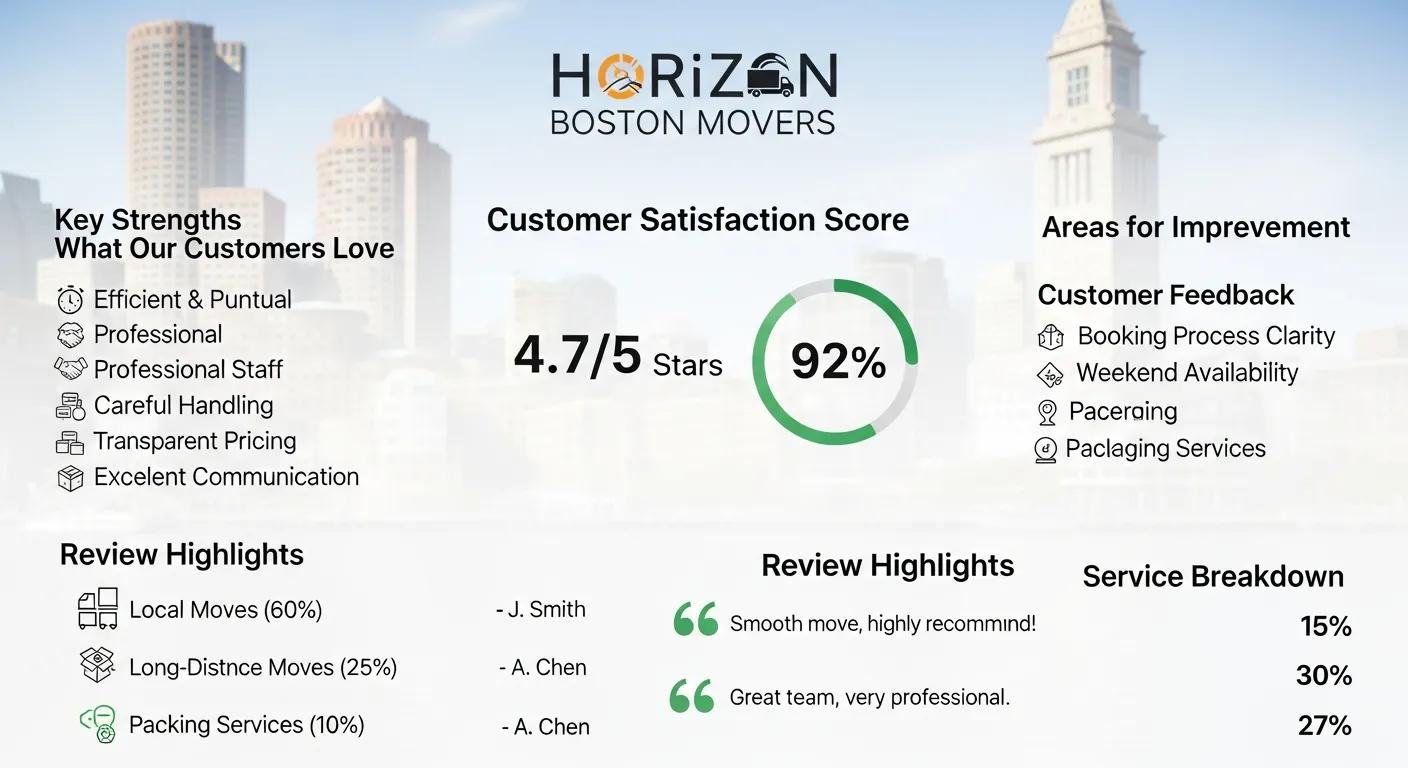
What Sets Horizon Boston Movers Apart: Unmatched Customer Care and Reliable Moving Services

Best Moving Companies Boston: Why Horizon Boston Movers Stands Out for Caring Service and Dependable Moves

Moving in Boston takes planning, local know‑how, and crews you can trust. Horizon Boston Movers centers every relocation on thoughtful customer care and reliable execution. This guide breaks down what makes a mover trustworthy, how proven operational routines cut stress and damage risk, and which specialty services matter for tricky or sensitive moves around the city. You’ll see how clear estimates and protection practices work in real moves, what to expect for senior transitions and piano hoists, and the simple steps to request a free, accurate quote. Practical examples, comparison tables, and concise checklists show how moving teams turn promises into measurable results — on time, protected, and communicative. Use this guide to compare providers, plan for common Boston challenges, and move forward with confidence.

Why Is Horizon Boston Movers the Top-Rated Boston Moving Company?

Horizon Boston Movers earns attention by prioritizing customer satisfaction, following transparent processes, and listening to what clients consistently report in reviews. The company’s cited 99 percent customer satisfaction and 300+ reviews support those claims, and proper licensing and insurance mean liability coverage is in place for most move scenarios.

Key differences that matter for Boston moves include:

  • Clear, documented estimates: Quotes spell out the scope so you know exactly what’s included.
  • Protection-first protocols: We use floor runners, door padding, and trusted packing methods to minimize damage.
  • Specialized crews for complex items: Trained teams handle pianos, hoists, and sensitive commercial equipment safely.
  • Customer-first communication: Direct planning and timely follow-up keep schedules aligned and expectations clear.

These practical distinctions show why operational detail matters when choosing a mover and set up how those practices play out on move day.

How Does Horizon Boston Movers Achieve 99 Percent Customer Satisfaction?

A satisfied customer reviews moving plans with a Horizon Boston Movers representative, highlighting strong customer satisfaction

That high satisfaction rate comes from consistent training, clear checklists, and follow-up that focuses on expectations and preventing damage. Crews follow step‑by‑step procedures for packing, loading, transit, and unpacking to limit variability and improve punctuality. Routine quality checks and customer communication checkpoints help catch issues early so they’re resolved before they escalate. Knowing these controls helps you evaluate how predictable and dependable a provider will be for your move.

What Do Boston Customers Say in Their Reviews and Testimonials?

Local reviews highlight punctuality, careful handling, transparent pricing, and compassionate service for sensitive moves—feedback that reflects operational strengths rather than marketing copy. Many customers specifically call out clear communication and the absence of surprise charges, which points to accurate estimating and well‑documented scopes. These repeatable patterns—protection protocols, courteous crews, and honest billing—are the best signal customers can use when checking reviews for their neighborhood or move type.

How Does Horizon Boston Movers Ensure Reliable and Stress-Free Moving Services?

Reliability is the result of pre‑move planning, trained crews, and equipment choices that prevent damage and delays. Pre‑move surveys and video or on‑site estimates capture the scope so crews can choose the right truck, packing materials, and permits. On move day, protections like floor runners, door jamb padding, and secure strapping are applied to protect homes and belongings. This structured approach reduces surprises and keeps moves on schedule.

Why this comparison matters: customers want predictable timelines, consistent protection, and competent crews because those things minimize downtime and stress during a relocation.

Service TypeKey Reliability AttributeWhat That Means For You
Local Moving ServiceTimely scheduling & route planningShorter transit windows and predictable arrival times
Long Distance Moving ServiceSecure load managementItems arrive in the same condition after transit
Commercial Moving ServiceProject coordination & minimal downtimeBusiness operations resume quickly with minimal disruption

This comparison makes it clear how each service maps to reliability attributes, helping you choose the right option and avoid mismatched expectations that cause post‑move headaches.

What Professional Standards Do Horizon Boston Movers Follow?

Crews adhere to standardized safety procedures, regular equipment maintenance, and required licensing—measures that reduce risk and liability on every job. Licensing and insurance create a framework for accountability and claims handling if damage occurs. Ongoing training emphasizes safe lifting, proper padding and strap techniques, secure load practices, and safe equipment operation. Those standards help ensure consistent outcomes and give customers confidence that moves follow documented safety practices.

How Does Transparent Pricing Guarantee No Hidden Fees?

Transparent pricing starts with accurate video or on‑site estimates and a written scope that lists included services and possible add‑ons, which cuts down on surprise charges at the end of the move. Horizon Boston Movers provides free video and on‑site estimates so quotes are based on what’s actually being moved, not rough guesses. Pricing models are explained up front and optional services—packing, storage, hoisting—are itemized so you choose the protections you want. Clear documentation and pre‑move confirmations make it easy to address discrepancies before move day.

Quick pricing comparison:

Pricing ModelWhat’s IncludedBenefit to Customer
Hourly-basedCrew time, basic equipmentFlexible and cost‑effective for small or local moves
Flat-rateFull move scope per estimatePredictable total cost for larger or complex moves
Free EstimateVideo or on-site assessmentAccurate quote that reduces surprises

What Specialized Moving Services Does Horizon Boston Movers Offer in Boston?

Specialized moves require tailored processes. Horizon Boston Movers offers dedicated workflows for senior moves, piano transport, hoisting, and commercial relocations. Each service pairs trained crews with the right equipment and planning steps to protect people and property. Senior moves emphasize empathy, flexible timing, and coordination with family or caregivers to ease transitions. For heavy or awkward pieces like pianos, crews perform risk assessments and use padding, straps, and hoisting gear when needed to move items safely.

Note: showing concrete outcomes helps customers choose services confidently and reduces uncertainty for higher‑risk moves.

Specialized ServiceSpecialized AttributeOutcome / Value
Senior Moving ServiceEmpathy-based planning & downsizing supportLower emotional stress and smoother transitions
Piano Moving ServiceSpecialized padding & secure lifting techniquesInstrument integrity preserved through transport
Hoisting ServiceExternal hoist planning & safety protocolsSafe removal of bulky items from windows or balconies

How Does Horizon Boston Movers Provide Compassionate Senior Moving?

Compassionate senior moving is built on personalized timelines, coordination with family or care providers, and help with downsizing at a comfortable pace. Crews schedule extra time to address emotional needs, label belongings clearly, and place items in the new space with respect. Communication checkpoints with family members reduce misunderstandings and allow item‑by‑item confirmation. That structure supports transitions that prioritize the senior’s comfort and safety.

What Makes Horizon Boston Movers Experts in Piano Moving and Hoisting?

Piano moving and hoisting start with a pre‑move risk assessment, the right equipment, and crews trained to protect delicate instruments. Teams plan routes, secure lifting points, and decide when external hoisting is safer than stairs or elevators. Protective wrapping and custom bracing keep the instrument stable in transit. Combined with insurance and documented procedures, these steps lower the main risks involved with heavy, fragile items.

How Can You Get a Free, Accurate Moving Estimate from Horizon Boston Movers?

Getting an accurate estimate is straightforward: pick video for speed or on‑site for complex inventories, then confirm the scope and schedule. Free video and on‑site estimates capture room‑by‑room details so crews prepare the right truck, equipment, and packing materials. After the estimate, you’ll receive a written quote to review and confirm, which clarifies what’s included and any optional services. This transparent process makes planning and move day smoother.

Follow these steps to request a quote and book your move:

  1. Request an estimate: Choose a free video estimate or schedule an on‑site visit to document items and access.
  2. Review the detailed quote: Confirm included services, optional add‑ons, and any special handling requirements.
  3. Schedule and prepare: Select a move date, follow pre‑move instructions, and confirm arrival windows with the crew.

What Are the Benefits of Video and On-Site Estimates?

Video estimates are fast and convenient for typical local moves, allowing teams to assess volume and basic access constraints without an in‑person visit. On‑site estimates are best for large, complex, or specialty-item moves because they reveal stairs, elevator access, and unique architecture that affect logistics. Both produce documented scopes that reduce miscommunication and improve quote accuracy. Picking the right estimate type improves planning and lowers the chance of day‑of surprises.

How Does the Simple Booking Process Work?

The booking process follows three clear stages so you know what to expect. First, request a free video or on‑site estimate to document inventory and access. Second, review and confirm the detailed quote, choose any optional protections or packing services, and finalize your date. Third, receive move‑day instructions and a direct contact for the crew so communication stays simple and reliable.

That straightforward flow reduces confusion and speeds planning so you can focus on the move itself. For help or to start scheduling, call Horizon Boston Movers at 617-991-7677 and mention your service needs for the most accurate guidance.

Frequently Asked Questions

What should I look for when choosing a moving company in Boston?

Look for proper licensing, clear insurance coverage, and consistent customer reviews. Choose companies that provide transparent pricing and detailed estimates and that specialize in the move you need—local, long distance, or commercial. Check experience with specialty items like pianos or senior moves, and confirm safety protocols and equipment. A dependable mover will have strong communication and a track record of satisfied customers.

How can I prepare for my move with Horizon Boston Movers?

Start by requesting a free video or on‑site estimate so the team can assess your inventory and access. After you get the detailed quote, confirm the services you want and schedule your date. Pack non‑essentials early, label boxes clearly, and make an inventory list. On move day, clear pathways for the crew and share any special instructions. These steps help ensure a smoother, more efficient move.

What are the advantages of using specialized moving services?

Specialized services provide solutions for unique challenges like pianos, senior relocations, or commercial moves. Trained crews know the techniques and safety measures needed for these jobs, such as instrument‑specific handling or empathy‑driven timelines for seniors. Using specialists reduces stress and helps protect valuable or sensitive items during transport.

How does Horizon Boston Movers handle unexpected issues during a move?

Horizon Boston Movers plans ahead and keeps communication open to handle unexpected problems. Trained crews follow established protocols to minimize risk and address issues as they arise. Regular checkpoints with customers help spot concerns early and resolve them quickly. Operational transparency means you’ll be kept informed about any adjustments, which reduces stress and builds trust during the move.

What should I do if I need to change my moving date?

Contact Horizon Boston Movers as soon as you can if you need to change your date. The company usually accommodates date changes depending on availability. Provide your preferred new date and details about the move so they can reschedule appropriately. Confirm changes in writing to make sure everyone is aligned on the updated plan.

Are there any items that Horizon Boston Movers cannot transport?

Yes. For safety and liability reasons, certain items are typically excluded—hazardous materials, perishables, and highly valuable items like cash, jewelry, or critical documents. Check with the company for a full list of restricted items before your move. For items they can’t transport, consider carrying them yourself or using specialized services that handle those materials safely.

How can I ensure my belongings are protected during the move?

To protect your belongings, rely on Horizon Boston Movers’ protection‑first practices: floor runners, door padding, and secure packing techniques. Pack fragile items in sturdy boxes, label them clearly, and point out valuables to the crew so extra care is taken. Review insurance and protection options with the company to understand coverage and add peace of mind for higher‑value items.

Conclusion

Choosing Horizon Boston Movers means choosing a team that values clear communication, reliable protocols, and compassionate care. Whether you need a standard local move, a senior transition, or expert handling for a piano or commercial relocation, Horizon’s processes and trained crews help deliver a smoother, lower‑stress experience. Ready to get started? Request your free, accurate estimate today and move forward with confidence.

Horizon Boston Movers Customer Reviews Reveal Service Quality

Horizon Boston Movers — Real Reviews, Real Results

Customer reviews are the quickest way to see how a mover performs on actual move days. This article pulls together Horizon Boston Movers’ customer feedback so you can judge reliability at a glance. We summarize ratings, note common praise and complaints across services, explain how pricing and transparency show up in reviews, and outline how the company typically handles follow‑up and remediation. Many people find online feedback scattered and hard to interpret; this piece groups what customers say into clear service attributes — professionalism, punctuality, careful handling — and gives practical tips for getting an accurate quote. We also answer four key questions readers ask most: overall service quality, pricing fairness, which services get top ratings, and how complaints are handled. Keywords like Horizon Boston Movers reviews and Boston moving company reviews are included to help you find the most relevant customer signals.

What Do Horizon Boston Movers Reviews Say About Service Quality?

Across platforms, reviewers keep pointing to three qualities that drive satisfaction: professional crews, on‑time service, and careful handling of belongings. Customers describe staff who communicate well during the estimate and on moving day, note arrivals that keep stress down, and praise packing or handling that prevents damage. Those repeated comments form the bulk of the review signal and explain the generally high satisfaction scores. Below we break those strengths into two focused areas — professionalism & care, and punctuality & efficiency — with paraphrased examples to show how they affect results.

Most Horizon Boston Movers reviews single out these top strengths:

  1. Professionalism: Clear communication, respectful crews, and adherence to agreed procedures.
  2. Punctuality: On‑time arrivals and smooth loading that cut total move time.
  3. Careful Handling: Furniture and fragile items wrapped and secured to avoid damage.

Those consistent references build trust for prospective customers comparing moving options. Knowing how reviewers describe professional behavior makes it easier to set expectations for your own move day.

How Do Customers Rate Professionalism and Care?

Customers give high marks for professionalism when movers communicate clearly, follow consistent handling practices, and treat tight Boston spaces respectfully. Reviewers often mention protective wrapping, use of pads and straps, and extra care with fragile pieces — signs they interpret as proper training and standards. When issues do arise, they tend to be isolated; many reviewers note a straightforward follow‑up that addressed specific handling concerns. This pattern helps you predict the likely level of care and plan what to confirm before booking.

What Feedback Highlights Punctuality and Efficiency?

Reviews call out punctuality as arrival within the promised window, efficient but careful carry‑outs, and time estimates that match actual move duration. Customers link punctual crews to lower costs under hourly pricing and say efficient workflows reduce stress in multi‑stop or apartment moves. Delays are mentioned but are usually explained or remedied, so punctuality reads as a dependable part of the service. Those efficiency signals also prompt questions about how pricing ties to time and how to lock in accurate time estimates.

How Transparent and Fair Is Horizon Boston Movers’ Pricing According to Customer Feedback?

Feedback shows the company commonly uses a time‑based pricing model that customers find fair when crews and estimators clearly explain hourly rates and expected duration. Reviewers appreciate written estimates, advance disclosure of common surcharges, and on‑site confirmations — all practices that reduce surprise charges and boost perceived fairness. When estimates and confirmations are straightforward, customers report higher satisfaction. The sections below dig into how reviewers describe time‑based pricing, scheduling flexibility, and common pricing signals found in reviews.

What reviewers consistently note about pricing transparency:

  • Valued practices: clear hourly breakdowns, written estimates, and upfront disclosure of add‑ons.
  • Typical result: transparent estimates lead to fewer disputes and higher satisfaction.
Pricing ModelTypical DescriptorCustomer Sentiment
Time-based pricingHourly billing with explained durationSeen as fair for shorter or well‑defined jobs
Flat-fee / Estimate-basedSingle quoted price for a scoped movePreferred for predictable budgets; accuracy depends on the estimate
Hybrid approachesEstimated hours with capped feesViewed positively when caps and inclusions are spelled out

What Do Reviews Reveal About Flexible and Time-Based Pricing?

Reviewers often say time‑based pricing benefits customers with small or quick moves because you pay only for actual hours worked. Positive reviews mention pre‑move walkthroughs or detailed phone estimates that account for stairs, parking, and crew size — those steps make billed time more predictable and reduce disputes. The takeaway: ask for time estimates and clarify scope (stairs, elevator waits, packing) to get the most reliable pricing under an hourly model.

Can Customers Negotiate or Change Moving Dates?

Customers report reasonable scheduling flexibility when changes are made with notice; last‑minute date shifts can be limited by crew availability. Reviewers praise responsive schedulers who offer alternate dates or adjust crew assignments when possible. Complaints about scheduling typically come from short notice or peak‑period demand. Practical advice from reviewers: confirm dates in writing and ask about rescheduling policies during the estimate so you avoid surprises and keep costs aligned with expectations.

Which Moving Services Receive the Best Customer Ratings?

Review signals vary by service: residential moves and packing / unpacking frequently score highest for care and local know‑how, while long‑distance and commercial moves rate well when coordination and timeline management are strong. Customers say crews familiar with Boston’s neighborhoods, stairways, and parking rules produce smoother residential moves. Long‑distance jobs get top scores when communication about pickup, transit, and delivery windows is clear. Below is a summarized list of service strengths and a quick comparison table drawn from customer feedback.

  1. Residential moves: Careful handling plus Boston neighborhood experience.
  2. Packing services: Fragile‑item protection and neat labeling.
  3. Commercial moves: Minimal disruption and punctual crews during business hours.
ServiceCommon PraiseTypical Rating Indicator
Residential movingCareful handling, local knowledgeVery high — frequently top ratings
Long-distance movingCoordination, reliable timelinesHigh when communication is consistent
Commercial movingMinimal disruption, on‑schedule crewsHigh for planned projects
Packing servicesFragile care, organized packingVery high for detailed pack jobs
Storage solutionsSecure handling, clear inventoriesPositive when tied to the move plan

What Do Residential Moving Reviews Highlight About Horizon Boston Movers?

Residential reviewers repeatedly praise the company’s ability to handle typical Boston challenges — narrow stairwells, elevator windows, parking permits — while protecting items and keeping the job moving. Customers mention protective wrapping, respectful work in tight spaces, and helpful coordination with building staff. Strong pre‑move communication and realistic time estimates that account for access constraints are often tied to positive outcomes.

How Do Long-Distance and Commercial Moving Reviews Compare?

Long‑distance reviews focus on coordination across pickup and delivery, secure loading for long transit, and clear handoff communication; when those pieces are handled well, customers are pleased. Commercial moves are evaluated on schedule adherence, minimizing business downtime, and coordination with facilities teams — reviews reward crews that move quickly without risking equipment. For both service types, upfront planning and clear lines of communication are key to high ratings.

How Does Horizon Boston Movers Handle Customer Feedback and Complaints?

Reviews show a consistent response pattern: customers report a concern, the company acknowledges it, investigates, and offers remediation when appropriate. That acknowledge–investigate–remediate rhythm appears across platforms and helps rebuild trust when issues arise. While every company handles complaints differently, Horizon Boston Movers’ responsiveness in many cases turns negative experiences into acceptable outcomes. Below we summarize common concerns, typical resolutions, and why many customers still recommend the company after follow‑up.

Common complaint types and usual responses:

  • Early acknowledgement keeps problems from escalating.
  • Investigation and remediation often resolve small damages or scheduling errors.
  • Follow‑up closes the loop and restores confidence.
Issue TypeExample Customer ConcernTypical Resolution / Company Response
Timing & schedulingDelayed start or unexpected waitApology, explanation, and adjusted scheduling or credit
Minor damagesScuffed furniture or small chipsInspection, repair offer or credit, and follow‑up
Communication gapsUnclear arrival windowClarifying calls, updated ETAs, and written confirmation

What Are Common Customer Concerns and How Are They Resolved?

Typical concerns include unexpected delays, minor damage, and scope confusion. Reviews say these issues are usually addressed through direct communication, an inspection, and offers such as credits or corrective visits. The company’s documented approach — photos, logs, and a remediation timeline — reassures many customers. Reviewers also recommend keeping an inventory and photographing items before the move to speed any claims process. That approach explains why several customers who reported problems ultimately gave positive overall recommendations after resolution.

Why Do Customers Recommend Horizon Boston Movers Despite Challenges?

Many reviewers still recommend Horizon Boston Movers because professional crews, fair time‑based pricing, and clear remediation outweigh occasional hiccups. Customers frequently note that a scheduling snag was fixed by responsive staff and an acceptable remedy. If you’re ready to act on those positive signals, request a written estimate, ask about hourly rates and packing options, and confirm complaint procedures — those steps reduce uncertainty and improve outcomes. Given the overall review trends, requesting a quote is a reasonable next step.

If you’re prepared to request a quote: reviews present Horizon Boston Movers as a reliable choice with strong signals for professionalism, punctuality, and pricing transparency. Ask for a detailed, written estimate and confirm handling and scheduling details when you book.

Frequently Asked Questions

What should I consider when choosing a moving company in Boston?

Focus on reputation, customer reviews, and the services offered. Look for movers who consistently score well for professionalism, punctuality, and careful handling. Check pricing transparency and scheduling flexibility, and confirm the company’s experience with your move type — for example, apartment moves, long‑distance deliveries, or commercial relocations.

How can I prepare for my move with Horizon Boston Movers?

Make an inventory of your belongings and note fragile or irregular items. Schedule a pre‑move walkthrough or a detailed phone estimate to discuss access, stair counts, elevator timing, and parking. Confirm the moving date and any extra services like packing or storage so the team arrives ready.

What are the benefits of using professional packing services?

Professional packing saves time and reduces the risk of damage. Trained packers use the right materials and techniques for fragile items and organize boxes for easy unpacking. It’s especially helpful for busy households, high‑value items, or complex moves.

How does Horizon Boston Movers handle last-minute changes to my moving schedule?

The company is generally accommodating when changes are requested early. Scheduling staff can often offer alternate dates or adjust crew size, but availability is limited during peak times. Reviewers recommend confirming changes in writing and asking about rescheduling terms during the estimate.

What should I do if I encounter issues during my move?

Tell the crew or the office immediately and document the problem with photos or notes. Horizon Boston Movers typically acknowledges the issue, investigates, and offers remediation. Prompt communication and documentation help speed resolution.

Are there any specific services that Horizon Boston Movers excels in?

Reviews commonly praise residential moving and packing for careful handling and local knowledge of Boston logistics. Commercial moves also score well when crews maintain schedules and limit disruption. Use review examples to match the company’s strengths to your needs.

How can I ensure a smooth moving experience with Horizon Boston Movers?

Request a detailed, written estimate that lists services and costs. Communicate special handling needs for fragile or bulky items and confirm access constraints. Stay organized, keep lines of communication open with the moving team, and follow up after the move if anything needs attention.

Conclusion

Horizon Boston Movers earns consistent praise for professionalism, punctuality, and transparent pricing — the kinds of traits you want from a mover. Reviews highlight careful handling, clear communication, and a reliable remediation process when problems occur. If you’re ready to move forward, request a detailed written estimate and confirm handling and scheduling details to make your move predictable and stress‑free. Explore a quote from Horizon Boston Movers to see how they can simplify your relocation.

Essential Factors to Evaluate When Choosing a Moving Company in Boston

Choosing a Reliable Boston Mover

Finding the right mover in Boston means checking a few local details—licenses, insurance, transparent pricing, and whether the service fits your situation—so your move stays on schedule and your possessions arrive intact. This guide walks you through the practical checks: verifying licenses and insurance, comparing written quotes, spotting review red flags, and choosing specialists for pianos, senior moves, or commercial relocations. You’ll get checklists, comparison tables, and concise answers to speed up vetting and reduce fraud risk during Boston’s busy moving season. If you want a local option that follows these best practices, Horizon Boston Movers is a licensed, insured Boston provider offering free video and on-site estimates, a Best Price Guarantee with no hidden fees, and several protection options for belongings; contact them by phone or email for a quote. Read on for step-by-step verification tips, reputation criteria, pricing questions to insist on, and a service checklist tuned to Boston logistics.

How Do You Verify a Moving Company’s Legitimacy in Boston?

Verifying a mover’s legitimacy means confirming their licenses, registrations, and insurance so you know the company is authorized and financially accountable for your move. These checks protect you from unlicensed operators and clarify whether the mover can handle intrastate or interstate work and what level of insurance they provide. Start by asking for license numbers and insurance proof, then confirm those details with Massachusetts regulators or federal registries depending on the move. The table below summarizes the core credentials and what they mean for Boston moves.

The table below compares common credentials and insurance types you should verify before hiring:

Credential / CoverageWhat it Applies ToWhat to Confirm
Massachusetts DPU licenseIntrastate moves within MAConfirm active status and license number
USDOT / FMCSA registrationInterstate long-distance movesVerify USDOT number and safety records
Insurance type (Released vs Full Value)Liability for loss/damageRequest policy summary and coverage limits

This comparison makes clear which credentials matter for local versus interstate work and why insurance type affects how claims are resolved. After you confirm credentials, ask the mover to email or show proof during a video or on-site estimate and keep copies for your records.

What Boston Licenses and Permits Should Movers Have?

For moves inside Boston you’ll usually want a Massachusetts DPU license for intrastate work and a USDOT number for interstate transport. Movers who work in the city should also be familiar with local parking and hoisting permits for narrow streets and oversized items. Verify each identification number with the proper regulator and ask about the mover’s experience securing permits for buildings with tight access. On the estimate, request specifics about parking reservations and hoisting so you don’t face last-minute delays or fines on moving day.

How Does Moving Insurance Protect Your Belongings?

Moving insurance typically comes in two basic forms: released value (minimal liability) and full value protection (broader recovery). Released value usually reimburses at a low per-pound rate and is often the default; full value protection covers repair, replacement, or fair market value but may include exclusions and deductibles. Photograph valuables and create an inventory before the move, and insist on written policy terms during the estimate so you understand claims procedures. For unique or high-value items, discuss supplemental third-party insurance and get those terms in writing.

How Can You Assess the Reputation of Boston Moving Companies?

Assessing reputation means reading review volume and patterns, checking third-party listings, and validating claims with references so you can spot consistent quality or recurring problems. Reliable signals include recent, detailed reviews (ideally with photos), prompt company responses to complaints, and transparent resolution histories. Red flags include repeated pricing disputes or vague, copy-paste reviews. Use the steps below to form a shortlist of trustworthy providers and prepare reference questions to confirm real-world performance.

Use the checklist below to evaluate online reputation and references:

  • Look for recent, detailed customer reviews across multiple platforms so feedback isn’t isolated.
  • Check whether the company responds to negative reviews in a constructive, timely way.
  • Compare aggregate metrics—review count and average rating—and read individual stories for recurring themes.

These checks turn star ratings into actionable insights and help you prepare the right questions for references before you commit.

What Should You Look for in Online Reviews and Ratings?

Helpful reviews mention specifics: arrival times, how items were handled, and whether billing matched the estimate. Be wary of short, generic reviews or many reviews posted in a short window. Focus on recent feedback and recurring comments about damage, billing issues, or outstanding service. Cross-reference platform reviews with any testimonials the company provides, and when unsure, ask for references from moves similar to yours to validate claims directly.

Why Are References and Testimonials Important When Hiring Movers?

References let you ask targeted questions about estimate accuracy, crew professionalism, damage handling, and cleanup—offering a live check against online claims. Ask for at least two recent references for moves like yours and use a short template: did the mover arrive on time, stick to the written estimate, protect floors and doors, and resolve any problems promptly? Testimonials that include verifiable details (dates, neighborhoods, scope) are far more useful than vague praise. Combining references with online checks gives a fuller picture and greater confidence.

What Are the Best Practices for Transparent Pricing and Avoiding Hidden Fees?

Transparent pricing starts with a clear estimate method, itemized quote components, and direct answers about potential extra charges so you can compare providers fairly. Ask for written estimates that list included services, packing materials, travel time, and likely surcharges such as long-carry or stair fees. Horizon Boston Movers, for example, offers a Best Price Guarantee with no hidden fees and free video and on-site estimates—practices that help verify pricing up front. Use the comparison table below to evaluate common pricing models.

Pricing ModelTypical UseKey Consideration
HourlyLocal moves with variable scopeWatch for minimums, crew size, and travel time
Flat-rate / BindingLong-distance or large movesConfirm inclusions and exclusions in writing
Video/on-site estimateAccuracy vs convenienceIn-person estimates are most reliable; video often sufficient if thorough

Itemized quotes and a clear estimate method reduce surprises. Always get the written terms that explain what happens if the inventory changes on moving day.

How Do You Get Accurate Moving Quotes in Boston?

Make an accurate inventory, share photos or do a video walkthrough, and get an on-site estimate when possible to limit differences between estimate and final bill. Confirm what’s included (disassembly, padding, mileage) and what costs extra (packing materials, elevator reservation fees), and get cancellation and deposit terms in writing. Ask about peak-season surcharges and whether estimates are binding or adjustable based on final inventory. Comparing at least three written estimates highlights outliers and helps you choose the best value for your needs.

What Common Hidden Fees Should You Watch Out For?

Hidden fees often show up as stair or long-carry charges, elevator reservation or building access fees, hoisting or parking permit costs, and packing-material surcharges. To avoid surprises, ask providers to itemize potential extras and give examples of when they apply, then get a written estimate that includes likely local permits or hoisting needs. During Boston’s busy months, confirm wait-time policies and how additional labor is billed. Insist on a final written invoice that matches the original estimate unless you approve changes in writing.

Which Moving Services Should You Consider for Your Boston Move?

Choose services based on distance, complexity, and special items. Local moves often use hourly rates with packing add-ons; long-distance moves usually require flat-rate quotes and formal paperwork. Consider core services—packing, storage, commercial moving—and specialized offerings like piano moving or hoisting for large furniture in tight Boston streets. The table below maps services to typical needs so you can decide which extras to hire professionals for.

Match services to common move scenarios:

ServiceTypical InclusionsRecommended For
Local movingCrew, truck, basic liabilityShort-distance residential moves
Long-distanceBinding or flat-rate quote, transportInterstate relocations
Senior movingDownsizing assistance, white-glove packingSeniors and assisted-living transitions

This mapping helps you prioritize services and budget for the extras that matter most in Boston’s urban environment.

How Do You Match Moving Services to Your Specific Needs?

If your move stays inside the city with multiple flights of stairs or tight parking, prioritize crews with hoisting experience and permit know-how; for interstate moves, require USDOT registration and a binding estimate. Downsizing, senior, or commercial relocations benefit from full-service packing, labeling, and staging support to minimize disruption. For fragile or high-value items, hire specialists and confirm specific insurance or crating options. Choosing services based on scope and access saves time and reduces damage risk.

What Specialized Services Are Available for Fragile or Unique Items?

Specialized services include piano moving, custom crating, climate-controlled storage, and hoisting for oversized items that won’t fit through stairs or narrow entries—each requires proper equipment and experienced crews. Verify that specialists use suitable gear, offer tailored insurance, and document the handling plan for delicate items. Ask for examples of similar moves and ensure the quote lists specialist fees and protections. Before booking, request a final written estimate reflecting any specialist services and confirming timing and permit arrangements.

Frequently Asked Questions

What Should You Do If You Encounter Issues During the Move?

If problems arise—delays, damage, or disagreements—notify your moving company right away. Document the issue with photos and notes, then follow the contract’s complaint and claims process. Most reputable movers have an internal process for resolving concerns, so start there. If the problem isn’t resolved, escalate to the regulator or seek legal advice for significant damages or clear contract breaches.

How Can You Prepare for a Smooth Moving Day?

Prepare a detailed inventory and label boxes clearly. Pack or arrange for packing before the movers arrive, and confirm date and arrival window the day before. Be available during the move to answer questions and provide access. Secure parking for the truck to avoid delays. A clear plan and simple organization go a long way toward a less stressful day.

What Are the Benefits of Hiring Professional Movers Over DIY Moving?

Professional movers bring experience in packing, loading, and transport that reduces damage risk. They arrive with the right equipment—dollies, pads, straps—and the manpower to move heavy or fragile items safely. Hiring pros saves time and physical strain, and reputable companies offer insurance options for added peace of mind.

How Do Seasonal Trends Affect Moving Costs in Boston?

Season affects cost and availability in Boston. Peak season—late spring through early fall—means higher demand, higher prices, and limited slots, so book early. Off-peak months, like winter, usually offer lower rates and more flexible scheduling. If your timing is flexible, consider off-peak months to save money and access more options.

What Should You Know About Moving Storage Options?

If you need temporary storage, confirm whether the mover offers short- or long-term options and check for climate control, security, and access rules. Ask about storage fees, how charges are applied, and whether insurance covers stored items. For valuable or sensitive belongings, choose a facility that meets your protection standards.

How Can You Ensure Your Valuables Are Protected During the Move?

Discuss insurance options with your mover early. Basic coverage may be included, but consider additional insurance for high-value items. Pack fragiles with bubble wrap, sturdy boxes, and padding, and photograph valuables for condition records. Share any special handling instructions with the crew so they take extra precautions.

What Are the Key Differences Between Local and Long-Distance Moving Services?

Local moves are typically charged by the hour and involve shorter distances; long-distance moves commonly use flat-rate quotes based on weight and distance and require more paperwork. Interstate movers must follow federal regulations (USDOT), while local movers are regulated at the state level. Knowing these differences helps you pick the right service and budget accurately.

Conclusion

Choosing a reliable mover in Boston protects your belongings and keeps your relocation on track. Verify credentials, check reputation, and insist on transparent pricing to make informed choices that match your needs. If you want a local partner that follows these practices, consider Horizon Boston Movers for clear estimates and professional support. Start your move with confidence by using these resources and connecting with experienced professionals who can guide you every step of the way.

How Past Customers Rate Their Experience With Horizon Boston Movers: Real Feedback Revealed

Horizon Boston Movers Customer Reviews: What Past Customers Say About Our Service and Experience

Before booking a move, most people look for honest feedback — this article pulls together the common themes from hundreds of Horizon Boston Movers reviews so you can make a smarter decision. With more than 100 reviews and a reported 4.9 out of 5 customer satisfaction score, the feedback helps clarify reliability, service quality, pricing transparency, and how the company handles issues. You’ll see what customers emphasize about punctuality, care for belongings, specialized moves (senior or piano moves), and how pricing and packages shape perceived value. We also map customer-reported attributes to service types, explain usual pricing perceptions, and outline the company’s satisfaction and resolution practices as described by reviewers. Keywords like Horizon Boston Movers reviews, customer satisfaction, and Boston moving company reviews appear naturally to help you decide whether to request an estimate or explore specific services.

What Do Customers Say About Horizon Boston Movers’ Reliability and Professionalism?

When customers talk about reliability and professionalism, they mean showing up on time, protecting homes, and keeping communication clear — all things that cut move-day stress and lower the risk of damage. Common praise focuses on punctual arrivals, careful handling of items, and clear pre-move instructions, which matter for apartment moves, building moves, and senior relocations. Reviewers often point to practical protections they noticed — padding, floor covers, and extra care around doorways and stairs — especially useful in tight Boston spaces. The sections that follow give specific examples of trust and professional behavior customers reference when choosing a mover.

How Do Past Customers Describe Horizon Boston Movers’ Trustworthiness?

Customers describe trustworthiness in concrete ways: accurate estimates, clear timelines, and careful handling of fragile items during loading and unloading. Many reviewers note crews honored agreed time windows and explained any delays, which matters for time-sensitive long-distance or commercial moves. Trust also shows up when people report that their belongings arrived without new damage and that crews used floor and door protection — small details that give peace of mind. Those practical assurances often convince seniors and businesses to book, since they lower perceived logistical risk.

What Feedback Highlights the Professionalism of Horizon Boston Movers’ Team?

Horizon Boston Movers crew carefully moving furniture with protective padding and professional equipment

Comments about professionalism focus on demeanor, efficiency, and equipment: customers praise polite, methodical crews, clean, well-stocked trucks, and the use of padding and straps. Reviewers call out clear on-site communication and organized loading that saves time without cutting corners — a sign of proper training and good processes. Many also mention crews treated homes with respect, avoiding scuffs and clearing away packing debris, which reinforces a professional impression and builds credibility when people choose a company.

How Do Customers Rate the Quality of Horizon Boston Movers’ Services?

Overall quality scores reflect steady satisfaction across common move types, supported by the site’s aggregate metrics — 100+ reviews and a reported 4.9 out of 5. Customers judge quality by timeliness, damage avoidance, and crew competence. Below is a compact comparison of what customers typically report for local, long-distance, and specialty services. After the table, two short sections give examples of local vs. long-distance experiences and impressions of specialized services.

Different services create different expectations; the table below summarizes typical customer-reported outcomes.

Service TypeCustomer-Reported AttributeTypical Feedback
Local MovingSpeed and logistical skillPraise for fast, coordinated loading and handling of parking or permit challenges in tight Boston neighborhoods
Long Distance MovingCoordination and clarityAppreciation for clear flat-rate estimates and secure packing for interstate transit
Senior MovingCompassion and pacingPositive notes about patience, help with estate logistics, and careful placement of cherished items
Packing ServicesProtection and organizationHigh marks for thorough packing, clear labeling, and careful handling of fragile items

What Are Common Customer Experiences With Local and Long-Distance Moves?

Customers say local moves demand speed and coordination to handle stairs, elevators, and tight parking; positive reviews highlight crews who manage permits and building rules without stress. By contrast, long-distance comments center on packing quality, the clarity of flat-rate pricing, and effective logistics coordination; satisfied customers note that clear estimates and secure packing reduced the risk of transit damage. Picking the right mix of packing, storage, and scheduling services matters — it changes outcomes and perceived value.

How Do Specialized Services Like Senior and Packing Services Receive Customer Feedback?

Specialized services earn feedback about empathy, customization, and skill. Senior moves stand out when crews work at a patient pace, assist with downsizing or estate tasks, and protect sentimental items. Packing services get high marks when teams use quality materials, label boxes for quick unpacking, and handle fragile items with care. Many customers combine packing with storage or labor-only help to simplify complex relocations, noting bundled support cuts stress and speeds settling in.

What Do Reviews Reveal About Horizon Boston Movers’ Pricing Transparency and Value?

Client reviewing a moving estimate with a Horizon Boston Movers team member in a living room setting

Customers generally describe pricing as clear and upfront, often calling out accurate estimates and few surprise charges. Perceived fairness ties directly to how transparent the company is about hourly rates, travel time, and special handling. Reviews frequently quote phrases like “No hidden fees,” “Competitive hourly rates,” and “Flat rates for long-distance,” which people use when comparing value. Below is a compact table mapping pricing features to customer impressions, followed by short sections that explain the no-hidden-fees policy and why bundled services add value.

The table below outlines common pricing features and how customers interpret them.

Pricing FeatureWhat It MeansCustomer Perception/Quote
No hidden feesFinal price matches the estimateCustomers report accurate final bills with few surprises
Competitive hourly ratesRates aligned with local marketSeen as fair for quick local jobs and labor-only work
Flat Rates for long-distanceSet price for long-haul movesHelpful for budgeting and avoiding unexpected mileage charges

How Do Customers Perceive Horizon Boston Movers’ Pricing and No Hidden Fees Policy?

Reviewers point to upfront video or on-site estimates as the reason final bills feel fair — many say charges for padding, stairs, or travel time were explained before the move. That clarity lowers the chance of disputes and boosts perceived value, especially on long-distance jobs where flat rates help with budgeting. Customers often contrast this transparency with negative experiences elsewhere, saying a clear estimate sets expectations and makes post-move reconciliation straightforward.

What Value Do Customers Find in Horizon Boston Movers’ Service Packages?

Customers who buy bundled services — moving, packing, and storage — often report simpler logistics and less coordination stress. Benefits mentioned include time savings from a single point of contact, better protection for fragile items via professional packing, and fewer vendors to manage on moving day. Those who used combined services typically describe a smoother transition and higher overall value than hiring separate providers.

How Does Horizon Boston Movers Ensure Customer Satisfaction and Handle Feedback?

Consistent satisfaction comes from predictable processes: clear estimates, protective handling, and timely follow-up. Reviews commonly note the company offers free video and on-site estimates, uses floor and item protection, and runs clean, well-equipped trucks to prevent on-site problems. The table below maps typical process steps to company actions and customer outcomes mentioned in reviews; the sections after the table describe the stress-free move workflow and how complaints are handled.

The following table connects process steps to outcomes customers report.

Process StepCompany ActionCustomer Outcome
EstimateFree video and on-site estimatesClear expectations and fewer billing surprises
Protection & ExecutionFloor protection, padding, trained crewLess damage and faster move completion
Follow-upPost-move communication and adjustmentsHigher satisfaction and quicker issue resolution

What Processes Does Horizon Boston Movers Use to Guarantee a Stress-Free Moving Experience?

The typical move starts with a free video or on-site estimate, followed by coordinated packing, protective handling during transit, and a post-move check to confirm satisfaction. Customers say these steps reduce surprises: estimates set timelines and costs, protection preserves floors and doors, and organized loading prevents delays. Sticking to these stages helps most customers have a smoother, less stressful transition into their new home.

How Are Customer Complaints Addressed and Resolved According to Reviews?

When issues come up, reviewers describe a fast, straightforward response: an initial follow-up call, an assessment of the concern, and adjustments or remediation when needed. Typical complaints are minor — small damage or scheduling hiccups — and clear documentation from the estimate phase speeds resolution. Customers are advised to document concerns promptly and reference estimate details to help the team handle things quickly.

  1. Key takeaways from customer feedback:Customers consistently value clear estimates and careful, protective handling.Professional, punctual crews reduce move-day stress and fewer complaints.Bundled services and flat-rate pricing increase perceived value for many customers.

Frequently Asked Questions

What Should I Look for When Choosing a Moving Company?

Look for consistent customer reviews, the specific services you need, clear pricing, and experience with moves like yours. Pay attention to reliability, professionalism, and how fragile items are handled. Ask about insurance and any extra fees. A reputable company should give a clear estimate and answer your questions openly.

How Can I Prepare for My Move with Horizon Boston Movers?

Start by decluttering and deciding what to keep, donate, or discard. Make a simple inventory and label boxes for easier unpacking. Tell the movers about any fragile or unusual items ahead of time, and check whether you need parking permits or building access instructions — that’s especially important in the city.

What Are the Benefits of Using Professional Packing Services?

Professional packing saves time and reduces stress. Experienced packers use the right materials and techniques to protect fragile items and label boxes for faster unpacking. This is especially helpful for busy households or complex moves where speed and protection matter.

How Does Horizon Boston Movers Handle Special Requests or Unique Situations?

Horizon Boston Movers is flexible with special requests — from senior and piano moves to fragile or oversized items. Tell the team about any unique needs during your estimate so they can plan accordingly. Their experience with varied move types helps them adapt and deliver safe, reliable results.

What Should I Do If I Encounter Issues During My Move?

If something goes wrong, tell the Horizon Boston Movers team right away. They follow a process of follow-up calls and assessments to resolve problems. Document the issue and reference your estimate to speed up the response. The company aims to address concerns promptly to keep your move on track.

Are There Any Additional Costs I Should Be Aware Of?

While Horizon Boston Movers is noted for transparent pricing, ask about potential extra costs like packing materials, long carries, or special handling for oversized items. Bring up possible fees during the initial estimate so there are no surprises on moving day and you can budget confidently.

Conclusion

Customers consistently report reliable, professional service from Horizon Boston Movers, reflected in their strong satisfaction ratings. Reviewers praise transparent pricing and careful handling of belongings — two factors that cut stress on moving day. If you value clear estimates, respectful crews, and the option to bundle packing or storage, Horizon Boston Movers is worth a free estimate. Request one today to see how they can make your next move simpler.

What Affects the Price of Moving Services? Insights From Horizon Boston Movers

Understanding Moving Costs in Boston

Moving costs come down to a handful of predictable variables: distance, how much you own, when you move (season and day), how easy the building is to access, and any extra services you request. This guide lays out those factors in plain terms, explains the Boston-specific logistics that affect price, and shows how to get an accurate, no-surprise quote. If you want a tailored estimate, Horizon Boston Movers provides free video and on-site estimates plus an online quoting tool — call 617-991-7677 or email horizonbostonmovers@gmail.com to request one. Read on to learn the main cost drivers, how add-ons like packing or piano moves change totals, what Boston neighborhoods tend to add to your bill, and how transparent quoting keeps surprises off the final invoice. Start with the core factors below, then use the examples and tables to roughly estimate what your move may cost.

What Are the Main Factors That Influence Moving Costs in Boston?

Moving prices reflect a few measurable drivers — distance, item quantity/weight, crew time, and timing — which are translated into hourly rates, mileage charges, or flat fees depending on the move. That billing model matters because local jobs are usually hourly while long-distance moves are typically quoted as flat rates plus mileage. Knowing which drivers apply helps you inventory accurately and flag access issues that change crew size or hours. Below is a short list of the primary factors to watch when comparing Boston moving estimates.

Key cost drivers in Boston include:

  1. Distance and mileage: Local moves are often billed hourly; long-distance moves usually use flat pricing plus mileage.
  2. Volume and weight: More rooms and heavier items mean bigger crews and trucks.
  3. Timing and seasonality: Weekends, end-of-month turnover, and summer demand typically push rates higher.
  4. Access and logistics: Stairs, elevators, long carries, and parking limitations add time and complexity.

Those drivers determine pricing mechanics and explain why two similar-size moves can produce very different quotes. The next section compares common scenarios so you can see how the mechanics apply.

Different combinations of distance, size, and timing lead to distinct pricing approaches in Boston.

Move FactorHow Pricing Is CalculatedTypical Mechanic
DistanceLocal: hourly rate + travel time; Long-distance: flat price + mileageHourly vs flat/mileage
Home size / volumeCrew size and truck requirements increase with rooms and bulkMore hours or a larger truck
Timing / seasonalityHigh-demand windows may add surcharges or limit availabilityPeak-day uplift (weekends/summer)

Accurate estimates rely on an honest inventory and clear access notes. The sections below break down distance and volume so you can apply these rules to your move.

How Does the Distance of Your Move Affect Pricing?

Distance largely determines the billing model and travel-related charges. Local Boston moves are commonly billed by the hour and include travel time and fuel in that hourly rate, so short moves with parking or access delays can cost more than a longer, straightforward job. Long-distance moves are usually quoted as a flat rate with mileage and fuel built in; those quotes account for distance, tolls, and long-haul logistics rather than pure crew hours. For example, a neighborhood transfer billed hourly rewards crew efficiency, while a 200-mile interstate move will be priced on a flat/mileage basis. Knowing which model applies makes it easier to compare estimates side by side and anticipate travel fees.

What Role Does the Size and Weight of Your Belongings Play in Moving Prices?

The size of your home and the bulk of your belongings determine crew size, truck size, and time on site — the three main cost drivers. A studio or one-bedroom often fits a two-person crew and a standard truck; a three-bedroom move usually needs more movers and may require multiple truck trips or a bigger vehicle, which raises hours or triggers a higher flat rate. Heavy or specialty pieces — pianos, safes, oversized antiques — add labor, equipment, and sometimes higher insurance. Providing a room-by-room inventory or an itemized list helps movers give accurate quotes and reduces the chance of surprise charges on moving day.

How Do Additional Services Impact the Total Moving Cost?

Optional services change the quote because they add labor, materials, or coordination beyond basic loading and hauling. Professional packing includes both materials and time; specialty handling needs extra skill and equipment; hoisting or crane work brings rental and permitting costs; and storage adds daily or monthly fees. When you compare estimates, treat optional services as modular line items you can accept, decline, or mix to control the final price.

Intro to packing and specialty service impacts: the table below shows typical Boston-level cost effects for common add-ons and what they cover.

ServiceWhat It CoversTypical Price Range (Boston)Notes
Packing servicesLabor plus materials (boxes, tape, padding)$100–$600 depending on partial vs fullFull packing saves time but costs more
Piano movingSpecialized crew, extra padding, and insurance$150–$800 depending on model and accessHeavier pianos need additional handlers
Hoisting / craneCrane rental, operator, and permit coordination$500–$2,000+ for complex liftsPermits and street closures increase cost
StorageShort- or long-term unit rental plus handlingVaries; daily/monthly pricing appliesUseful if move-in timing is uncertain

Each add-on turns a simple transport job into a multi-line quote that should be clearly itemized. Next, we break down packing options so you can decide whether professional packing makes sense for your move.

  • Intro to packing choices: professional packing ranges from fragile-only to full-service and affects both labor and materials lines.
  • The list below explains common packing options so you can pick the level that fits your budget and schedule.
  1. Partial packing: Movers pack selected rooms or fragile items — lower material and labor costs than full packing.
  2. Full packing: Movers pack everything; includes materials and substantially more labor time.
  3. Fragile-only packing: Focuses only on delicate items and reduces time compared to full packing.

Choosing the right packing level balances time saved against added cost. Knowing your preference helps you request a quote that reflects exactly the services you want.

What Are the Costs of Professional Packing and Unpacking Services?

Professional packing adds predictable charges for labor and materials but reduces on-site time and lowers the risk of damage. Partial packing covers high-value or delicate items at a lower price than full-service packing, while full packing bundles materials and labor for a turnkey solution that simplifies a tight schedule. Typical supplies include boxes, tape, paper, and padding; these may be included in a package or listed separately. For busy households or moves with many specialty items, the time savings can offset the cost by reducing total crew hours on moving day. Your budget, timeline, and how much hands-on work you want to avoid will determine the best choice.

How Do Specialty Item Handling and Hoisting Services Affect Pricing?

Specialty handling increases cost because it requires more time, protective materials, and sometimes outside equipment or permits. Items like pianos, antiques, and large appliances need specialized techniques and declared valuation for insurance, which adds labor and liability considerations. Hoisting — moving items using a crane or external hoist through windows or balconies — brings equipment rental, operator fees, permit coordination, and often extra crew for rigging. These elements turn a simple quote into a multi-line invoice, so disclose specialty items early to get an accurate estimate and avoid day-of surprises.

Which Logistical and Accessibility Factors Affect Moving Prices in Boston?

In Boston’s dense neighborhoods, building access and local logistics often drive time-on-site and therefore cost. Stairs, narrow hallways, no elevator access, long carries from truck to door, and restricted curb space all increase crew time and complexity. Local parking rules and the need for temporary no-parking permits or meter holds can add fees or delays that become billable hours. Providing access details and arranging permits in advance reduces unpredictability and helps keep the final invoice close to the original quote. The table below summarizes common access constraints and their likely effect on a quote.

Accessibility IssueTypical Effect on QuoteExample Impact
Stairs (multiple flights)More labor hours; may require extra movers15–30 extra minutes per flight
Long carry (100+ ft)Slower handling; higher labor timeAdds crew minutes per trip; more breaks
No immediate curb accessRequires permits or longer loading timePermit fees + additional labor/time
Narrow streets / tight turnsLonger loading/unloading windowsMore crew time for maneuvering

Recognizing these issues ahead of time lets you lower costs by booking elevator windows, pre-measuring stairways, and arranging parking permits. The next section explains how clear, itemized quotes limit surprises when these factors appear.

How Do Accessibility Challenges Like Stairs and Long Carries Influence Costs?

Stairs and long carries increase handling time for each item and often require extra movers to maintain safety and pace. Every additional flight or lengthy carry multiplies handling time for bulky pieces and raises the chance you’ll need padding or special equipment, which shows up as higher labor in the quote. Booking elevator windows, staging items near entryways, or using temporary storage to reduce repeated trips can cut total hours — and your final bill. Tell your estimator about these conditions so they’re included up front rather than added on move day.

What Are the Costs and Requirements for Boston Parking Permits and Tolls?

Parking permits and local rules can turn a simple move into a permit-driven operation with fees and scheduling requirements. Temporary no-parking signs, meter holds, and street-space reservations often require applications and lead time, with fees paid by the customer or billed through the mover. Tolls and bridge charges apply on long-distance legs and should be included in the estimate. Securing permits in advance and confirming who pays which fees prevents delays and avoids billed waiting time — an important step when planning a Boston move.

How Does Horizon Boston Movers Ensure Transparent Pricing and Avoid Hidden Fees?

Horizon Boston Movers focuses on clear, itemized quotes and offers multiple estimating options to reduce surprises and help customers choose the most cost-effective plan. We provide free video and on-site estimates plus an online quote system that together produce written estimates listing included services and known extras. Horizon Boston Movers stands by a No hidden fees approach and a Best Price Guaranteed promise, and we disclose common additional charges — permits, specialty handling, packing materials — during the estimate. That transparency makes it easy to compare quotes and pick the right plan before your move day.

What Is the Process for Getting a Clear Moving Quote from Horizon Boston Movers?

Start with an online quote or a free video estimate to share your inventory, access notes, and preferred dates; for complex jobs, we recommend an on-site estimate. When you meet with an estimator, provide a room-by-room inventory, note stairs/elevator access, list specialty items (pianos, hoisting needs), and flag any parking or permit issues so the written quote reflects the true scope. Horizon Boston Movers will then deliver a written estimate clarifying whether billing is hourly or flat, what services are included, and any optional add-ons. Giving accurate information up front cuts down on revisions and helps you lock in the right date and crew size.

What Does the “No Hidden Fees” Guarantee Include?

The No hidden fees guarantee means standard labor, basic protective padding, truck usage, and the agreed crew hours are included in the written quote. Items like packing materials, specialty handling, hoisting, and city permits are listed separately and disclosed during the estimate. Horizon Boston Movers will note who is responsible for permit fees or tolls so you won’t see surprise charges at the end of the job. Getting a detailed written estimate and confirming the optional services you want is the best way to avoid unexpected costs and budget confidently for your Boston move.

Frequently Asked Questions

What should I consider when planning my moving date in Boston?

Think about season and day: summer, weekends, and end-of-month dates are busiest and often more expensive. If you can move mid-week or outside peak season, you’ll likely find better rates and more availability. Book early and be flexible with dates when possible to secure the best options.

How can I prepare my belongings for a move to minimize costs?

Declutter before you pack: sell, donate, or discard items you don’t need to reduce volume and weight. Do your own packing if you want to save on labor, or pack select rooms to lower packing fees. Use sturdy boxes, label everything, and create an inventory — that helps movers give a more accurate quote and speeds up loading and unloading.

Are there any hidden costs I should be aware of when moving?

Some charges commonly pop up if not discussed: packing materials, specialty handling for heavy or fragile items, and parking permits or tolls on long trips. Ask for an itemized estimate that lists potential extras so you know what to expect and can make informed choices.

What are the benefits of hiring professional movers versus DIY moving?

Professional movers bring experience, equipment, and insurance that reduce the risk of injury and damage. They handle logistics, packing, and heavy items efficiently, saving you time and stress. While hiring movers costs more upfront, the convenience and lower risk often make it a better value for many households.

How can I ensure my belongings are protected during the move?

Consider moving insurance or declared valuation coverage through the mover for financial protection. Use good packing materials and clearly label fragile boxes. Communicate special handling needs to your movers in advance so they can plan appropriate padding and placement in the truck.

What should I do if my moving plans change last minute?

Contact your mover as soon as possible — many companies, including Horizon Boston Movers, offer flexible rescheduling but availability and price can change, especially in peak season. If you need temporary storage, ask about short-term solutions your mover can provide to bridge any timing gaps.

Conclusion

Knowing what affects moving costs in Boston — distance, volume, timing, and access — puts you in control of your budget and helps you choose the right services. Horizon Boston Movers is committed to transparent pricing and clear, written estimates so your move goes smoothly and without surprises. Contact us today for a free estimate and take the first step toward a hassle-free move.

Commercial Moving Services Boston: What You Need to Know

Seamless Office Moves in Boston

Commercial moving services handle the planning, packing, transport and setup of a business’s assets during a relocation. They’re built to protect equipment, keep downtime to a minimum and meet any regulatory or building requirements. This guide explains what commercial movers do in Boston, why specialized relocation matters for offices, warehouses, medical practices and retail, and how local rules—permits, loading zones and building policies—affect logistics. You’ll find the main cost drivers and pricing models, a step‑by‑step process designed to limit disruption, and the extra services—packing, storage, hoisting and greener options—that often matter for Boston moves. Throughout, we use practical checklists, comparison tables and action‑focused advice to help facilities managers and business owners plan a smooth transition.

What Are Commercial Moving Services and Why Choose Them in Boston?

Commercial moving services are professional relocations for businesses that include organized packing, labeled inventories, heavy‑equipment handling and staged reassembly to reduce operational disruption. They combine trained crews, purpose‑built vehicles and coordination with vendors and building managers to protect assets and preserve continuity. In Boston, tight streets, municipal loading rules and frequent permit needs make local experience essential to avoid delays and fines. Knowing the different types of commercial moves shows why specialized teams and the right tools matter for each business.

What Types of Commercial Moves Do Boston Businesses Require?

Different commercial moves have distinct handling needs and logistical challenges. Here are the common categories and what each typically requires.

  • Office relocation: moving desks, cubicles, filing systems and IT with labeled packing and staged reassembly.
  • Warehouse transfers: handling palletized inventory with forklifts and trucks suited for bulk loads.
  • Medical and laboratory moves: secure handling, climate control and strict chain‑of‑custody for sensitive equipment.
  • Retail and hospitality relocations: coordinating fixtures and displays, often with overnight or staged shifts to avoid customer disruption.

Each of these services — from office relocation to warehouse moving — needs specific planning, equipment and expertise to reduce risk and downtime.

Why Choose Horizon Boston Movers for Your Commercial Move?

Horizon Boston Movers offers local commercial moving services with transparent pricing and clear trust signals to simplify business relocations. We operate licensed, insured crews, provide free video or on‑site estimates, and stand by a “No hidden fees” policy. Our teams arrive in clean, fully equipped trucks and can coordinate permits, building approvals and bundled services like packing and storage so you don’t have to. If you’re ready to compare options, request a detailed written estimate that spells out timelines, scope and costs.

How Much Do Commercial Movers in Boston Cost and What Affects Pricing?

Commercial moving costs vary by pricing model, labor and equipment needs, and local logistics. Common pricing approaches are hourly rates (which scale with crew size and truck time), flat‑rate bids (which account for scope and specialty handling) and per‑item charges for unusually heavy or delicate pieces. The main cost drivers are total volume/weight, distance, access difficulty, specialty rigging and any permit or parking fees specific to Boston.

The short comparison below shows which attributes most affect price so you can budget realistically.

Understanding these cost drivers helps decide whether to stage moves, schedule after hours, or hire specialty riggers.

Cost DriverAttributePricing Impact
Volume/WeightCubic feet and pallet countHigh: larger volume needs more labor and truck space
Access & ParkingStairs, elevators, loading zonesMedium–High: adds time and may require permit fees
Specialized HandlingServers, lab equipment, pianosHigh: requires special equipment, extra insurance and skilled crews

This table shows volume and specialized handling usually drive the biggest cost increases, while access challenges add time‑based charges.

What Factors Influence Commercial Moving Costs in Boston?

Costs are shaped by total item volume, distance between sites, building access constraints and any specialty handling or permit needs. Volume and weight determine truck size and crew hours, so larger offices require more resources. Access issues—stairways, narrow alleys or limited loading zones—typically extend crew time and often call for hoisting or paid parking permits, which are common in Boston’s dense neighborhoods. Specialized moves like IT racks, medical imaging or heavy machinery need additional insurance, rigging and certified crews, which increases estimates.

Providing a detailed inventory and clear photos reduces estimate variability and speeds up accurate quoting.

How Can You Get a Free and Transparent Commercial Moving Quote?

Start with clear scope details: square footage, floor numbers, elevator access, an itemized list of specialty equipment and preferred dates. Photos or a short video walkthrough greatly improve accuracy. Use online forms for initial pricing, then schedule a free video or on‑site estimate for firm numbers—video estimates save time while on‑site visits confirm access constraints. Ask for a written estimate that breaks out labor, truck time, permits and any flat‑rate items so you can compare bids objectively.

Supplying an organized inventory and available scheduling windows is the best way to reduce uncertainty and lock in firm pricing.

How Does the Commercial Moving Process Work in Boston?

The typical commercial move follows a clear sequence: assessment and quote, planning and permitting, packing and staging, execution and transport, and reassembly with final validation. We use digital inventories and clearly assigned roles to limit downtime and keep assets traceable from origin to destination. Each step includes assigned tasks and typical timelines so managers can schedule phased moves or after‑hours work to keep operations running. Knowing who does what reduces risk and makes vendor coordination straightforward.

What Are the Key Steps in a Boston Commercial Move?

Here’s a practical checklist with core phases and expected durations to help you plan around business hours.

  1. Assessment & Estimate: confirm inventory and access; typically 1–7 days to schedule.
  2. Planning & Permits: secure loading permits and building approvals; allow 3–14 days where required.
  3. Packing & Staging: label, pack and prepare IT systems; usually 1–3 days depending on scope.
  4. Move Day & Setup: transport and reassemble assets; timing varies by size and is often done in phases.

These stages—Assessment → enables → Accurate Planning—create predictable timelines and reduce on‑site surprises.

StepResponsible PartyTypical Timeline
Assessment & EstimateMoving coordinator / Client1–7 days
Permitting & SchedulingMover / Building manager3–14 days
Packing & ExecutionMoving crew / IT vendor1–3+ days

This table sets expectations so stakeholders can align internal resources with vendor availability.

How Do Commercial Movers Minimize Downtime During Office Relocation?

Movers limit downtime with phased relocations, IT‑first strategies and after‑hours or weekend scheduling. Phased moves split work into functional units—by department, floor or critical system—so some operations stay active while others move. Prioritizing servers, telephony and key workstations lets IT validate connectivity quickly and reduces productivity loss. Real‑time tracking and digital inventory ensure items are logged and reinstalled correctly, speeding operational recovery.

This strategic approach keeps critical business functions running with as little interruption as possible.

Workplace Continuity: Minimizing Downtime During Relocation

Practical strategies and technology choices that help facilities teams keep essential services online during a move.

These tactics—phased moves, IT‑first handling and off‑hour work—combine to preserve revenue‑generating activities while you transition.

What Additional Services and Considerations Are Important for Boston Commercial Moves?

Common add‑ons include professional packing, short‑ and long‑term secure storage, hoisting for large items, permit handling and responsible disposal or trash removal to smooth site turnover. Each service targets a specific pain point: packing reduces internal labor, storage bridges scheduling gaps, hoisting solves access limits, and permit handling avoids fines. Sustainability options like reusable crates, cardboard recycling and optimized routing lower environmental impact and can be added to bundled pricing. Comparing these choices helps you decide what to include in bids and what to outsource.

What Packing and Storage Options Are Available for Boston Businesses?

Packing ranges from basic desk‑level service to full‑service fragile crating and custom equipment crating. Secure short‑term and climate‑controlled long‑term storage are available for sensitive items. When move dates don’t align, short‑term storage lets you stage furniture or inventory; medical practices often choose climate‑controlled, monitored facilities for equipment. Packing can be scheduled by department to spread cost and reduce disruption, and secure storage is helpful when renovation or phased occupancy is planned.

These services are intended to help you manage people and resources throughout the relocation process.

Office Relocation Sourcebook: Cost‑Effective Project Management

A practical reference for relocation teams that covers planning, staffing and cost‑effective execution.
ServiceService OfferedBenefit/When to Use
Professional PackingPartial to full packing and labelingUse when internal staff capacity is limited
Storage SolutionsShort‑term or climate‑controlledUse to bridge scheduling gaps or protect sensitive items
Hoisting & RiggingExternal crane or rigging servicesUse for rooftop moves or heavy machinery

This table helps match services to common business needs and clarifies when each add‑on delivers the most value.

What Local Regulations and Sustainability Practices Affect Commercial Moving in Boston?

Boston moves often require loading‑zone permits, certificates of insurance and coordination with property managers to reserve elevators or service entrances. Missing these can delay moves or trigger fines. Letting your mover handle permit applications reduces administrative burden and helps ensure compliance with municipal and building rules. For sustainability, ask about reusable crates, cardboard recycling and optimized routing to lower fuel use—these practices cut waste and can be included in bundled pricing.

Being proactive about permits and green options streamlines logistics and aligns your move with compliance and sustainability goals.

Minimizing Office Relocation Downtime and Staff Ramp‑Up Time

Guidance on reducing disruption and shortening the time staff need to reach full productivity in a new space.

Proactive permit handling and sustainable choices make moves smoother and help meet corporate policies on compliance and environmental stewardship.

Frequently Asked Questions

What should businesses consider when planning a commercial move in Boston?

Plan for local regulations, building access and the operational needs of your teams. Confirm permits, possible parking restrictions and the layout at the new site. Inventory your assets and decide on packing and storage options to reduce downtime. Working with experienced commercial movers helps you navigate these details and keeps the move on schedule.

How can businesses ensure the safety of their equipment during a move?

Work with professional movers who specialize in sensitive and heavy items. Use the right packing materials—custom crates, foam and proper padding—and create a detailed inventory with labeled boxes. Discuss insurance options up front so you understand coverage for transit and handling.

What are the benefits of using professional packing services?

Professional packing saves time and reduces risk. Trained packers secure items efficiently and label boxes for faster reassembly, which lets your staff stay focused on core work. For fragile or high‑value equipment, professional crating and handling provide extra protection and peace of mind.

How can businesses minimize disruptions to their operations during a move?

Use a phased relocation strategy so some departments remain operational while others move. Schedule critical work—servers, phones and key workstations—first, and consider after‑hours or weekend moves for high‑impact areas. Clear communication and a detailed timeline will keep staff informed and reduce surprises.

What role do sustainability practices play in commercial moving?

Sustainability reduces waste and can lower costs. Options include reusable crates, recycling programs and optimized routing to cut fuel use. Many movers offer eco‑friendly packing supplies and disposal services—ask to include these in your plan if corporate responsibility matters to you.

What should businesses do if they encounter unexpected challenges during a move?

If problems arise—delays, access issues or schedule changes—stay flexible and keep lines of communication open with your mover. Experienced crews can often offer on‑the‑spot solutions. Maintain a contingency plan with alternate access routes or backup storage and keep stakeholders informed so everyone can adapt quickly.

Conclusion

Hiring professional commercial movers in Boston helps you move with less disruption, better protection for assets and clearer compliance with local rules. With experienced crews, transparent pricing and optional services like packing, storage and hoisting, you can maintain business continuity throughout the relocation. When you’re ready, request a detailed estimate to review timelines, scope and costs and start planning your office move.

Comparing Horizon Boston Movers: Pricing and Services vs. Competitors in the Moving Industry

Horizon Boston Movers — How We Stack Up Against Other Boston Movers

Picking the right mover in Boston comes down to three things: clear pricing, the services you need, and trust signals that let you book with confidence. This page walks through how Horizon Boston Movers compares to local competitors by outlining common pricing structures, typical cost ranges for local and long-distance moves, and the specialty services that matter to specific customers. You’ll get a straightforward explanation of hourly versus flat-rate pricing, sample costs for studio-to-3BR moves in Boston, which niche services (piano moves, hoisting, senior relocations) affect value, and how to spot hidden fees in estimates. Our goal is practical: arm you with checklists, example scenarios, and comparison tables that map market norms to Horizon’s guarantees so you can request truly comparable quotes. Below we answer four core questions: pricing differences and sample costs, service mix and specialty offerings, review context and satisfaction, and the main cost drivers that change final quotes in Boston.

What Are the Key Pricing Differences Between Horizon Boston Movers and Other Boston Moving Companies?

In Boston, moving companies generally use two pricing approaches: hourly rates for local jobs and flat-rate quotes for long-distance moves. Hourly pricing bills for crew time plus travel and truck use; it rises with crew size and extra work like stairs or long carries. Flat-rate quotes bundle distance, estimated hours, fuel, and logistics into a single number for more predictable interstate work. Transparent movers list travel time, packing labor, and any surcharges; less transparent estimates leave those items lumped together. Knowing which model a quote uses helps you compare bids by separating hourly line items from bundled flat-rate components and checking for explicit promises like “No hidden fees” and included protections.

Here are the top three pricing distinctions to verify when comparing movers.

  • Transparency: whether travel time, waiting, and stair fees are itemized on estimates.
  • Pricing model: hourly versus flat-rate and exactly which costs each model covers.
  • Specialty surcharges: fixed fees for pianos, hoisting, permits, or long carries.

These elements determine how apples-to-apples two quotes really are—so always ask for a line-item estimate and confirm what protections are included before you book.

Below is a quick table that shows how common pricing models map to typical inclusions and Boston price ranges.

Pricing ModelWhat’s Typically IncludedTypical Boston Range
Hourly (Local)Crew hours, truck use, basic protection; possible surcharges for stairs or long carries$120–$170 per hour (total crew rate)
Flat-rate (Long-distance)Distance, estimated hours, fuel, tolls bundled into one quoteVariable; usually quoted as a single interstate package
Specialty FeesHoisting, piano moving, parking permits, stair/long-carry feesFixed surcharges added on top of base estimate

This table helps you see where Horizon and competitors may differ on line items and inclusions. Next, we explain how Horizon’s pricing approach applies to common Boston moves.

How Does Horizon Boston Movers’ Pricing Model Work?

Horizon Boston Movers uses hourly rates for local moves and flat rates for long-distance work. We offer free video or on-site estimates and promote a “Best Price Guaranteed” and “No hidden fees” promise to emphasize transparency. Hourly local moves generally include crew time, truck use, and basic protection; optional services like packing, hoisting, or piano handling are quoted separately. For example: a small one-bedroom local move might be billed as two movers for three hours plus travel time—so confirm travel charges and minimums on your estimate to avoid surprises. Ask the estimator to list any surcharges and permit requirements on the written quote so Horizon’s guarantees line up with competitor bids.

That sets the stage for the quick cost ranges and the seasonal effects we see in Boston.

What Are Typical Local vs. Long Distance Moving Costs in Boston?

Local move costs in Boston depend on apartment size, access, and stairs; summer demand typically raises hourly rates and minimums. Use these baseline ranges for quick comparisons: Studio: $250–$600; 1BR: $350–$900; 2BR: $600–$1,400; 3BR: $900–$2,000 for local moves, depending on crew hours and complexity. Long-distance flat-rate moves vary by mileage and volume; bundled quotes can be more predictable but require careful inventory to avoid mid-move adjustments. Getting a free on-site or video estimate—an option Horizon offers—reduces variance by letting the mover confirm volume and access before locking a flat rate.

Use these ranges as a baseline when lining up written estimates so you’re comparing the same line items across bids.

Which Moving Services Does Horizon Boston Movers Offer Compared to Competitors?

Service breadth shapes value. Most Boston movers cover basic local and long-distance moves; fewer provide niche services that need special equipment or trained crews. Horizon Boston Movers lists the following services: local moving, long-distance moving, commercial moving, packing, storage, labor-only help, college moves, senior moving, piano moving, hoisting services, permit handling, and trash removal—so we cover routine and specialty needs. Competitors often match core offerings but may differ on hoisting, piano expertise, or senior-focused planning; those gaps let specialists charge premiums or deliver better safety and coordination.

Below is a concise comparison of three specialty services and how Horizon positions them versus typical competitors.

ServiceHorizon Boston Movers OfferingTypical Competitor Offering
Piano / Specialty Item MovingDedicated piano moving with protective packing and trained crewSome companies offer it; others subcontract out specialty moves
Hoisting ServicesIn-house hoisting for large or awkward items, plus permit handlingLess commonly handled in-house; often outsourced by competitors
Senior MovingTailored senior moving support with slower pacing and planningVaries—some competitors don’t offer senior-specific packages

This comparison shows where Horizon’s explicit service list aligns with market offerings and where competitors may fall short on specialized coverage.

What Specialized Services Does Horizon Boston Movers Provide?

Specialized services—piano moves, hoisting, senior relocations—require trained crews, specific rigging or dollies, and coordination with building management or permit authorities. That work raises complexity and safety needs. Piano moves often need extra manpower, specialized padding, and sometimes hoisting when stairs or tight hallways block a normal carry path; these justify fixed specialty fees. Senior moves focus on clear labeling, careful pacing, and sensitive handling to reduce stress and risk. A mover that lists these services clearly signals operational readiness and can avoid delays caused by subcontracting.

How Do Horizon Boston Movers’ Commercial and Residential Services Compare?

Commercial moves typically need larger crews, off-hours scheduling, multiple workstations, and closer coordination with building operations. Residential moves emphasize access, floor protection, and individual item care. Horizon’s commercial offerings include planning and equipment for business moves—comparable to many local competitors—but the difference is often in documented project plans and permit handling for tight Boston sites. Expect higher labor totals and possible staging or storage for complex offices; residential jobs often face narrow streets and parking permit logistics that add time and cost. Ask for a project plan and timeline with itemized phases so you can compare commercial bids on equal footing.

These operational distinctions affect pricing structure and the type of estimate you should request.

How Do Customer Reviews and Satisfaction Rates of Horizon Boston Movers Compare to Other Boston Movers?

Reputation combines review counts, average ratings, and trust markers like licensing and insurance—together they tell a fuller story than any single score. Horizon Boston Movers reports more than 300 reviews and a 99 percent customer satisfaction rate (company-provided); that indicates a large sample and high reported satisfaction, but you should cross-check platforms for recency and detail. Competitors show varying review volumes and averages; a high score with few reviews is less reliable than many consistent, recent reviews. When evaluating movers, prioritize recent comments about transparency, damage claims, punctuality, and how disputes were handled.

Practical steps for interpreting reviews and next actions when vetting movers:

  • Check review volume and dates so you see current performance, not just historical praise.
  • Spot recurring themes—pricing transparency, timeliness, and damage-free moves are key.
  • Verify licensing and insurance details alongside reviews to confirm protection.

These checks help turn reputation signals into selection criteria for who to invite for an estimate.

What Do Customers Say About Horizon Boston Movers’ Pricing Transparency and Service Quality?

Customers often highlight clear estimates, no-surprise final invoices, and careful handling of belongings. Horizon’s “No hidden fees” promise and free on-site or video estimates are designed to address those exact concerns. Review themes usually note higher satisfaction when estimates are itemized and surcharges are explained in advance. The company’s reported 300+ reviews and 99 percent satisfaction figure support its transparency claims, but prospective clients should read individual reviews for context and request itemized written estimates. That reduces disputes and sets clear expectations before moving day.

This brings reputation signals back to the practical estimating practices you should require when comparing bids.

How Do Competitors’ Reviews and Ratings Stack Up in Boston’s Moving Market?

Competitors vary: some have long track records and many testimonials, others emphasize low-cost value with clear pricing guides, and a few show strong local reputations with accreditation badges. Those trust signals complement raw review scores. A higher rating is useful, but sample size, complaint resolution, and platform diversity matter just as much; companies with many reviews across multiple platforms give a more reliable picture. When comparing Horizon to other local firms, weigh review volume against average score and look for third‑party verifications like licensing or accreditation. Ask each prospective mover for references or recent job examples to validate claims.

Interpreting ratings this way leads naturally to assessing the main cost drivers that shape final quotes.

What Factors Influence Moving Costs and Value When Choosing Horizon Boston Movers or Competitors?

Key cost drivers are distance and fuel, volume and truck size, specialty items that need extra labor or equipment, seasonality, and local logistics like permits or hoisting. Each factor changes labor hours, equipment needs, or administrative fees; a clear estimate will show how these elements affect the quote. Comparing overall value means looking at included protections, transparent line items, and the mover’s ability to handle specialty needs—not just the lowest headline price. The table below outlines these factors and their typical impacts so you can predict adjustments to a base estimate.

Cost FactorHow It Affects PriceEstimated Impact / Example
DistanceAdds fuel, tolls, and driver timeLong-distance flat rates usually bundle these into one fee
VolumeDetermines truck size and crew hoursMore volume increases hours and possibly truck size
Specialty itemsRequires extra crew, equipment, or hoistingFixed surcharges for pianos and hoisting
Permits & parkingAdministrative time and permit feesMay add fixed costs and extra logistics time

How Do Distance, Volume, and Specialty Items Affect Moving Prices?

Distance raises fuel and driver time; volume dictates truck size and crew hours, so an accurate inventory is essential for a fair quote. Specialty items like pianos or antiques need trained crews, extra padding, and sometimes hoisting permits and equipment—these are usually charged as fixed surcharges. Seasonality matters: peak summer demand increases hourly rates and minimums, while off-peak bookings can lower costs. Ask movers to list how each factor was accounted for in the written estimate so you can compare the same variables across companies.

Clear accounting for these factors cuts surprises and gives you leverage to negotiate reasonable, transparent pricing.

Why Are Transparent Pricing and No Hidden Fees Important for Boston Movers?

Opaque pricing leads to disputes, surprise charges on moving day, and a poor customer experience. Transparency aligns expectations and reduces risk. Common hidden fees include stair or long-carry charges, waiting time, parking permit costs, and elevator reservation fees; a trustworthy estimator will document these possibilities up front. Horizon Boston Movers promotes “No hidden fees” and free video/on-site estimates to ensure clarity, but you should verify those promises appear on the itemized written estimate. Asking about included protections, cancellation policies, and dispute resolution will quickly show how transparent any mover will be when handling your move.

Use these evaluation criteria to request comparable, itemized quotes and protect your budget and belongings during a Boston move.

Frequently Asked Questions

What Should I Look for in Customer Reviews When Choosing a Mover?

Focus on review volume and recency to gauge current service quality. Look for recurring comments about pricing transparency, punctuality, and how damage claims or disputes were handled. A strong average rating with many recent reviews is more reliable than a high score with few entries. Also check for third-party verifications like licensing and insurance to confirm the mover is properly credentialed.

How Can I Ensure Accurate Estimates from Moving Companies?

Ask for detailed, itemized quotes that break down labor, travel time, and potential surcharges. Request a free on-site or video estimate so the mover can see your belongings and access constraints. Make sure the estimate spells out fees for stairs, long carries, permits, or other extras to avoid surprises on moving day.

What Are the Benefits of Using Specialty Moving Services?

Specialty services—piano moving, hoisting, senior relocation—bring trained crews and the right equipment for delicate or heavy items. That reduces the risk of damage and makes complex moves run smoother. For seniors, specialized support often includes extra planning and a gentler pacing to lower stress during the transition.

How Do Seasonal Trends Affect Moving Costs in Boston?

Seasonality has a big impact: summer is peak moving season, which often means higher hourly rates and larger minimums. Off-peak periods like late fall and winter usually offer lower rates and more flexible scheduling. If your dates are flexible, moving off-peak can save money and simplify scheduling.

What Should I Know About Hidden Fees in Moving Estimates?

Hidden fees can significantly increase your final bill. Common add-ons include charges for stairs, long carries, waiting time, and parking permits. To avoid surprises, request a comprehensive list of potential fees and have them included in your written estimate. Reputable movers will be transparent about all possible costs.

How Can I Compare Different Moving Companies Effectively?

Collect detailed estimates from several providers and compare pricing models, included services, and customer reviews. Make sure all potential fees are itemized and evaluate the breadth of specialty services if you need them. This side-by-side approach helps you choose a mover that fits your budget and handles your specific needs.

Conclusion

Choosing the right moving company in Boston shapes your entire relocation experience. Horizon Boston Movers stands out for clear pricing, a broad set of specialty services, and strong reported customer satisfaction—making us a reliable option for both local and long-distance moves. By understanding pricing models, asking for itemized estimates, and checking service readiness for specialty needs, you can request comparable quotes and move with confidence. Ready to compare your options? Start with a free video or on-site estimate to get an accurate, written quote tailored to your move.

Essential Factors to Consider When Choosing the Right Moving Company in Boston

Choose the Best Mover for Your Boston Move

Moving in Boston brings specific logistics, regulations, and costs that make the right mover essential for a calm, predictable day. This guide walks you through the most important factors—licensing and insurance, reputation and reviews, clear pricing, and true local experience—so you can compare companies with confidence and avoid surprise charges or damage. You’ll learn how to check Massachusetts credentials (DPU) and federal identifiers (USDOT/MC), spot trustworthy online reviews and complaint trends, choose pricing models that limit hidden fees, and understand why neighborhood know‑how matters in places like Beacon Hill and Back Bay. Practical checklists, quick comparison tables, and neighborhood examples give you focused questions to ask at your estimate. When you finish, you’ll have a concise checklist for hiring licensed, insured movers who know Boston permits, hoisting needs, and older‑building logistics.

Which Licensing and Insurance Items Should You Verify for Boston Movers?

Licenses and insurance protect you if something goes wrong during a move. Confirming credentials shows a mover operates under regulatory oversight and carries the right coverages. For local jobs, movers should have intrastate authorization from the Massachusetts Department of Public Utilities (DPU); for interstate moves, they should list a USDOT/MC registration. Also request cargo insurance, general liability, and workers’ compensation proofs. Ask for license and registration numbers, get the insurer’s declarations page, and note whether valuation or declared‑value options are offered in writing. Checking these items lowers your risk and gives you clear channels for complaints when needed.

Use the short checklist below as a quick reference when evaluating credentials; a compact comparison table follows for faster scanning.

  • Key verification steps before you hire:
  1. Ask for the mover’s DPU license number and record who issued it.
  2. Request the USDOT/MC registration for any move that crosses state lines.
  3. Get written confirmation of cargo insurance, liability insurance, and workers’ compensation coverage.

These priorities make it easier to compare companies; next we explain why licensing matters in real moving scenarios.

Why Does Licensing Matter for Protecting Your Move in Boston?

Licensing ties a mover to formal oversight and to complaint processes that matter if damage, loss, or billing disputes occur. Licensed carriers must meet safety and financial responsibility standards, and regulators provide documented ways to file complaints and seek remedies. Unlicensed or uninsured movers raise your risk because they may lack the insurance or records needed to resolve claims, leaving you with fewer options. Knowing this helps you balance low bids against documented accountability and shows where to verify credentials online or on paper.

How to Check Massachusetts DPU and USDOT Insurance Credentials

To verify a mover, get the DPU license number and USDOT/MC identifier, then ask the insurer for a declarations page showing policy limits and effective dates for cargo and liability coverage. For interstate work, confirm the USDOT/MC number is active and that the carrier lists sufficient cargo and liability limits; federal registries track safety and registration status. Keep copies of the bill of lading, the written estimate, and insurance confirmations in your move file so you can reference them if a claim arises—this makes dispute resolution much smoother.

Before we move on to reputation, use the quick table below to compare license types and verification steps at a glance.

License / CredentialIssued ByHow to Verify / Why It Matters
Massachusetts DPU local mover licenseMassachusetts transportation regulatorAsk the mover for the license number; a valid DPU license shows intrastate authorization and local oversight.
USDOT / MC numberFederal motor carrier registryRequest the USDOT/MC; active registration confirms interstate authority and federal safety records.
Cargo & Liability InsurancePrivate insurers (policy declarations)Request the declarations page with policy limits and effective dates to confirm coverage for loss or damage.

That table helps you prioritize the documents to request during an estimate and prepares you for follow‑up questions.

How Should You Evaluate Boston Moving Company Reviews and Reputation?

When reading reviews, focus on volume, recency, and repeating patterns rather than single star ratings. Look at platforms with detailed accounts (Google, Yelp, BBB), note how companies respond to problems, and watch for comments on crew professionalism, punctuality, and damage handling. Cross‑check aggregate ratings with written testimonials and examples that describe stairs, hoisting, or older buildings. Companies that document before‑and‑after photos or use online quote systems that log estimate details give stronger evidence of reliable processes. How a company responds to complaints reveals whether it takes responsibility and resolves issues.

Use the quick checklist below to read reviews efficiently before you decide.

  • How to interpret reviews quickly:
  1. Prioritize recent, specific reviews that describe timing, crew behavior, and how damage was handled.
  2. Look for patterns—consistent praise for punctuality or repeated complaints about hidden fees.
  3. Confirm the company responds constructively to negative feedback and offers remediation.

This approach helps you cut through noise and focus on real signals of reliability; next we give a concrete social‑proof example from a local provider.

What Makes a Review Reliable for Boston Moving Companies?

Trustworthy reviews include concrete details: crew size, estimated versus actual time, how stairs or elevators were handled, packing quality, and how any damage claims were resolved. A large number of recent positive reviews signals consistent performance; older ratings are less useful. Look for photos, timestamps, and follow‑ups that show whether issues were addressed—those indicate the company keeps records and stands behind its work. These clues help you move past star averages to judge operational reliability.

How Do Horizon Boston Movers’ Customer Testimonials Reflect Their Trustworthiness?

Horizon Boston Movers cites clear review metrics as social proof—reporting 300+ reviews and a 99% customer satisfaction rate—which indicates substantial positive feedback in aggregate. Those numbers are useful, but you should still read recent, detailed reviews about tricky Boston moves (stairs, pianos, hoisting) and ask for references. For extra assurance, request a detailed quote, ask for case examples that match your situation, or schedule a free video or on‑site estimate so you can see how they document scope and pricing.

That example leads naturally to pricing transparency and ways to avoid hidden fees during estimates.

What Pricing Factors Should You Consider to Avoid Hidden Fees in Boston Moves?

Transparent pricing means an itemized estimate, clear definitions of what’s included, and disclosure of common extra charges. Prepare questions ahead of time so you’re not surprised on moving day. Pricing models include hourly rates for local jobs, flat rates for long‑distance moves, and binding versus non‑binding estimates—each has trade‑offs in predictability and potential extras. Watch for common surcharges like stair or long‑carry fees, packing materials, fuel, parking or permit charges, and hoisting costs; ask movers to list these in writing. Understanding those elements helps ensure the quote you accept matches the final invoice.

Use the comparison table below to decide which pricing model fits your move and risk tolerance.

Pricing ModelWhat It IncludesWhen It’s Best / Risk of Hidden Fees
Hourly rateCrew time, basic truck useBest for short, local moves; final cost can rise if the job runs long.
Flat / long-distance rateSet price for a defined route and servicesBest for measurable long-distance moves; reduces surprise charges when scope is clear.
Binding estimateFirm total based on inventoryBest for cost certainty; less risk of upward adjustments if inventory is accurate.

This comparison clarifies the trade‑offs; next, learn what a good on‑site estimate should include and which red flags to avoid.

How Do Transparent Moving Quotes Work and Why Do They Matter?

A transparent quote spells out services, labor hours, truck size, materials, permits, and known surcharges so you can compare offers fairly and avoid disputes. On‑site or video estimates let the mover verify inventory in a way phone quotes cannot, which reduces the chance of surprises on the final bill. Red flags include vague line items, verbal‑only estimates, or refusals to provide written descriptions of included services—any of these should prompt you to ask for clearer documentation. Request an itemized written estimate so you can compare apples to apples between providers.

Clear, itemized pricing helps you make informed choices and keeps unexpected charges to a minimum.

Transparent Pricing: Theory, Tests, and Implications for Marketing Practice

In retail markets, opaque pricing shows a single number with no breakdown of how proceeds are allocated. Transparent pricing reveals allocation details and can change customer behavior and trust.

Transparent pricing: theory, tests, and implications for marketing practice, RE Carter, 2010

What Pricing Options Do Boston Movers Like Horizon Boston Movers Provide?

Horizon Boston Movers outlines pricing designed to protect customers: competitive hourly rates, flat long‑distance quotes, a “Best Price Guaranteed” promise, and an explicit “No Hidden Fees” claim. Those value propositions aim to reduce surprise costs, but you should still request an itemized estimate and confirm in writing what any guarantee covers. For the greatest certainty, pair a clear written estimate with a documented inventory and, when available, a binding or flat long‑distance rate.

Next, we explain how local expertise changes logistics and cost in Boston neighborhoods.

Pricing ModelWhat It IncludesValue
Binding estimateInventory-based firm totalPredictability for customers; fewer billing surprises.
Hourly with itemizationTime + materials listedFlexibility for variable jobs; requires careful monitoring.
Flat long-distanceOne price for route & servicesCertainty for interstate moves; efficient for planning.

How Does Local Expertise Affect Your Moving Experience in Boston?

Local knowledge matters for planning, permits, truck choice, and crew tactics—especially in dense or historic neighborhoods where parking, narrow streets, and old buildings add complexity. Movers who know Boston understand when to request loading‑zone permits, when hoisting is required for upper floors, and how to size trucks to avoid restricted streets. That experience reduces delays, lowers the chance of fines or denied access, and helps crews estimate time for stair carries or elevator coordination. Choosing a mover with local experience usually means a smoother schedule and fewer surprise fees tied to Boston’s quirks.

Below is a quick table that maps neighborhood challenges to practical mover solutions so you can see when special services are needed.

  • Local expertise improves outcomes by:
  1. Coordinating permits in advance to secure legal loading zones and avoid fines.
  2. Selecting equipment—hoists or smaller trucks—so crews can access narrow streets or brownstone stoops.
  3. Applying crew experience for stair carries, elevator reservations, and superintendent coordination.

These points show the operational benefits of local knowledge; next is a compact table linking neighborhoods to common solutions.

Boston Neighborhood / ChallengeTypical IssueHow Professional Movers Handle It
Beacon HillNarrow streets, limited curb accessUse smaller trucks, schedule off‑peak loading, and secure permits.
Back Bay / South EndTight parking, brownstone stairsCoordinate parking permits and crew staging; use stair‑rated dollies.
University / College areasShort notice moves, tight time windowsOffer flexible labor‑only or scheduled student moving options with precise timing.

This mapping makes clear when services like parking permits or hoisting are needed and how they prevent day‑of problems. Horizon Boston Movers lists parking permits, hoisting, and neighborhood experience among its services; request a free video or on‑site estimate to confirm logistics for your move.

Frequently Asked Questions

What should I consider when choosing a moving date in Boston?

Pick your date with seasonality and local events in mind. Off‑peak months (late fall through early spring) usually mean lower rates and better availability. Weekdays tend to be less busy than weekends. Also check the city calendar—events or parades in neighborhoods like Back Bay or Beacon Hill can limit street access on certain days.

How can I prepare my belongings for a move in Boston?

Start by decluttering and donating items you won’t keep. Use sturdy boxes and protective wrap for fragile pieces, and label every box with its contents and destination room. Create a simple inventory list to track valuables and to speed up any claims process if needed. Pack an essentials box you’ll keep with you on moving day.

What are the common challenges faced during a Boston move?

Boston’s historic layout and dense streets create common hurdles: narrow roads, scarce curb space, and older buildings without elevators. You may need loading‑zone permits or a hoist for upper‑floor moves. Winter weather can also complicate timing and safety. Hiring movers who know the city helps you plan around these issues.

How do I handle special items like pianos or antiques during a move?

Tell your mover about special items when you request a quote. Pianos, antiques, and other valuables often require extra manpower, special padding, or hoisting equipment. Make sure these items are listed on the estimate and covered by insurance. Ask for references or past examples of similar moves to confirm the crew’s experience.

What should I do if my moving company cancels or reschedules?

If your mover cancels, contact them immediately to learn why and to request alternatives. Review your contract for cancellation terms and any penalties. Keep a written record of all communications and, if needed, have a backup list of local movers who can step in. Checking reviews and reputation for reliability is useful when you need a replacement.

Are there specific regulations for moving in and out of Boston?

Yes—many Boston neighborhoods require loading‑zone permits and have restrictions on truck sizes and access times. Check with the Boston Transportation Department or ask your mover if permits are needed. A local mover should handle permit coordination and make sure your move follows city rules to avoid fines or delays.

Conclusion

Choosing the right mover in Boston makes the day smoother and protects your belongings and budget. Verify licensing and insurance, read recent detailed reviews, and demand an itemized estimate that lists likely surcharges. Prioritize movers with local experience who understand permits, hoists, and older‑building logistics. Reach out for personalized quotes and use the checklists here to compare providers—your move will go more predictably when you hire a licensed, insured local team.

How to Reschedule Your Move With Horizon Boston Movers When Plans Change Unexpectedly

How to Reschedule Your Move With Horizon Boston Movers When Plans Change Unexpectedly

Plans shift — and when they do, we make rescheduling straightforward. This guide walks you through how to change your moving date with Horizon Boston Movers, why acting quickly helps, and what to expect so your timeline and belongings stay protected. You’ll find our key rescheduling guidelines, a simple step-by-step process to request a new date, common reasons moves get delayed (like closing issues or illness), and how confirmations and protections work after you rebook. Handy checklists and comparison tables help you decide fast. Need help now? Call us at (617) 991-7677 or email info@moversboston.org to request a quote or discuss options.

What Is Horizon Boston Movers’ Policy for Changing Your Moving Date?

Our rescheduling policy explains notice windows and how availability and any fees are handled when a move date changes. We aim for transparent scheduling: giving us more notice preserves your options and lowers the chance of extra charges, while short-notice requests depend on crew and truck availability across Boston. If you’re unsure about specifics for your booking, our customer support team or your booking agreement can clarify details — and the earlier you tell us, the easier it is to protect your preferred date. Below is a quick comparison showing how notice typically affects fees and availability so you can plan next steps.

The table below shows typical notice brackets and likely fee outcomes.

Notice WindowPotential Fee / AvailabilityTypical Outcome
14+ daysNo fee / High availabilityEasy to rebook preferred date
3–13 daysPossible small fee / Moderate availabilityRebooking likely; options depend on demand
0–2 daysPossible late fee / Limited availabilitySubject to crew/truck availability; same-week changes may incur charges

In short: more notice usually means more choices and fewer fees. Contacting us early gives you the best chance to keep the move on your terms.

What Notice Period Does Horizon Boston Movers Require to Reschedule?

Notice windows help us manage crews and routes so we can serve all customers reliably. We recommend as much advance notice as you can give — it usually keeps your rate and preferred crew intact. Short-notice requests (a few days or less) are handled when we have available crews and trucks and may include a rescheduling fee or a revised estimate depending on services. When you call, tell us any alternate dates and whether services will change (storage, packing, piano moves) so we can find the best option quickly. If a real estate closing or other important event is the cause, let us know — it helps us prioritize a flexible solution.

Are There Fees or Penalties for Rescheduling Your Move?

Whether a fee applies depends on timing, the services you booked, and commitments we’ve already made for your move. Generally, changes made well in advance are less likely to carry charges; same-week or same-day changes have a higher likelihood of fees to cover crew time or lost bookings. In some cases — like severe weather or emergency closures — fees may be waived depending on the situation and documentation. Ask how any quoted rescheduling fee will be billed (as a separate charge or on a revised invoice) so you know what to expect, and keep the updated confirmation email as your record.

How Do You Reschedule Your Move Date With Horizon Boston Movers?

Rescheduling is a straightforward support process: gather your booking details, propose new dates, and contact us through the quickest channel for your situation. Our team will check crew and truck availability, explain any fee implications, and send written confirmation for the new date and services. Follow the steps below to reschedule efficiently and reduce interruptions to your moving plan.

Follow these steps to reschedule your move:

  1. Gather booking details: Have your booking ID, original move date, and customer name ready when you call or email.
  2. Propose new dates: Offer two or three alternative date windows to increase the chance of a smooth rebooking.
  3. Specify service changes: Tell the team if you need packing, storage, piano moving, or hoisting added or removed.
  4. Request written confirmation: Ask for an updated confirmation email that lists date, time, crew size, and any fees.

Once you complete these steps, our support team will confirm availability and send an updated booking confirmation to finalize the change.

What Information Do You Need to Provide When Rescheduling?

Complete booking information speeds the process and reduces back-and-forth. Have your booking ID or customer name, original moving date and address, preferred new date or date range, and any changes to services (for example, adding storage or cancelling packing). If you have special items — a piano, tight stairs, elevator access, or hoisting needs — tell us so we can match the right equipment and crew. For senior or commercial moves, mention accessibility or permit requirements early to avoid delays.

How Can You Contact Horizon Boston Movers to Change Your Move Date?

Person on the phone arranging moving details from home

Pick the contact method that matches how quickly you need a change: phone for immediate or same-day requests, email for non-urgent updates that need a written record, and our quote/contact form for full rebookings. We’re available by phone at (617) 991-7677 and by email at info@moversboston.org; calling is best for time-sensitive requests because a representative can check real-time availability. When you email, include your booking details and preferred dates up front to speed our response. For same-day changes, follow up an email with a call to confirm we received your request.

Contact MethodRequired InfoExpected Response Time
PhoneBooking ID, customer name, new date optionsImmediate / same-day
EmailBooking ID, original date, requested date range, service changes24–48 hours
Quote request / contact formFull move details and timeframe24–72 hours

Phone is best for urgent changes; email gives you a written record for more complex updates.

What Are Common Unexpected Reasons to Reschedule Your Move With Horizon Boston Movers?

Common reasons people reschedule include real estate closing delays, sudden illness or emergencies, severe weather, and last-minute building access or permit issues. Each situation calls for a different next step: quick rebooking for illness, short-term storage for a closing delay, or a weather hold if conditions are unsafe. Knowing likely options ahead of time helps you choose the most efficient solution — reschedule, move part of your items, or use temporary storage. Below are frequent scenarios with the best first action to take.

Common scenarios and immediate actions:

  • Property closing delay: Ask about short-term storage or reschedule to the next available date.
  • Personal emergency or illness: Request an emergency postponement and give an expected new timeframe.
  • Severe weather or road closures: Check whether rescheduling is covered or if a temporary hold is available.

How Does Horizon Boston Movers Handle Property Closing Delays?

If a closing slips, we usually offer flexible rebooking or short-term storage to bridge the gap. Tell us as soon as the delay is confirmed and provide a realistic new move window so we can reserve the right crew and truck. In many cases we can split services — move some items now and store the rest — if that fits your timeline better. Documentation from your realtor or title company can help in some situations, though our schedulers will focus on practical options that minimize extra fees while protecting your plan.

What Support Is Available for Personal Emergencies or Illness?

We handle personal emergencies and health-related postponements with empathy and practical options like blackout-date holds, emergency postponements, and flexible rebooking when resources allow. Contact our support team quickly with a proposed new timeframe and tell us if you need temporary packing or storage help. For senior moves or customers with special needs, mention any accommodations so we can assign teams experienced in sensitive transitions. Prompt, clear communication helps us prioritize a compassionate solution while keeping your belongings safe.

ScenarioSupport OfferedRecommended Next Step
Closing delayShort-term storage; rebookingNotify immediately and request storage quote
Illness/emergencyPostponement / hold optionsCall to request emergency reschedule
Severe weatherReschedule or waive fees in some casesConfirm status and request written update

This quick mapping helps you match your situation to a practical response and choose the best immediate action.

How Does Horizon Boston Movers Support You During Move Date Changes?

When dates change, our support focuses on clear communication, careful handling of your belongings, and flexible add-on services like storage and packing to smooth the transition. We staff insured, professional crews and use clean, well-equipped trucks to protect your items during a date change or interim storage. We also offer free video and on-site estimates so you can update plans with accurate information instead of guessing. These service elements reduce the stress of rescheduling by making costs, timelines, and protections clear before you reconfirm a new date.

What Makes Horizon Boston Movers’ Rescheduling Process Stress-Free?

We reduce stress with clear written confirmations, transparent pricing, and insured crews experienced with partial moves and storage transfers. Our no-hidden-fee approach and competitive hourly and flat-rate options make it easier to compare rebooking choices. For example: a customer with a two-week closing delay used short-term storage and a later full-day rebook to protect belongings and budget. Those kinds of predictable options help when plans change unexpectedly.

How Can You Confirm Your New Moving Date With Horizon Boston Movers?

The best way to confirm is to request written documentation and immediately verify the key booking elements after rebooking. Make sure the confirmation lists the new date and time window, crew size, services included (packing, storage, piano move), and any revised fees or credits. Ask for an email or a follow-up call summary and save that confirmation for your records. If anything looks off, call (617) 991-7677 or email info@moversboston.org right away so we can correct it and lock in your revised schedule.

A short checklist to verify on your confirmation:

  1. Date and time window: Confirm the exact move day and expected start time.
  2. Crew and equipment: Verify number of movers and special equipment needed.
  3. Services and fees: Ensure packing, storage, or additional fees are listed.
  4. Written confirmation: Save the email or written estimate for your records.

Checking these items closes the loop and keeps your rescheduled move on track under the protections we provide, making the transition smoother and more reliable.

Frequently Asked Questions

What should I do if I need to reschedule my move on short notice?

Contact us as soon as you can and give your booking details plus a couple of alternate dates. Last-minute changes may be limited by crew availability and could include fees, but we’ll work to find the best option. Calling is fastest for same-day requests.

Can I change my moving services when I reschedule?

Yes. Tell us what you want to add or remove — packing, storage, piano moving, etc. — when you contact us so we can update the estimate and make sure the right crew and equipment are scheduled.

How does Horizon Boston Movers handle rescheduling during peak moving seasons?

Peak season fills up quickly, so earlier notice gives you the best chance to keep your preferred date. If you need to reschedule, our team will review availability and suggest alternatives. Being flexible with dates helps most during busy periods.

What happens if I miss my scheduled moving date?

If you miss your date, call us immediately. We’ll review options like rescheduling or temporary storage. Missing your date can lead to extra fees, so prompt contact helps limit costs and keeps your items handled safely.

Are there any special considerations for rescheduling a corporate move?

Yes — corporate moves often have tighter timelines and extra logistics. When rescheduling, give full details about scope changes, number of employees, and any special equipment or access needs so our team can coordinate properly.

How can I ensure my belongings are protected during a rescheduled move?

Tell us about any fragile or high-value items when you reschedule. Our insured crews and properly equipped trucks protect your belongings, and a written confirmation will outline the protections and services for the new date.

What should I do if I need to reschedule due to unforeseen circumstances?

Contact us as soon as possible, explain the situation, and give a proposed new timeframe. We’ll work with you to find a solution — whether that’s rescheduling, temporary storage, or a staged move — and we’ll treat your request with care.

Conclusion

When plans change, Horizon Boston Movers is here to help you reschedule with as little stress as possible. With clear policies, flexible options, and prompt communication, we’ll protect your timeline and belongings. Reach out to discuss your situation or explore services that make the transition easier. Call (617) 991-7677 or email info@moversboston.org to secure a new moving date.

Affordable Movers in Boston Neighborhoods: What You Need to Know

Budget-Friendly Movers in Boston — Local, Reliable, Affordable

Finding an affordable mover in Boston means juggling price, building access, and dependable crews so your things arrive safe and on budget. This guide lays out realistic price ranges, neighborhood-specific hurdles, a step-by-step vetting process for low-cost but trustworthy movers, and how transparent estimates stop surprise fees. You’ll get clear cost expectations for common move sizes, a practical checklist to compare hourly versus flat-rate quotes, and money-saving strategies for students, seniors, and city apartments. We also map neighborhoods to estimated ranges, call out access and permit issues that raise costs, and show what honest, line-item pricing should include so estimates match reality. Along the way we reference short, verifiable trust signals from Horizon Boston Movers to show how a reputable provider presents clear quotes and offers video or on-site estimates without steering the recommendation.

How Much Do Affordable Movers Cost in Boston Neighborhoods?

Affordable moving costs in Boston hinge on move size, building access, travel time, and special items. Local moves from studios to 2BRs tend to fall into predictable ranges that help with budgeting and planning. Knowing these averages helps you choose whether an hourly crew or a flat rate is the better value for your situation. The table below gives neighborhood-focused ranges for common move profiles and shows how access and parking can push prices up.

NeighborhoodTypical Move SizeEstimated Local Move Cost Range
Allston/BrightonStudio / 1BR$300 – $600
Dorchester / Mattapan1BR / 2BR$400 – $800
South End / Back BayStudio / 1BR (elevator)$450 – $900
Beacon Hill / North EndStudio / 1BR (walk-up)$500 – $1,000

That table shows neighborhoods with limited access or walk-ups usually land at the higher end of the ranges. Exact quotes still require a detailed inventory and access notes to finalize. The next section breaks down the main cost drivers that make a quote rise or fall.

What Factors Influence Moving Costs Across Boston Neighborhoods?

Moving costs change because of distance, volume, crew hours, access challenges, timing, and specialty items like pianos or oversized furniture.

For example, a 2BR in Back Bay with elevator access often needs fewer crew-hours than a similar 2BR in Beacon Hill with multiple narrow staircases — and those extra stairs add labor time and cost. Travel time and mileage factor into hourly moves, while parking permits and hoisting add administrative steps and potential fees. To lower costs, reduce volume through decluttering, pack as much as you can before movers arrive, and schedule weekday or off-peak moves; those choices cut crew hours and can meaningfully reduce a quote.

Which Boston Neighborhoods Have the Most Affordable Moving Rates?

Neighborhoods with straightforward street access, fewer stairs, and less congestion tend to be the most affordable for local moves. Blocks with easy loading zones and elevator access — parts of Allston, Brighton, and some Dorchester areas — typically require fewer crew-hours and see fewer travel delays.

By contrast, historic and dense downtown areas with narrow streets or frequent permit needs push costs higher. Building rules, elevator reservations, and university move-ins all create variability, so always request an on-site or video estimate to confirm the range for your exact address.

How Can You Find Cheap and Reliable Moving Services in Boston?

Finding movers who are both affordable and reliable means running a simple, structured vetting process: verify licensing and insurance, compare line-item quotes, read recent local reviews, and confirm what protections each estimate includes. A systematic comparison avoids apples-to-oranges pricing and helps you spot hidden fees before you book. Use the checklist below to prepare and compare accurate quotes.

  1. Request a written estimate after an on-site or video walkthrough so your inventory and access details are documented.
  2. Verify licensing and insurance so your mover meets local regulations and carries liability coverage.
  3. Compare apples-to-apples: normalize hourly rates by projected crew hours, truck size, travel time, and included materials.
  4. Read several recent reviews to confirm consistency in punctuality, care for belongings, and billing practices.

Following these steps lowers risk and makes it easier to choose value over the lowest headline price. The next section highlights concise, verifiable reasons some providers stand out for budget-conscious customers.

What Makes Horizon Boston Movers a Top Choice for Budget Movers?

Horizon Boston Movers demonstrates clear, customer-facing trust signals that budget-minded movers should watch for. The company promotes a Best Price Guarantee, advertises no hidden fees, and provides free video and on-site estimates so you get accurate, line-item pricing before moving day.

Other practical proof points include professional crews, protection for belongings and interior surfaces, clean, fully equipped trucks, and consistent customer satisfaction reflected in more than 300 reviews. If you want a free quote after comparing companies, request a video or on-site estimate to see a detailed price breakdown and confirm the protections for your specific move.

How to Compare Boston Local Moving Rates for the Best Value?

Comparing local moving rates means normalizing quotes and asking targeted questions about inclusions, exclusions, and time estimates so you can judge real value rather than just the lowest number. Ask how many movers and trucks are assigned, whether travel time and mileage are charged, what packing materials are included, and who handles permits or hoisting if required.

As a rule: prefer flat pricing for moves with complicated access or long hours where time can spike, and choose hourly when your move is small and efficiently packed. Align these details across quotes to pick the option that minimizes surprises and keeps costs predictable.

What Are the Unique Moving Challenges in Boston Neighborhoods?

Boston neighborhoods have distinct logistics that affect move time and cost — narrow streets, permit regulations, frequent walk-ups, and concentrated university move windows. These constraints can increase crew hours, require special equipment, and complicate scheduling, which raises quotes. Knowing common local challenges before your estimator visit helps you spot potential cost drivers and plan simple mitigations to reduce delays and expense.

Scenario / AreaPrimary ChallengeImpact on Cost / Time
Historic districts (e.g., Beacon Hill)Narrow streets, stair-only accessLonger labor hours, potential hoisting, higher charges
Downtown core (e.g., Back Bay)Loading zone scarcity, trafficIncreased time parking, meter or permit needs, crew wait time
University neighborhoodsPeak move-in/out windowsLimited availability, surge pricing on weekends
Suburban-adjacent areasLonger travel/mileageAdded travel fees and crew time

This breakdown shows how neighborhood features translate into price impacts and helps you form the right questions to ask during an estimate. Next, we explain how permits and building access typically affect final quotes.

How Do Parking Permits and Building Access Affect Moving Costs?

Parking permits, loading zone reservations, and building access rules often turn a straightforward estimate into a more complex job with extra steps and fees. Permits may require advance applications, paid short-term reserves, or coordination with building management; movers may bill for the administrative time or added labor needed to comply.

If your building requires elevator reservations or enforces strict move windows, those constraints can extend crew hours or force weekend scheduling at premium rates. To avoid surprises, confirm who will arrange permits, share elevator reservation details with the estimator, and include access constraints in any video or on-site walkthrough.

What Tips Help Reduce Moving Expenses in Boston’s Urban Areas?

Practical savings for Boston moves include scheduling on weekdays or during off-peak months, decluttering to lower volume, and choosing hybrid services like labor-only loading to cut costs. Packing yourself ahead of time and using affordable packing supplies reduces crew hours, while consolidating small items into fewer boxes speeds loading.

Students and seniors can often benefit from short-distance weekday moves or special packages — and from getting multiple video estimates so you can compare exact line-item inclusions. These steps reduce labor hours and remove common cost drivers, making the move more affordable and predictable.

How Does Transparent Pricing Ensure No Hidden Fees in Boston Moves?

Transparent pricing removes surprise charges by listing what’s included, what triggers extra fees, and how time or distance affect the total; a trustworthy quote separates labor, truck time, travel, materials, and permits.

Demand a price specification that shows inclusions, exclusions, and the assumptions used (for example, estimated crew-hours and access conditions). The table below compares service types and the typical inclusions or pricing models to expect when evaluating Boston movers’ quotes.

Transparent Pricing: Theory, Tests, and Marketing Implications

This paper examines how revealing price breakdowns — instead of showing a single opaque number — changes shopper choices. Across experimental tests the authors find that transparent pricing affects consumer decisions in predictable ways: when customers see how costs are allocated, their preferences and willingness to pay can shift. The research contrasts transparent pricing with related marketing tactics and shows that revealing allocation details often changes perceived fairness and choice behavior, sometimes leading consumers to prefer options that are not the lowest headline price.

Transparent pricing: theory, tests, and implications for marketing practice, RE Carter, 2010
Service TypeWhat Should Be IncludedTypical Pricing Model
Hourly Local MoveLabor, basic truck, travel timeHourly rate + mileage/travel fee
Flat-Rate Local MoveLabor, truck, equipment for agreed inventoryOne-time flat fee based on inventory and access
Labor-OnlyMovers provide labor only; client provides truckHourly labor charges, no truck fee
Specialty ItemsSkilled handling, padding, hoisting as neededQuoted separately or as surcharge

This comparison helps you match the right pricing model to your situation and highlights where hidden fees often appear — packing materials or extra stops, for example. The next section shows what Horizon Boston Movers lists as typical inclusions so you can see transparency in practice.

What Is Included in Horizon Boston Movers’ Flat and Hourly Rates?

Horizon Boston Movers lists several standard inclusions that illustrate transparent pricing: protection for belongings and interior surfaces, professional movers to handle loading and unloading, and clean, fully equipped trucks. They also offer free video and on-site estimates so customers receive a detailed price breakdown before moving day.

Common extras — packing materials, specialty-item handling, or permit fees — should be shown as optional line items in any quote. Ask for a written estimate that separates these elements so you can verify final costs before you commit.

How to Get Accurate, Upfront Moving Quotes in Boston?

To get reliable, upfront quotes, prepare an inventory list, note building access and parking details, and request a video or on-site estimate so the estimator can see stairs, elevators, and hallways. Be specific about special items, desired packing services, and any timing restrictions so the quote reflects real-world conditions.

Request a written price specification that itemizes labor hours, truck fees, travel, materials, and any permit assistance, and confirm cancellation or change policies before you agree. Providing clear information up front leads to an accurate line-item quote and reduces the chance of surprise charges on moving day.

Frequently Asked Questions

What are the best times to schedule a move in Boston to save money?

To save on moving costs, aim for weekdays and off-peak months. Weekends and the first or last days of the month are busiest and usually more expensive. Winter months and mid-week dates often have lower demand and better pricing. Planning for these quieter windows helps you avoid surge rates and find better deals.

How can I prepare for a move to minimize costs?

Prepare by decluttering to reduce volume, packing as much as you can ahead of time, and using affordable packing supplies. Label boxes clearly and create an inventory — that speeds the crew and lowers hours. Share accurate details with movers so quotes reflect the real job and you avoid last-minute add-ons.

Are there any specific moving services for students in Boston?

Yes. Many movers offer student-friendly options like discounted short-distance moves, flexible scheduling around academic calendars, and small-space packages for dorms or apartments. Some companies also provide labor-only services so students can save by using their own vehicle for transport. Always ask about student discounts when you request quotes.

What should I do if my moving date changes?

If your date changes, tell your mover right away. Most reputable companies allow rescheduling but may have fees depending on timing. Also reconfirm permits or elevator reservations for the new date. Clear, early communication helps avoid complications and extra charges.

How do I handle special items like pianos or antiques during a move?

Notify your mover in advance about special items — pianos, antiques, or large artworks often need specialized handling and equipment, which affects cost and logistics. Ask about padding, hoisting, and climate-controlled transport if needed, and get any specialty services quoted separately so coverage is clear.

What are the common hidden fees to watch out for when hiring movers?

Watch for charges such as fees for packing materials, fuel surcharges, stairs or long carries, travel time, and permit costs. Some companies may also add fees for extra stops or for items not listed in the original inventory. To avoid surprises, request a detailed written estimate that lists potential extra charges and ask about anything that’s unclear.

How can I ensure my belongings are protected during the move?

Choose a licensed, insured mover and confirm their liability and insurance options. Use proper packing for fragile items — bubble wrap, padding, and sturdy boxes — and label fragile boxes. Perform a quick inventory before and after the move and photograph high-value items if you want extra documentation. These steps make it easier to resolve any issues quickly.

Final Thoughts

Choosing budget-friendly movers in Boston doesn’t mean sacrificing reliability. By understanding local pricing, comparing service options, and insisting on transparent, line-item quotes, you can reduce stress and avoid hidden fees. Start by gathering accurate details for an on-site or video estimate, compare written quotes, and pick the provider that offers clear pricing and proven care. Your move will go smoother when you pair good planning with a trustworthy team.