
Understanding the Key Factors That Impact Moving Service Prices in Boston

How Moving Costs Add Up in Boston: A Practical Guide to Pricing, Fees, and Accurate Quotes

Moving in Boston combines predictable costs with a handful of local wrinkles that change what you’ll pay. This guide lays out the main cost drivers—distance, volume, labor and logistics—so you can read estimates clearly and avoid surprises. You’ll get concrete examples comparing local hourly moves to long-distance flat-rate jobs, see which add-on services typically increase bills, and learn how seasonality, parking permits and building access create extra fees. Our goal is to help you compare estimates and prepare for moves in Boston’s narrow streets and restricted parking areas. Below we walk through cost factors, labor and add-ons, timing and logistics, and a step-by-step process for getting reliable, itemized quotes — including how Horizon Boston Movers uses free video and on-site estimates to keep pricing transparent.

What drives moving prices in Boston?

Checklist of moving cost factors with a moving truck in the background

Boston moving prices hinge on a handful of measurable factors that determine needed labor, time, and equipment. Each factor affects either the pricing model (hourly vs. flat) or the resources required, and together they shape the final quote. Understanding these drivers makes it easier to compare bids and spot where you can save. Below we break down distance, size/volume, labor and add-ons, specialty handling, seasonality, accessibility and insurance.

Key cost drivers and what they mean for your estimate:

  1. Distance and travel time: Longer moves raise mileage, travel time and may shift you to flat or weight-based pricing.
  2. Size and volume of belongings: More items mean bigger trucks, larger crews, and more billed hours or weight charges.
  3. Labor and additional services: Packing, disassembly, specialty moves and each mover’s hourly rate drive labor costs up.
  4. Timing and logistics: Peak season, weekends, stairs, elevators, parking permits and hoisting needs add time and fees.

The table below shows common pricing models and how Boston conditions usually affect them.

Pricing ModelCharacteristicTypical Boston Impact
Hourly × CrewTime-based pricing for local movesTraffic, stairs and tight access extend billed hours
Flat/WeightFixed price for long-distance or interstateBase fee set by distance and shipment weight
Mileage + TimeCombines travel and on-site laborUrban mileage and congestion increase overall cost
Add-on FeesPermits, hoists, specialty handlingOften fixed surcharges or hourly add-ons in city moves

That comparison explains why the same household inventory can produce very different quotes depending on the pricing model and local constraints. Next we’ll look at how distance affects pricing and how home size maps to crew needs.

How distance changes Boston moving costs

Distance determines whether a move is quoted hourly or via a flat/weight model, and it adds travel time and fuel to every estimate. Local Boston moves are typically hourly, where crew size and estimated hours matter most. Long-distance moves usually use flat rates based on mileage and weight. For example, an in-city two-bedroom move billed hourly needs more labor hours than a studio; an interstate job will include fuel, mileage and potential weight tiers. Travel time to and from pickup also adds to the total billed hours for local quotes or appears as a line item on longer routes. Knowing which model applies helps you see where to negotiate or optimize.

Why the size and volume of your belongings matters

Volume dictates truck size and crew allocation, which directly affects billed hours or weight-based charges on long hauls. Bigger homes may need larger trucks or multiple trips, adding labor time and mileage; apartments with bulky furniture often require extra care. Typical crew setups scale with scope: a studio may be OK with two movers, while a two-bedroom commonly needs three or more. A detailed inventory cuts down surprise upgrades and lets crews bring the right equipment from the start. Next we’ll cover how labor choices and optional services further affect quotes.

How labor and extra services change your quote

Labor is the core of most moving quotes: hourly rate × crew size × hours equals the main cost for local moves. Providers set different hourly rates and minimums, and added complexity (stairs, disassembly, heavy items) increases hours and may require specialty skills. Optional services—full packing, crating, piano moves, hoisting and storage—add both materials and labor. Below is a compact guide to which add-ons usually drive the biggest incremental costs.

Service TypePricing MechanismCost Driver
Packing ServicesLabor + materialsHours spent packing and the cost of supplies
Piano MovingSpecialist labor + equipmentExperienced crew and protective gear
Hoisting/CratingPermit + equipment + laborCrane or hoist rental and permit fees
StorageMonthly fee + handlingStorage unit size and transfer labor

Use that table to spot services that typically add the most cost so you can prioritize what to include. Next, we outline typical labor rates and crew sizes.

Typical labor rates and crew sizes for Boston moves

Rates and crew size vary by company, property access and move complexity. For a simple local job, two movers and one truck can often finish a studio or small one-bedroom in a few billed hours. A two-bedroom usually needs three movers and a larger truck, which raises billed hours but speeds the job and reduces risk. Stairs, narrow hallways and tight parking add labor time and may justify a larger crew to prevent damage and delays. Ask movers about crew training and average completion times—experience often lowers billed hours.

Which add-on services commonly raise costs?

Add-on services are convenient but also the usual source of surprise fees when not itemized. Full-service packing costs labor and materials, custom crating for fragile or valuable items adds fixed fees, and hoisting or piano moves require equipment rentals and permits. Short-term storage brings handling and monthly charges; post-move trash removal adds disposal labor. When comparing quotes, ask for itemized line items for each add-on so you can accept, decline or shop around for savings. The next section explains how timing and logistics further affect pricing.

How timing and logistics change moving prices in Boston

Timing and logistics affect availability and demand, which shows up in pricing through peak premiums, scheduling constraints and permit needs. Summer, weekends and month-ends usually carry higher rates and less availability; weekdays and off-season bookings tend to be cheaper. Logistics like elevator reservations, stair carries, narrow streets and required parking permits increase on-site time and can trigger municipal fees or hoisting costs. Planning around these constraints lowers the chance of added charges and helps you lock in the right crew and truck size. Below is a quick overview of how seasonality and scheduling typically impact price.

Timing/Logistics FactorEffect on PricePractical Impact
Peak Season (summer)Higher demand, higher ratesBook early to secure reasonable rates
Weekends/Month-endPremium availabilityFewer slots and higher costs
Parking/PermitsFixed fees or added timePermit applications or meter charges
Accessibility (stairs)More labor hoursNeed for bigger crews or special equipment

This table shows why early planning and logistics checks can save money and prevent last-minute premiums. Next we offer timing tips and a permit checklist.

How the time of year and day affects prices

Demand spikes in summer and at month-ends push prices up because trucks and movers fill quickly, and providers may apply premium rates for those windows. Weekdays and off-peak months give you more flexibility and usually lower hourly rates. Booking several weeks in advance often secures better pricing and guarantees the crew and truck size you need. If possible, schedule mid-week or mid-month to reduce the chance of surcharges and get more competitive hourly options.

Which accessibility and permit issues matter most?

Accessibility affects labor time: stair carries, long carries from the curb and elevator reservations all add billed hours and coordination. Municipal parking permits or temporary meters are often required for larger trucks in dense neighborhoods and can come with application fees or fines if not obtained. Hoisting large items needs crane rental and sometimes a permit—both fixed costs. Create an access checklist and share it with movers before estimates so they can plan crew size and equipment accurately.

How to get an accurate, transparent quote in Boston

A reliable quote starts with a clear inventory, access details and a chosen pricing model, followed by a video estimate or on-site inspection to confirm time and equipment needs. Best practice is to request an itemized estimate that separates labor, travel/mileage, materials, permits and specialty fees. Compare at least two written quotes, check whether estimates include insurance/valuation options, and ask for clarification on any vague line items. To generate leads: provide thorough information, build trust, and invite quote requests or bookings. Here’s a simple step-by-step process for getting a dependable estimate.

  1. Prepare an inventory and note access issues so movers can assess scope accurately.
  2. Request a free video estimate for a quick price range and initial vetting.
  3. Schedule an on-site estimate when accuracy matters, especially for specialty items.
  4. Ask for a written, itemized quote listing labor, materials, permits and insurance options.

Following these steps helps you compare bids fairly and reduce the risk of hidden charges. Below is a short checklist of what to confirm with any prospective mover.

How free video and on-site estimates work

A free video estimate lets you show movers inventory and access via smartphone, giving you a fast initial price range and helping narrow candidates. On-site estimates are more precise—estimators can count stairs, confirm elevator access and inspect large or awkward items. Combine both: use video to shortlist providers, then get an on-site visit from your top choice to finalize an itemized quote. Always ask the estimator to note assumptions (crew size, truck size, permit needs) so the written estimate matches those details.

How Horizon Boston Movers keeps pricing clear and fair

Horizon Boston Movers focuses on transparent pricing and clear commitments to reduce surprise charges and make bid comparisons straightforward. We promote a Best Price Guaranteed approach and a “no hidden fees” promise alongside competitive hourly rates and free video & on-site estimates to simplify quoting. These practices, plus 300+ reviews and a 99% customer satisfaction rate, are our trust signals—so ask for written, itemized estimates and confirmation of any guaranteed pricing. To request a transparent quote, call Horizon Boston Movers at 617-991-7677 to schedule a free video or on-site estimate and request a fully itemized quote before booking.

Frequently Asked Questions

What should I consider when planning my move in Boston?

Think about timing, accessibility and the volume of items. Peak seasons like summer and month-ends raise costs and limit availability. Also decide whether you’ll need extra services—packing, hoisting or specialty handling—which add to the bill. Planning ahead and sharing access details with movers will help you get better rates and avoid surprises.

How can I minimize moving costs in Boston?

Move during off-peak times (weekdays or mid-month), declutter before packing, and compare itemized quotes from multiple companies. Lock in permits and clear access to avoid delays and extra labor time. Doing these things can noticeably lower your final bill.

What insurance or valuation options should I consider?

Most movers offer basic liability coverage that pays a limited amount per pound for damaged items. For broader protection, consider full-value protection, which covers repair or replacement of lost or damaged goods. Ask each company to explain their options so you can choose the protection level that fits your needs and valuables.

Are specific permits required for moving in Boston?

Yes—larger trucks often require parking permits or temporary meter reservations in dense neighborhoods, and hoisting large items can need crane permits. Check with local authorities and your mover early so permits are applied for in time and you avoid fines or delays.

How can I verify a moving company’s reputation?

Check online reviews and ratings, look for transparent pricing and strong customer feedback, and confirm licensing and insurance through the Federal Motor Carrier Safety Administration (FMCSA) or local regulators. Ask for references and examples of similar moves. A reputable company will provide documentation and answer your questions openly.

Why hire professional movers instead of doing it yourself?

Professional movers handle logistics, packing and heavy lifting safely and efficiently, saving you time and reducing injury risk. They bring the right equipment and offer insurance options, which provides more protection for your items than a DIY move typically does. While DIY can seem cheaper upfront, professionals often prevent hidden costs and setbacks that add up quickly.

Conclusion

Knowing the main factors that influence moving prices in Boston helps you make smarter decisions and avoid unexpected costs. By paying attention to distance, volume, labor and timing—and by requesting itemized, written estimates—you’ll be in control of your move and your budget. Take the next step: get a transparent quote from a reputable mover and plan your move with confidence.
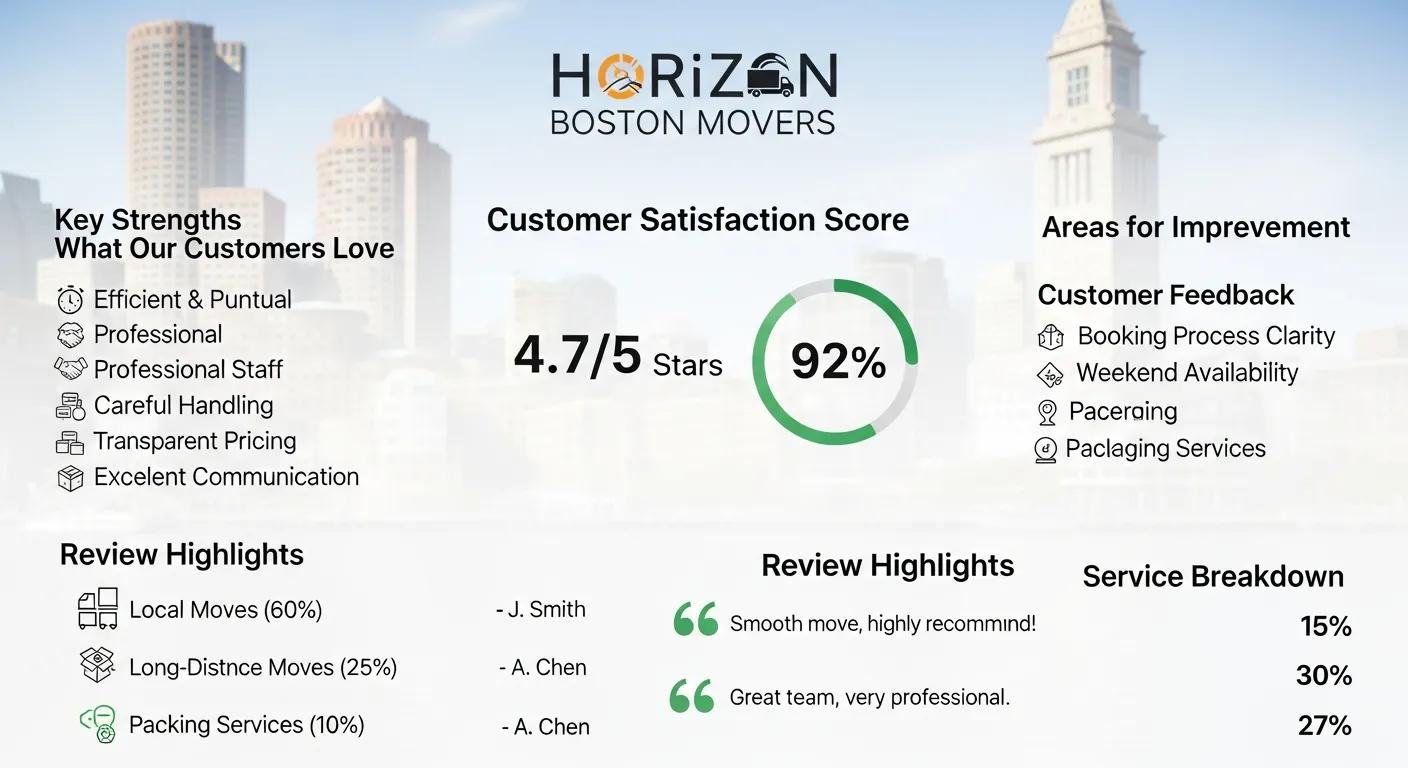

Discover What Customers Are Saying About Horizon Boston Movers: Reviews and Reliability Insights

Horizon Boston Movers — Customer Insights

Choosing a mover in Boston means balancing practical needs—on-time arrival, careful handling, and clear pricing—with trust signals that show a company consistently delivers. This guide brings together verified customer feedback and reliability indicators for Horizon Boston Movers so you can decide whether to request a quote. You’ll learn what customers praise most, how review metrics and accreditations back up reliability, which move types people recommend the company for, and how free estimates and transparent pricing reduce surprises. We based this analysis on aggregated review patterns, documented accreditations, and service-specific feedback (local, long-distance, senior and piano moves) to give a concise, evidence-focused picture. If you want to compare options quickly, the sections below include short lists, compact tables, and clear criteria to help you hire with confidence.

Horizon Boston Movers — Customer Reviews and Reliability Snapshot

Choosing a mover in Boston means balancing practical needs—on-time arrival, careful handling, and clear pricing—with trust signals that show a company consistently delivers. This piece summarizes verified customer feedback and reliability indicators for Horizon Boston Movers to help you decide whether to request a quote. You’ll see what customers commonly praise about service quality, how review metrics and accreditations support reliability, why clients recommend the company for certain moves, and how transparent pricing and free estimates reduce unexpected charges. The analysis draws on aggregated reviews, listed accreditations, and service-specific feedback (local, long-distance, senior and piano moves) to create a practical, evidence-based overview.

Can you hear me now? Learning from customer stories, RA Westbrook, 2011

What customers say about Horizon Boston Movers’ service quality

Customers define moving “service quality” around four consistent themes: professional crews, careful handling of belongings, punctuality, and clear communication. Review patterns suggest these elements—trained staff, well-equipped trucks, quality packing materials, and written estimates—work together to lower stress and reduce claims. The real benefit customers mention is fewer delays and items arriving in good condition, which is why many say they’d hire the company again. Below we break down the most-cited attributes and show how review themes line up with operational practices.

Which service aspects get the most praise?

Across reviews, people most often highlight punctuality, careful handling, clear communication, and good value. Those points reflect both crew behavior and behind-the-scenes processes that shape the moving day. Here’s a short summary with real-world context drawn from aggregated review themes.

  • Punctuality: Crews arrive on time and start promptly.
  • Handling care: Items arrive without damage thanks to protective packing.
  • Communication: Clear estimates and day-of updates cut down uncertainty.
  • Value: Transparent quotes and fair final bills make customers feel they got a good deal.

These strengths point to solid training, reliable equipment, and predictable processes—factors that lead into the next section on how testimonials build a picture of reliability.

How do testimonials show Horizon Boston Movers is reliable?

Common review themes—summarized rather than quoted—describe on-time crews, accurate inventories on estimates, and deliveries without damage. Reviewers often note successful navigation of tight staircases or careful piano moves, which signals both skill and the right tools. That repeated operational praise suggests reliability comes from steady crew training, clean, fully equipped trucks, and clear packing protocols. Those themes link directly to measurable reputation signals like ratings and accreditations, which we cover next.

How reliable is Horizon Boston Movers, based on verified reviews?

We measure reliability by review volume, overall satisfaction, and outside accreditations that corroborate consistent performance. Public listings show a strong review count and a high satisfaction rate, which reinforces the qualitative themes above. The table below summarizes core review and trust metrics so prospective customers can verify for themselves.

MetricDescriptionReported Value
Review countAggregated positive reviews across platforms200+
Satisfaction rateProportion of positive feedback reported98%+
Aggregate presencePlatforms where reviews appearGoogle, HomeAdvisor, BBB, Angie’s List

High volume paired with a strong satisfaction percentage makes the reliability signal more credible: many reviewers report similar operational strengths, lowering the chance praise is isolated. Next we look at ratings and platform presence to help you confirm those claims.

What do ratings and review counts say about reputation?

Ratings matter both for count and consistency: 200+ reviews combined with a near-universal positive rate (98%+) points to repeatable performance rather than one-off success. The short table below ties each platform to the typical metric and offers a quick note so you can check sources yourself.

SourceTypical RatingNotes
Google ReviewsHigh average rating (4.8/5)Public summaries show steady praise
HomeAdvisorTop-rated / ScreenedPlatform screening indicates contractor vetting
BBB / Angie’s ListAccreditation / AwardsExternal recognition supports trust claims

Because these patterns appear across multiple platforms, you can place more weight on the operational praise in testimonials. The next section lists the accreditations that commonly back up those claims.

How do licenses, insurance, and awards support reliability?

Third-party certifications and awards confirm screening, customer satisfaction, and standards that reduce hiring risk. Key trust signals tied to the company include platform accreditations and program badges that show screening and performance. Below is a quick summary of what those signals usually mean for customers.

  • Google Guaranteed: Indicates participation in a platform verification program.
  • BBB Accredited Business (A+): Suggests formal complaint handling and transparency.
  • HomeAdvisor and Angie’s List awards: Reflect consistently high service ratings.

Together, these accreditations cut uncertainty: they point to a history of positive outcomes and to processes (insurance checks, contractor screening) that protect customers. When you request an estimate, ask to see documentation and clarify liability coverage specifics.

Is Horizon Boston Movers a good fit? When customers recommend them

Deciding whether a mover is “good” comes down to matching priorities—professionalism, care, predictability, and transparent pricing—to the specific service. Customers tend to recommend a mover when those expectations are met repeatedly in contexts like tight urban moves, long-distance logistics, senior transitions that need sensitivity, or piano handling that requires special equipment. The table below compares service types with reported strengths and typical use cases to help you judge the fit.

Service TypeCustomer-Reported StrengthsTypical Use Case
Local MovingPunctual crews, efficient loadingApartment-to-apartment within Boston
Long DistanceDetailed inventories, secure transportInterstate relocations with logistics
Senior MovingScheduling flexibility, sensitivityAssisted-living transitions
Piano MovingSpecialized equipment & careUpright/grand piano relocation

This table shows where customer praise concentrates and why reviewers recommend the company for certain move types: specialized needs require both experience and proper equipment, and reviewers repeatedly call those out. Below are the most common reasons customers say they’d recommend Horizon Boston Movers.

Top reasons customers recommend Horizon Boston Movers

Customers usually cite a small set of repeatable strengths when recommending a mover. Here are the top reasons and what each means in practice.

  1. Professional crews: Fewer damages and faster loading.
  2. Careful packing and handling: Reduced loss and repair costs.
  3. Transparent pricing and accurate estimates: Less chance of surprise charges.

If your priorities are keeping items safe, having predictable arrival times, and clear billing, those are the main indicators to weigh when choosing a mover. The next section looks at how specialized services affect satisfaction.

How do specialized services — senior and piano moves — affect satisfaction?

Specialized moves require extra protocols: sensitivity and flexible scheduling for seniors, and custom equipment plus permits for piano moves. Reviews about senior moves emphasize patient crews and good coordination with family; piano-related feedback highlights careful packing, specialty dollies, and damage-free delivery. When those skills appear consistently across reviews, satisfaction tends to be higher because the main risks are anticipated and managed.

How Horizon Boston Movers handles pricing and delivers value

Transparent pricing reduces friction by spelling out what’s included and what’s not, while free estimates give a concrete basis for comparison. The company advertises a “Best Price Guaranteed” policy and offers free estimates aimed at eliminating hidden fees and clarifying travel time, basic protection, and included services. The table below shows common price features and whether they’re typically included or excluded so you know what to ask about.

Service TypePrice Feature IncludedPrice Feature Excluded
Local MovingTravel time, basic protectionOptional full-value insurance
Long DistanceInventory-based quote, fuelUnplanned storage costs
Labor OnlyCrew time, toolsPacking materials, permits

Use this table to compare line items and ask targeted questions during estimates. Below are the common elements covered by a typical “Best Price Guaranteed” message and how to confirm them at quote time.

What the ‘Best Price Guaranteed’ policy usually covers

Price-match or guarantee language needs limits and scope to be meaningful. Typically it promises no hidden fees, free estimates, and that quoted line items match final charges when conditions match the estimate. When you request a quote, confirm the specific guarantees listed below.

  • No hidden fees: All line items shown on the written estimate.
  • Free estimates: On-site or virtual inventory assessments at no cost.
  • Protection of belongings: Basic protection included; optional upgrades available.

Ask for the estimate in writing and clarify optional add-ons so the guarantee applies to your move. Horizon Boston Movers supports this approach by offering free estimates and clear cost breakdowns during quoting.

How free estimates and clear quotes build confidence

A clear estimate process reduces uncertainty by documenting inventory, timing, and itemized pricing you can compare across providers. A thorough estimate includes a walkthrough (in-person or virtual), a written inventory, and an itemized quote that separates included services from optional ones.

When comparing quotes, check whether pricing is hourly or flat, if travel time is included, and what liability coverage is offered. Those details help you make apples-to-apples comparisons and choose the option that fits your budget and risk tolerance.

If you’re ready to get a written estimate or verify credentials, Horizon Boston Movers can be reached through their published contact channels. We recommend requesting a free written estimate, confirming accreditations, and reviewing documented coverage before you book.

Frequently Asked Questions

What should I look for when choosing a moving company in Boston?

Look at customer reviews, service options, pricing transparency, and accreditations. Prefer companies with consistent positive feedback and clear, written estimates. Also confirm licenses and insurance, and ask about experience with any special requirements you have—like piano moves or senior relocations.

How can I verify the reliability of Horizon Boston Movers?

Check reviews on Google, HomeAdvisor, and the Better Business Bureau. Look for consistent praise around punctuality, care, and communication. Verify any listed accreditations and ask the company to show documentation during the estimate.

What types of insurance do moving companies typically offer?

Most movers offer basic liability coverage (often included) and optional full-value protection. Basic coverage limits compensation per pound; full-value protection covers repair or replacement up to the item’s value. Ask for details during the estimate so you understand what’s included and what costs extra.

Are there any hidden fees I should be aware of when hiring movers?

Hidden fees can appear for packing materials, fuel surcharges, or extra labor for heavy items. Avoid surprises by requesting a detailed, written estimate that lists all potential charges and by confirming the limits of any “Best Price Guaranteed” promise.

How do I prepare for a move with Horizon Boston Movers?

Start by decluttering and making an inventory. Share any special requirements (fragile items, exact dates) when you request the estimate. Confirm parking and access at both locations, and review the written estimate so you know what’s included on move day.

What specialized services does Horizon Boston Movers offer?

They handle local and long-distance moves, senior relocations with sensitivity and scheduling flexibility, and piano moves that require specialized equipment and techniques. Tell them about any special needs when you request a quote so they can plan properly.

How can I contact Horizon Boston Movers for a quote?

Contact them via the phone number, email, or online form listed on their site. Be ready with details like home size, move distance, and any special services you need. Take advantage of their free estimates to get a clear, written quote.

Conclusion

Horizon Boston Movers earns consistent praise for professionalism, careful handling, and transparent pricing—qualities that make them a reliable choice for many Boston-area moves. If those qualities matter to you, request a free estimate and review the written quote before booking. With clear communication and documented credentials, Horizon Boston Movers is positioned to make your next move smoother and more predictable.

Comparing Horizon Boston Movers’ Pricing: How Do We Stack Up Against Local Competitors?

Horizon Boston Movers: Pricing Comparison

Choosing a mover in Boston means weighing price, clarity, and the specific services you need. This guide compares common local and long-distance pricing approaches so you can evaluate value without guesswork. You’ll see how hourly local rates and flat long-distance quotes are built, which factors push a price up or down, where hidden fees usually appear, and practical steps to get accurate, no-obligation estimates. We focus on measurable elements—crew-size hourly rates, estimated move ranges by home size, flat-rate inclusions, and common fee triggers—so you can compare quotes from Boston movers with confidence. The four main sections cover transparent pricing and guarantees, local cost benchmarks, long-distance flat-rate comparisons, and concrete ways to avoid surprise charges.

How Does Horizon Boston Movers Ensure Transparent and Competitive Pricing?

Transparent pricing means clear rate structures, itemized inclusions, and an estimate process that minimizes surprises—reducing disputes and making comparisons straightforward. Key practices include thorough video or on-site surveys, explicit lists of what’s covered under hourly or flat rates, and written policies customers can reference. At Horizon Boston Movers we back our promises with a Best Price Guarantee, a no-hidden-fees approach, competitive hourly local rates, flat long-distance options, and free video or on-site estimates to improve accuracy. Together these policies align quoted and actual charges and set expectations about protection for your belongings, crew equipment, and surface protection to lower claim-related extras. Below we define the two main pricing models and when each is appropriate.

What Are Horizon Boston Movers’ Local and Long-Distance Pricing Structures?

Local moves are most often billed by the hour and account for crew, truck, and active moving time; this rewards efficiency but depends on clear minimums and published hourly rates. Hourly quotes typically state a minimum number of hours and per-crew hourly rates that scale with crew size and job complexity; specialty packing, permits, or long carries are usually listed separately. Long-distance moves are commonly offered as flat rates that bundle truck use, labor, basic protections, and fuel into a single price based on inventory, distance, and service level. Flat rates reduce budget uncertainty for interstate moves but must clearly list inclusions and exclusions. Knowing which model applies—hourly for local, flat for long-distance—lets you compare quotes apples-to-apples and ask the right follow-up questions about bundled services.

Why Choose Horizon Boston Movers for No Hidden Fees and Best Price Guarantee?

A no-hidden-fees promise matters only when it’s supported by documented estimates, itemized quotes, and a clear dispute process. Horizon Boston Movers offers free video and on-site estimates plus explicit commitments about no hidden fees and our Best Price Guarantee; when followed, these practices limit surprise line items like ambiguous time charges or unlisted surcharges. Expect a written estimate that lists included services (truck, crew, basic protections), optional add-ons (packing materials, specialty-item handling), and any minimums or surcharges—so you can challenge unexpected charges if needed. Accurate, inventory-based estimates combined with a Best Price Guarantee make it easier to compare multiple Boston movers on true value. The next section breaks down typical hourly and per-home-size cost benchmarks you’ll see locally.

What Are the Typical Local Moving Costs in Boston Compared to Horizon Boston Movers?

Local Boston moves are driven mainly by crew size, hourly rates, and minimum booking hours—comparing those elements helps you spot competitive offers. Market averages vary by crew; cost drivers include stairs, long carries, elevator access, and parking or permit needs, all of which change effective hourly cost. Below is a concise comparison of typical crew hourly ranges in the Boston market with a Horizon example rate so you can benchmark quotes. After the table we list primary cost drivers you should expect to see called out on any transparent estimate to determine whether a low headline rate remains competitive once add-ons apply.

Crew SizeTypical Boston Hourly RangeHorizon Boston Movers Example Rate
2 movers + truck$120–$170 per hourCompetitive hourly rate (within local market range)
3 movers + truck$160–$220 per hourCompetitive hourly rate (within local market range)
4 movers + truck$200–$280 per hourCompetitive hourly rate (within local market range)

This table shows Horizon’s position: inside local market ranges while stressing competitive hourly pricing and accurate estimates.

How Do Hourly Rates Vary by Crew Size for Local Moves?

Crew size changes both pace and cost: more movers usually finish faster but raise the per-hour labor portion of the quote. A 2-person crew often suits a studio or small 1BR where heavy lifting is limited; 3- or 4-person crews are better for larger 2BR–4BR homes or moves with many stairs or bulky items because they cut total hours on the clock. Minimum-hour policies (commonly 2–4 hours) mean small moves still carry a baseline cost—so always ask about minimums and how travel time is billed. Choosing the right crew size minimizes total cost rather than focusing only on the lowest hourly rate.

What Are Estimated Local Moving Costs by Home Size in Boston?

Ballpark local move ranges use a representative hourly rate and typical durations to set expectations before an on-site estimate. Typical assumptions use a mid-range hourly rate and average travel/carry times: studio moves often finish in 2–3 hours; 1BR in 3–4 hours; 2BR in 4–6 hours; 3BR in 6–8 hours; and 4BR+ in 8+ hours, depending on inventory and access. Cost-increasing factors include stairs, elevator restrictions, narrow halls, heavy specialty items, and peak-season demand—these should be itemized in a transparent quote so you can compare final estimates. For a precise number, request a free video or on-site estimate so quoted hours and any necessary surcharges are captured up front.

How Do Horizon Boston Movers’ Long-Distance Prices Compare to Boston Competitors?

Flat-rate long-distance pricing gives a single, inventory-based price tied to distance—making budgeting easier but requiring explicit inclusion and exclusion lists to avoid surprises. Flat rates commonly include truck use, crew labor for loading/unloading, basic protective materials, fuel, and limited liability coverage; exclusions often cover full-value insurance, specialty crating, long-term storage, and extra packing services unless added. Horizon Boston Movers advertises flat-rate long-distance options with stated inclusions, free estimates to capture inventory precisely, and protections for belongings and property; putting these inclusions in writing helps you compare the true value of flat quotes from competing movers. The compact table below matches move scenarios to representative long-distance ranges and highlights Horizon’s typical flat-rate inclusions.

Move ScenarioEstimated Boston Long-Distance RangeHorizon Flat-Rate Inclusion Example
Studio–1BR, <500 miles$1,200–$3,000Truck, crew, basic protection, fuel, free estimate
2BR–3BR, 500–1,000 miles$3,000–$7,500Truck, crew, basic protection, fuel, inventory-based flat quote
3BR–4BR, 1,000+ miles$7,500–$15,000Truck, crew, basic protection, fuel; special packing optional

What Is Included in Horizon Boston Movers’ Flat Rate Long-Distance Pricing?

Flat-rate inclusions should be explicit so you know what’s covered without surprise line items: crew labor for loading and unloading, truck use, basic protective materials, and fuel are commonly included. Exclusions that often add fees are comprehensive insurance beyond basic liability, specialty packing or crating for antiques and pianos, temporary storage, and third-party hoisting or permits—confirm whether these are included or priced separately. Horizon’s free video and on-site estimates are designed to capture inventory and access conditions so the flat quote reflects the full scope of work and reduces later adjustments. Clear inclusion lists make comparing flat quotes from different movers straightforward and help you judge overall value once optional services are added.

What Are Typical Long-Distance Moving Cost Estimates from Boston?

Long-distance estimates depend heavily on shipment weight, distance, and required services; representative ranges set expectations but aren’t a substitute for an inventory-based quote. Small shipments (studio/1BR) moving a few hundred miles can land in the low thousands; large 3BR–4BR interstate moves can reach many thousands depending on weight and special handling. Seasonality and peak dates also push prices higher. Cost drivers include packing needs, insurance level chosen, permits or hoisting, and storage timing. Obtain a free video or on-site estimate so the inventory and access details that determine a firm flat-rate are captured. When comparing long-distance offers, prioritize written flat-rate details and confirm what protections and optional services are included.

How Does Horizon Boston Movers Help Customers Avoid Hidden Moving Fees?

Hidden fees usually stem from vague estimate language, unreported access issues, or unlisted surcharges. Identifying common fee types and their triggers helps you request explicit confirmations before booking. Practical prevention steps include detailed video or on-site surveys to document stairs, long carries, elevator limits, and parking needs; itemized written estimates that list included services and optional add-ons; and clearly stated policies for minimum hours, overtime, and permit-related charges. The table below maps common hidden fee types, typical triggers, and how a transparent estimate process prevents surprises—followed by a short checklist to use when comparing quotes.

Hidden Fee TypeTypical Charge or TriggerHow Horizon Boston Movers Prevents It
Stair / long-carry fees$50–$200+ per incidenceVideo/on-site estimates document stairs/long carries in quote
Fuel or travel surchargesPercentage or flat add-onFlat-rate documentation or hourly travel time disclosed upfront
Parking/permit feesPermit cost or lost timeEstimates note permit needs and itemize related charges
Overtime / after-hoursHourly premiumsWritten hours and overtime policy provided in estimate

This table shows that pre-move documentation is the practical way to avoid unexpected charges.

What Hidden Fees Should Boston Movers’ Customers Watch For?

Watch for vague wording like “may apply” without examples, missing minimum-hour disclosures, or absent lists of included services—those gaps often hide potential surcharges. Red flags include unclear travel-time language, no stated heavy-item handling policy, and missing information on permit or parking responsibilities. Ask to see a sample itemized estimate and confirm whether quoted figures include travel time, fuel, basic protections, and required permits so you can compare quotes on equal terms. Clarify ambiguous lines early to reduce pay-on-site surprises and make apples-to-apples comparisons across Boston movers.

How Does Horizon Boston Movers Guarantee Accurate, No-Obligation Quotes?

Accurate, no-obligation quotes come from capturing inventory and access conditions via video or on-site surveys, then issuing a written estimate that lists included services, optional add-ons, minimums, and any conditional surcharges. Horizon Boston Movers provides free video and on-site estimates intended to produce inventory-based quotes and lower the chance of post-move adjustments; our no-hidden-fees statement aims to align the final invoice with the written estimate. Protect yourself by requesting the written estimate, confirming overtime and parking policies, and asking for guarantee language in writing so you have recourse if billed differently. For the most reliable comparison, get multiple inventory-based estimates and use the checklists in this guide to determine which mover offers the clearest value.

Frequently Asked Questions

What Should I Look for in a Moving Estimate?

Look for an itemized estimate that clearly lists what’s included and what isn’t. Check crew size, hourly rates, minimum charges, and any possible surcharges for stairs, long carries, or permits. A transparent estimate will also note exclusions like insurance levels or specialty packing so you can compare offers fairly and avoid surprises.

How Can I Prepare for a Move with Horizon Boston Movers?

Start by sorting belongings and deciding what to keep, donate, or discard. Book a free video or on-site estimate so we can see your inventory. Tell us about heavy items, access issues, or tight parking in advance. Confirm your moving date and any necessary permits to help the day go smoothly.

What Are the Benefits of Using a Flat-Rate Pricing Model for Long-Distance Moves?

Flat-rate pricing gives predictable costs and simpler budgeting by bundling truck use, labor, and basic protections into one price. It makes comparisons easier, but be sure the flat rate lists inclusions and exclusions so you don’t get surprised by optional services that aren’t covered.

How Do Seasonal Changes Affect Moving Costs in Boston?

Seasonality affects demand and pricing. Summer is peak moving season and usually costs more; winter and weekdays tend to be less expensive with more availability. Holidays and weekends can also raise rates. Scheduling during off-peak times can save money and improve scheduling flexibility.

What Should I Do If I Encounter Unexpected Charges After My Move?

If you see unexpected charges, first compare the invoice to your written estimate. Contact Horizon Boston Movers to ask for clarification and keep a record of all communications. If charges weren’t disclosed, discuss a dispute or escalation path with the company; if needed, contact a consumer protection agency for further help.

Can I Change My Moving Date After Booking with Horizon Boston Movers?

You can usually change your moving date, but notify us as soon as possible. Date changes depend on availability and may incur fees based on the booking terms. Check your agreement and speak with your Horizon representative to confirm any changes.

Conclusion

Horizon Boston Movers focuses on clear pricing and a commitment to no hidden fees so your move is less stressful. Understanding hourly and flat-rate structures helps you pick the right option for your budget and needs. Ready to get a reliable price? Request a free video or on-site estimate today and see the transparent quote you deserve.

Real Customer Reviews: What People Are Saying About Horizon Boston Movers’ Exceptional Services

Boston Movers — Real Reviews From Real Customers

Real customer reviews are the most reliable way to judge a moving company. This article pulls together verified feedback about Horizon Boston Movers — covering reliability, specialty moves, pricing transparency, and overall recommendations. You’ll see which themes keep coming up — punctuality, careful handling, professional conduct, and clear estimates — and how those themes apply to services like senior moves and long-distance relocations. Instead of sales copy, this review hub uses aggregated customer sentiment, third‑party trust signals (BBB accreditation, industry awards), and practical summaries — plus EAV tables and customer-sourced lists — so you can judge whether to request a tailored estimate.

What Are Customers Saying About Horizon Boston Movers’ Reliability and Professionalism?

Customers generally define reliability as showing up when promised, sticking to the agreed timeline, and protecting belongings in transit. Reviews consistently tie these behaviors to lower moving stress: coordinated crews and clear pre-move planning cut delays and last‑minute surprises, which speeds unloading and reduces damage. Many reviewers point to repeatable predictability — moves that run according to plan save time and reduce anxiety. The list below summarizes the most common praises for reliability and professionalism.

  • Arriving on time and completing the job as scheduled.
  • Respectful, uniformed crews who explain timelines and next steps.
  • Careful handling of fragile and high-value items to minimize damage.

Those reliability themes show up in concrete crew behaviors and the efficiency customers describe in their anecdotes.

Different reviewers call out specific practices that illustrate how Horizon Boston Movers delivers both efficiency and care.

How Do Reviews Highlight Horizon Boston Movers’ Efficiency and Care?

Customers who praise efficiency point to organized crews using protective materials and systematic loading patterns to maximize space and limit handling. Reviewers describe a consistent workflow — careful wrapping of fragile items, floor protection in homes, and logical loading — that helps items arrive intact and moves finish on time. Efficiency often translates into measurable benefits, like fewer billed hours than expected and quicker setup in the new home, which reduces overall moving fatigue. Those service-level examples of care build customer trust and drive recommendations.

These practical examples prepare the way for stories showing professionalism in action and how crews handle problems when they arise.

Which Customer Experiences Showcase Professionalism in Boston Moving Services?

Many anecdotes highlight courteous communication, timely updates, and calm problem solving during unforeseen challenges. Reviewers describe crews navigating tight staircases, disassembling furniture correctly, and confirming placement preferences with homeowners — behaviors they call professional. Customers also note that clear, respectful interaction during stressful moments, such as parking or building restrictions, eases friction and builds confidence. These stories show professionalism is as much about accountability and communication as it is about strength and equipment.

Customers often point to company-level trust signals when explaining why they hired Horizon Boston Movers: mentions include BBB accreditation, industry awards, a reported 99 percent satisfaction rate in public profiles, and a review base of 300+ reviews. Those metrics frequently reassure clients facing complex logistics. If you’re comparing options, request a quote to see how your move’s specifics are priced and scheduled.

How Do Horizon Boston Movers’ Customers Rate Their Specialized Moving Services?

When reviews focus on specialized services, sentiment centers on whether crews matched the service to the client’s specific needs — for example, respecting seniors’ pace and dignity or securing items for long‑distance transit. Reviewers commonly praise responsiveness during planning and the crews’ ability to adjust packing and scheduling to the assignment. Below is a brief, service-by-service summary of prevailing customer impressions.

  1. Senior moving: Compassionate crews, patient pacing, and extra staging help.
  2. Long-distance moving: Secure packing, clear transit updates, and items arriving as expected.
  3. Piano and fragile-item moves: Use of specialized equipment and cautious placement to avoid damage.

Those service-specific comments lead naturally to a comparison of what customers most value and why many ask for tailored estimates for nonstandard moves.

To compare customer sentiment across specialized services, the table below summarizes common praise and typical outcomes reported by customers.

ServiceCommon PraiseTypical Outcome
Senior movingPatient crews, respectful communicationReduced stress for seniors and families
Long-distance movingSecure packing, transit updatesItems arrive intact and on schedule
Piano & fragile movesUse of specialized equipmentSafe transport with minimal risk

This comparison shows that tailored practices — not one-size-fits-all approaches — earn the strongest praise. The next subsections dive a bit deeper into senior and long-distance feedback and how services align with those expectations.

What Do Senior Moving Clients Say About Their Experience?

Seniors and their families repeatedly cite compassion, clear step-by-step explanations, and a slower, patient pace that matches comfort levels. Reviews often mention crews taking extra time to sort, label, and stage items in the new home, which reduces confusion for older adults and caregivers. Customers credit that extra attention with lowering anxiety and preserving dignity during transitions, especially when sentimental belongings are involved. Emotional support plus logistical competence drive positive senior-moving feedback.

A different set of priorities appears in long-distance reviews, where secure packing and transit communication matter most for satisfaction.

How Are Long Distance Moving Reviews Reflecting Customer Satisfaction?

Long-distance reviewers emphasize packing standards, secure containerization, and clear communication about transit windows. Customers report peace of mind when crews use robust padding, crates, and straps. Regular updates during transit and accurate arrival estimates reduce uncertainty over longer timelines, and delivered items commonly match pre-move condition expectations. These outcomes highlight the value of consistent packing protocols and clear carrier coordination for cross-region relocations. When customers request a tailored estimate for long-distance moves, they’re usually seeking clarity on transit insurance and packing options.

What Pricing and Transparency Feedback Do Customers Provide for Horizon Boston Movers?

Customers often comment on how closely final invoices match initial estimates and whether pricing felt fair for the level of service. Positive pricing reviews typically mention clear, line-item quotes and few surprise fees. Reviewers credit detailed upfront quoting and transparent explanations of charges with making comparisons easier and reducing booking anxiety. That clarity increases trust and the likelihood of referrals. The list below captures common pricing-related observations from recent feedback.

  • Line-item estimates that spell out labor and materials.
  • Frequent mentions of a Best Price Guarantee or competitive pricing.
  • Easy scheduling and clear descriptions of add-on services like packing or hoisting.

To show how customers describe pricing features, the EAV table below maps pricing attributes to customer comments and gives example values or quotes.

Pricing FeatureCustomer-Reported AttributeExample/Value
Quote clarityLine-item breakdowns reduce surprises“Estimate matched final bill”
Best Price GuaranteeConfidence in competitive pricing“Felt assured we had a fair rate”
No-hidden-fees claimFew reports of unexpected charges“Transparent about extra services”

Customers frequently reference specific quote attributes when describing pricing transparency. Reviews mentioning the Best Price Guarantee say it gave them confidence to request estimates, and many note the convenience of online or video estimates before booking. If you want a clear price, request a free video or online quote to compare options and confirm what’s included.

How Do Customers Describe Horizon Boston Movers’ Best Price Guarantee?

In reviews, the Best Price Guarantee is described more as reassurance than a strict warranty: customers say it made them comfortable requesting estimates because pricing felt benchmarked against competitors. Psychologically, the guarantee lowers perceived risk when services vary in scope. Reviewers cite staff who explain how estimates are calculated and who compare packing or storage options to fit budgets. In practice, reviewers treat the guarantee as a trust signal rather than a hard price cap.

What Do Reviews Reveal About the Quote and Booking Process?

Customers often praise responsiveness and accuracy in the quoting experience — quick replies to online inquiries and informative video or in‑home estimates that capture the move scope precisely. Reviewers say detailed visual inspections (photos or video) during estimates reduce later discrepancies between estimate and final invoice. Typical positive outcomes are accurate arrival windows and few post-move billing disputes, outcomes customers attribute to upfront clarity. If you value certainty, request a video or online estimate to set clear expectations before booking.

Why Do Customers Recommend Horizon Boston Movers for Stress-Free Moving in Boston?

Customers recommend Horizon Boston Movers for connected reasons: consistent punctuality, careful handling of belongings, transparent pricing, and courteous, professional crews. Together these drivers produce what reviewers describe as a stress-free move — operational reliability cuts down on unknowns, and attentive crews minimize damage and unpacking time. Below is a short checklist of customer-verified practices that lead to low-stress outcomes and explain why many refer the company to friends and neighbors.

  • Punctual, well-coordinated arrival and on-time completion.
  • Protective packing and careful loading/unloading practices.
  • Transparent estimates, clear communication, and courteous crews.

Those themes explain why reviewers who recommend Horizon Boston Movers highlight both operational competence and human-centered service. The next subsection links the operational practices reviewers credit with delivering these low-stress outcomes.

What Common Themes Emerge From Customer Testimonials?

Testimonials consistently mention punctuality, careful handling, clear pricing, and friendly professionalism — often more than one trait in the same review. These themes address core customer concerns: timing, damage risk, and unexpected costs; together they form a coherent trust signal. Representative quotes frequently note floor and furniture protection, confirmation of placement instructions, and an accurate final invoice. Repeated mentions across many reviews create an overall impression of dependable service quality that prospective customers rely on.

Those testimonial themes map directly to the operational practices reviewers say produce smooth moves.

How Does Horizon Boston Movers Ensure a Hassle-Free Moving Experience?

Reviewers attribute hassle-free moves to trained crews, the right equipment, protective packing materials, and proactive communication before and during the move. Customers describe crews using padding, straps, and careful wrapping; coordinating parking and building access in advance; and following clear labeling systems for organized unloading. Together, these practices produce measurable benefits: fewer damaged items, shorter move times, and clearer post-move organization. If these standards match your expectations, request a free quote to turn the confidence in reviews into a concrete moving plan.

Frequently Asked Questions

What should I look for in customer reviews of moving companies?

Focus on reviews that report reliability, professionalism, and pricing transparency. Look for details on punctuality, how crews handled belongings, and whether communication about timing and costs was clear. Specific examples — how a crew managed a tight staircase or building rules — are especially helpful. Also check feedback on specialized services to see if the company meets unique needs like senior or long-distance moves.

How can I ensure my belongings are safe during a move?

Choose a mover that emphasizes careful packing and handling. Look for reviews mentioning protective materials (padding, straps), systematic loading, and clear labeling. Ask about insurance and damage-claim procedures, and confirm the company’s packing standards. A reputable mover will explain protections and provide updates during the move.

What are the benefits of requesting a tailored estimate?

A tailored estimate reflects your specific needs — home size, move distance, and special requirements — and helps ensure you understand costs and services. Customers say tailored estimates reduce surprises on moving day and provide a clearer picture of what to expect, which boosts overall satisfaction.

How do I know if a moving company is trustworthy?

Look for third-party endorsements like BBB accreditation or industry awards, and read customer reviews for evidence of consistent reliability and professionalism. Pay attention to feedback on communication, adherence to schedules, and handling of belongings. A strong record of positive reviews and transparent pricing practices is a solid indicator of trustworthiness.

What should I do if I encounter issues during my move?

If problems arise, communicate with the crew or customer service right away and document the issue. Reputable movers have protocols to address delays, damage, or misunderstandings. Discuss the situation on-site or with customer service so the company can resolve it promptly.

Are there any hidden fees I should be aware of when hiring movers?

Hidden fees can happen, so ask for a detailed cost breakdown before you hire. Look for reviews that praise clear line-item estimates. Reputable movers provide upfront quotes covering likely charges — labor, materials, and add-on services — but always clarify anything that’s unclear to avoid surprises.

Conclusion

Customer feedback shows Horizon Boston Movers delivers reliable, low-stress moves — punctual crews, careful handling, and transparent pricing are recurring praises. Real reviews and third-party signals reinforce confidence in their specialized services, from senior relocations to long-distance moves. Requesting a tailored estimate is the best next step to align your needs with the company’s proven practices. See how Horizon Boston Movers can make your next move smoother and more predictable.

Comparing Horizon Boston Movers: How Our Rates Stack Up Against Other Affordable Movers

Horizon Boston Movers: Rate Comparison

Finding a mover that pairs fair pricing with clear billing matters in Boston. This guide lines up local moving cost benchmarks with Horizon Boston Movers’ time-based, hourly approach so you can spot the most cost-effective, trustworthy option for your move. Read on for typical hourly rates in the area, the main factors that change price in Boston, what a transparent hourly plan usually covers, and how specialty services — like piano moves or storage — affect your total. You’ll get practical tips to avoid surprises and a simple checklist for requesting and comparing quotes. When you finish, there’s a short guide on getting an accurate estimate and how to request a free, time-based or in-home quote from Horizon Boston Movers.

What Are the Typical Moving Rates in Boston and How Does Horizon Boston Movers Compare?

Local Boston moving costs are usually shown as hourly crew charges and job ranges; city averages reflect higher labor, tight access, and drive-time premiums. A time-based price tracks labor hours, truck time, and travel, so hourly models often match the actual work for short, local moves. Below are compact examples and a quick comparison to show how hourly pricing converts into real costs for common home sizes. Those examples help you decide whether a time-based hourly quote or a flat/weight-based offer better fits your move.

How Do Horizon Boston Movers’ Hourly Rates Match Boston’s Average Moving Costs?

Boston’s local hourly rates typically reflect two- to three-person crews plus truck time. Horizon Boston Movers follows a time-based hourly model that lines up with local market norms while stressing clear billing and no hidden fees. Example scenarios show how crew size and drive time change totals: a studio with a two-person crew and a short drive can finish in about two hours, while a 2BR move often needs four to six crew hours depending on access. These quick scenarios translate hourly pricing into budgeting expectations and show where savings come from efficient packing and timing.

What Factors Influence Local Moving Costs in Boston?

Several Boston-specific factors affect moving costs and alter both hourly and flat-rate bids. Stairs, narrow hallways, and limited parking increase labor time; traffic and long drives raise truck hours and fuel charges; specialty items like pianos or antiques need extra crew and equipment; and city permits or hoisting add logistical steps. To lower costs, schedule off-peak, clear pathways before movers arrive, and give accurate inventory details so estimates are precise. Time-based pricing rewards efficient moves, so a little prep can reduce the final bill.

  • Crew labor hours, access difficulty, drive time, and specialty items are the main cost drivers in Boston.
  • Good scheduling and unobstructed access cut billed labor hours and total cost.
  • Providing an accurate inventory and planning ahead creates more reliable time-based estimates and fewer surprises.

These are practical levers renters and homeowners can use to influence hourly totals and prepare for the comparisons below.

Move Type / Home SizeTypical Boston Estimate (Hourly model)Horizon Boston Movers — Time-based Example
Studio / Efficiency2–3 hours of crew time; aligns with local hourly benchmarksAbout 2 hours with a 2-person crew; transparent hourly billing with basic padding included
1BR Apartment3–4 hours, depending on access and drive timeTypically 3 hours with a 2–3 person crew; estimate shows labor plus truck time
2BR Apartment4–6 hours; stairs or long carries increase timeUsually 4–5 hours; a transparent hourly breakdown is available on request

Use these scenario-based comparisons as starting points when you collect quotes so you’re comparing like-for-like on crew size and assumed services.

How Does Horizon Boston Movers’ Transparent Pricing Provide Better Value?

Transparent pricing means the hourly rate and included services are spelled out, and common add-ons are disclosed up front so you can compare real value. A time-based hourly plan ties the bill directly to the work performed, which can be cheaper for shorter local moves or when you handle some packing yourself. Consistent transparency prevents surprise fees and gives you options—like packing small boxes—to control costs. The section below lists what a clear hourly price should include so you can use it as a comparison checklist.

What Is Included in Horizon Boston Movers’ Time-Based Pricing Model?

A clear hourly rate typically covers core labor, truck time, basic padding and wrapping, plus standard fuel and mileage within city limits. Horizon Boston Movers uses an itemized hourly approach that shows what’s standard and what’s optional, helping you evaluate true value. Common optional add-ons usually quoted separately include full packing labor, specialty-item rigging, premium insurance, and long-term storage. Knowing inclusions up front makes it easier to compare hourly offers and decide whether a flat rate actually saves money.

  • Common inclusions: labor, truck time, basic padding, and standard fuel.
  • Common optional add-ons: full packing labor, specialty handling, premium insurance.
  • Always ask for itemized line items in the written estimate to confirm what the hourly rate covers.

This checklist helps you spot gaps in competing quotes and avoid overlooked exclusions.

How Does Horizon Avoid Hidden Fees Compared to Other Boston Movers?

Preventing hidden fees depends on clear communication, written estimates, and defined chargeable events like stair carries or long driveway distances. Horizon Boston Movers recommends in-home or virtual walkthroughs so access issues are captured before move day. A documented estimate reduces ambiguity around wait time, elevator delays, or permit coordination fees. When you request a detailed quote, verify that the provider lists potential charges and explains how they apply so you can compare offers fairly.

  • Ask whether long carries, parking permits, and elevator wait times are specified in writing.
  • Choose providers who offer in-home or virtual walkthroughs to finalize time estimates accurately.
  • Confirm billed units (hours, crew size, truck time) before booking to avoid later disputes.

These comparison points help you pick a transparent provider and lead into how specialty services change costs.

How Do Horizon Boston Movers’ Specialized Services Affect Overall Moving Costs?

Specialty services add distinct cost elements because they require more labor, special equipment, or storage logistics. Packing services increase labor hours and materials; storage brings monthly fees and handling charges; piano moves or hoisting need specially trained crews and rigging, quoted separately. Each specialty item should be evaluated for required equipment and time — hourly pricing will reflect the effort, while flat fees may hide uncertainty. The table below breaks down common specialty services with typical inclusions so you know what to expect.

What Are the Costs for Packing, Storage, and Specialty Moves Like Piano Moving?

Below is a concise comparison of specialty services with indicative ranges and what’s usually included to help when you request time-based quotes.

Service TypePrice Range (Indicative)What’s Included / Notes
Packing (per room or full service)Typically billed hourly plus materialsLabor for wrapping, boxes, and basic labeling; premium packing quoted separately
Storage (monthly handling)Monthly fee plus handling chargesShort-term loading/unloading often included; long-term rates depend on facility
Piano / Specialty movingQuote-based; requires specialty riggingSpecialized crew, padding, piano board, and possible hoisting equipment

This table shows how specialty moves change the work profile and why detailed quotes should list added labor and equipment time for accurate comparison.

How Do These Services Compare to Other Affordable Moving Companies in Boston?

Compared to many conventional providers, a transparent hourly model can include basic services that others list as add-ons, giving clearer apples-to-apples comparisons. Horizon Boston Movers’ time-based approach highlights what’s standard versus optional so you can see whether low headline rates omit essential tasks. Flat-rate offers may look appealing at first but can hide extra charges tied to access or specialty items. Use a checklist of included labor, truck time, padding, fuel, and optional services to see which quote truly delivers value.

  • Check whether box materials, basic padding, and fuel are included in the base rate.
  • Make sure specialty handling or hoisting is separately itemized and quoted.
  • Prefer estimates that state assumptions (crew size, access, drive time) so comparisons are fair.

This checklist helps you separate providers who offer genuinely affordable, transparent service from those with low headline prices that add charges later.

How Can Customers Get Accurate Quotes and Compare Boston Moving Company Prices?

Accurate comparisons start with consistent inputs: the same inventory, access notes, and service list for each provider you contact. A three-step process yields the most reliable quotes: submit a detailed inventory or use an online form, schedule a virtual or in-home walkthrough to confirm access and timing, and request a written, itemized estimate listing hourly units, crew size, and optional add-ons. This approach highlights the differences between hourly and flat-rate methods and shows where transparency changes the final cost. The section below outlines Horizon Boston Movers’ estimate process and how reviews reveal real cost-value signals.

What Is the Process for Getting a Transparent Quote from Horizon Boston Movers?

To get an accurate time-based estimate, give an inventory and access notes and choose an in-home or virtual walkthrough so the estimator can see stairs, parking, and elevators. Horizon Boston Movers provides a written, itemized estimate that shows hourly assumptions, crew size, truck time, and any optional services like full packing or specialty handling. Expect a clear breakdown that matches the observed conditions and be ready to ask about potential charges for permits or hoisting. This process helps ensure the quote reflects real labor and equipment needs and lowers the chance of surprises on moving day.

How Do Customer Reviews Reflect Satisfaction with Horizon’s Pricing and Value?

Reviews mentioning clear billing, few surprises, and fair final invoices are strong indicators that a provider communicates pricing well and delivers on expectations. When you read reviews, focus on comments about itemized estimates, punctuality, and how optional services were handled to see whether billing matched promises. Many satisfied customers point to transparency and straightforward hourly accounting as reasons they’d recommend a mover. Look for phrases like “no surprise charges” or “clear hourly billing” when weighing value between companies.

  1. Steps to evaluate quotes: submit inventory, schedule a walkthrough, get a written itemized estimate.
  2. Checklist items to compare: crew size, included padding/materials, truck time, and optional services.
  3. Red flags in quotes: vague inclusions, missing assumptions about stairs/parking, or no written estimate.

These actionable steps help you gather comparable bids and choose the best mix of price and transparency. If you want a time-based estimate or help arranging an in-home walkthrough, request a free estimate from Horizon Boston Movers via their website, phone, or an in-home visit — they provide transparent hourly pricing and an itemized written quote to simplify comparisons.

Frequently Asked Questions

What Should I Consider When Choosing a Moving Company in Boston?

Look for reputation, clear pricing, and the services you need. Read reviews that mention billing, punctuality, and how the company handled problems. Confirm the provider offers written estimates and will do an in-home or virtual walkthrough. Knowing what’s included and excluded in their pricing helps you avoid unexpected costs and choose the best value for your move.

How Can I Reduce My Moving Costs in Boston?

Reduce costs by moving during off-peak times (weekdays or non-holiday dates), decluttering beforehand, and packing as much as you can yourself. Give accurate inventory details and make sure paths and parking are clear for the movers — that streamlines the job and can lower billed hours.

What Are the Benefits of a Time-Based Pricing Model?

Time-based pricing ties what you pay to the actual labor and time required, making charges easier to understand. It can be more economical for shorter moves since you only pay for the time spent. This model also encourages transparency because you can see how charges break down by hours and services.

Are There Any Hidden Fees I Should Be Aware Of?

Some movers may add fees for access challenges like stairs or long carries, or for extra services such as packing or storage. To avoid surprises, ask for a detailed written estimate that lists possible charges. Specifically ask about parking permit fees, elevator usage, and delay charges so you can compare quotes accurately.

How Do I Prepare for a Move with Horizon Boston Movers?

Start with a detailed inventory and note access issues at both locations. Schedule an in-home or virtual walkthrough to confirm the estimate. Have packing materials ready and pack non-essential items ahead of time. Clear walkways and parking for the truck to help the move run smoothly.

What Should I Look for in Customer Reviews of Moving Companies?

Focus on reviews that mention transparency, reliability, and overall satisfaction. Look for specific examples of clear pricing, accurate estimates, and how the company handled problems. Positive notes about punctuality, professionalism, and no surprise charges are good signs. Watch for recurring themes to judge strengths and weaknesses.

Conclusion

Choosing Horizon Boston Movers gets you clear, time-based pricing and service designed for Boston moves. By knowing the factors that influence costs and the advantages of hourly pricing, you can make smarter choices that save money and reduce surprises. Ready to move? Request a free, itemized quote today and see how clarity and fair billing make the difference.

Customer Reviews on Horizon Boston Movers: Affordable Pricing and Exceptional Service Quality

Affordable Moves, Remarkable Reviews

Horizon Boston Movers consistently appears in local reviews for pairing clear, time-based pricing with top-rated service. This guide breaks down what customers say about affordability and care, explains how time-based pricing works, and highlights the review patterns that most often predict a smooth move. We know people worry about surprise fees or crews that mishandle fragile items—so we map common reviewer concerns to real examples and practical steps you can take. You’ll find a plain-language explanation of pricing mechanics, evidence-backed service attributes (punctuality, professionalism, careful handling), and a look at how customer feedback drives real improvements. Read on for a straightforward comparison of pricing options, review evidence on service quality, why both homeowners and businesses trust us, and how feedback translates into better operations—so you can decide whether to request a free estimate or start a booking.

What Do Customers Say About Horizon Boston Movers’ Affordable Pricing?

Reviewers regularly call Horizon Boston Movers’ pricing transparent and competitive. Many customers prefer time-based billing to weight-based quotes because it reduces surprise fees and often lowers the final cost on local moves. Time-based pricing bills for crew hours, travel, and specific services like packing or piano moves—so the cost tracks the actual work performed and rewards good preparation. Aggregated reviews show strong perceptions of value, with an average rating near 4.9 from over 100 reviews. Below we explain how time-based pricing works, list the main factors that affect estimates, and give a compact comparison to set realistic expectations.

How Does Horizon Boston Movers’ Time-Based Pricing Work?

Time-based pricing charges for the actual labor and time required: hourly crew rates multiplied by crew size and hours worked, plus adjustments for travel and any specialty services. The main variables are crew size, total hours for packing and loading, travel distance and traffic, and special handling needs like pianos or long carries. You can lower costs by pre-packing, decluttering ahead of the move, and labeling items clearly to speed loading and unloading. Knowing these components helps you compare estimates fairly and predict likely invoice ranges based on move complexity.

Note: the table below shows common pricing elements and how they’re typically billed so you can compare time-based models with weight-based alternatives.

Pricing ElementHow it’s chargedTypical outcome or benefit
Crew hoursHourly rate × crew size × hours workedCost tied to actual labor; good preparation shortens hours
Travel time & fuelTime-based surcharge for transit between locationsTransparent travel cost instead of hidden fees
Specialty handling (pianos, bulky items)Added per-task time and equipmentClear, fair extra charge for specialized care

This comparison shows how time-based billing converts visible work into predictable charges, which helps customers plan and control their moving budget.

Which Customer Testimonials Highlight Horizon’s Cost-Effectiveness?

Across platforms, many reviewers say Horizon Boston Movers’ quotes were among the lowest of the estimates they requested. They attribute savings to efficient crews and transparent, time-based estimates rather than unexpected weight surcharges. Reviews often mention clear upfront conversations about hourly rates and what is included, which reduced worry about final invoices. Several customers also said a detailed breakdown of crew time and services helped them adjust tasks before moving day to manage costs.

If you’re comparing estimates, ask for a breakdown of time components and which optional services add hours—this makes it easier to compare quotes on an apples-to-apples basis.

How Do Horizon Boston Movers’ Reviews Reflect Their Exceptional Service Quality?

Review data links Horizon Boston Movers to high scores on key service attributes—precision and care, professionalism, punctuality, speed, and friendliness. Those traits show up as careful packing of fragile items, clear scheduling communication, on-time arrivals, efficient loading/unloading, and courteous crews. Below we match those attributes to what reviewers describe so you know what to look for when reading feedback or planning your move.

What Ratings Do Customers Give for Professionalism and Care?

Aggregated summaries rank professionalism and careful handling among the top attributes, with reported scores like 9.68/10 for professionalism and 9.71/10 for precision and care in available summaries. Professionalism usually means uniformed, well-equipped crews, labeled boxes, and methodical wrapping of fragile items—practices that reduce breakage and speed unpacking. Customers say these actions cut post-move stress and claims. Seeing these behaviors in reviews translates numeric scores into the on-the-ground practices you can expect during your move.

Common signs of strong professionalism and care reviewers mention include:

  • Systematic packing: Boxes are organized and labeled by room for easier unpacking.
  • Protective handling: Furniture, doorways, and floors are shielded to prevent damage.
  • Clear communication: Crews and coordinators explain timing and next steps.

These indicators show how high attribute scores deliver practical benefits on moving day.

Which Customer Stories Showcase Punctuality and Efficiency?

Many reviewers single out punctuality and speed as major reasons they were satisfied—crews arrived on time and often finished loading or unloading faster than expected without shortcuts on care. Punctuality comes from disciplined scheduling, smart route planning, and properly sized crews so jobs are completed within quoted windows, which reduces downtime for both households and businesses. Efficiency shows up in fewer truck trips, quick setup and teardown, and clear task division among team members—details customers frequently mention when recommending the company. If you need to minimize time on-site, ask for a time-based estimate that lists expected hours and crew size so you can confirm projected timelines before booking.

If keeping your move on schedule is a priority, request a time-based estimate with expected hours and crew size to make sure our projected timeline matches your needs.

Why Is Horizon Boston Movers Trusted for Residential and Commercial Moves?

Trust comes from transparent pricing, consistent service behaviors noted in reviews, and the ability to apply the same standards across residential and commercial moves. Homeowners report careful handling and friendly crews; business clients praise coordinated logistics and minimal downtime. The patterns in reviews explain how service choices create different outcomes—helping you decide if our strengths match your move type.

How Do Reviews Describe Residential Moving Experiences?

Residential reviews repeatedly highlight careful handling of personal items, respectful crew demeanor, and clear timing and packing communication—elements that reduce emotional stress for families. Customers often say crews protected floors and doorways, labeled boxes by room, and treated heirlooms with special care, which made unpacking easier. Courteous, communicative teams also help when coordinating with seniors or households that need extra time. These themes show that we prioritize client comfort and property protection in home moves.

The table below links residential services to common customer outcomes described in reviews.

Service TypeCustomer Outcome / BenefitExample outcome summary
Residential movingReduced damage and stressCareful packing, labeled boxes, protected flooring
Senior movingCompassionate handlingGentle pacing and clear communication during transition
Specialty moves (piano)Safe, equipment-backed transportSpecialized handling reduces risk of instrument damage

This comparison shows how service choices align with different residential priorities and expected benefits.

What Do Commercial Clients Say About Horizon’s Efficiency?

Commercial reviewers often report that coordinated scheduling, clear pre-move planning, and efficient crew execution minimized downtime and helped businesses reopen on schedule. Business clients value a precise scope of work, which supports quick transitions and avoids surprise charges. Reviews point to planning tools, staging areas, and experienced crew leads as reasons office moves ran smoothly with minimal lost productivity. For organizations, these results mean preserved workdays and predictable timelines.

If you’re moving a business, request an itemized time-based estimate and a proposed schedule to confirm our plan fits your operational needs.

How Does Horizon Boston Movers Address Customer Feedback and Improve Service?

We turn customer comments into concrete changes through a documented feedback loop: we log issues, diagnose root causes, apply remedies, and follow up to confirm satisfaction. Review narratives often mention quick responses and visible improvements after feedback. Below is a typical conflict-resolution workflow and examples of changes that come from recurring customer input. Clear escalation paths and transparent remedies help convert isolated problems into system-wide fixes, which builds long-term confidence.

What Processes Ensure Customer Satisfaction and Conflict Resolution?

When a problem is reported, our usual workflow includes logging the issue, a timely assessment, remedial steps, and follow-up to confirm the outcome. Customers say prompt acknowledgment and clear timelines reduce frustration and make the process feel managed rather than ad hoc. Typical timelines include immediate acknowledgment, an operational review to determine corrective actions, implementation of fixes or compensation if appropriate, and a final check-in to confirm satisfaction. This predictable structure reassures customers that issues will be handled methodically and fairly.

Typical resolution steps you can expect include:

  1. Report and Document: You tell us the issue and we log it.
  2. Assess and Propose: Our team investigates the root cause and recommends fixes.
  3. Remediate and Follow-Up: We apply corrections and check back to confirm you’re satisfied.

These steps show how structured feedback handling preserves satisfaction and supports ongoing improvement.

How Has Customer Input Led to Service Enhancements?

Customer feedback has led to clearer quote breakdowns, more detailed pre-move checklists, and stronger crew training on handling fragile items—changes reviewers often mention when praising improved clarity and care. Recurring review themes get converted into concrete updates like standardized packing protocols and refined scheduler scripts. Tracking and acting on feedback demonstrates a commitment to continuous improvement that helps sustain high ratings. If you value a mover that iterates based on customer experience, ask how feedback is tracked and implemented when you book.

If you’re ready to move forward, request a free, no-obligation estimate that itemizes time-based charges and outlines the planned crew and schedule—this gives you the transparency needed to compare quotes and book with confidence.

Frequently Asked Questions

What should I consider when preparing for a move with Horizon Boston Movers?

Declutter ahead of time to reduce what needs moving—fewer items usually means lower cost. Pre-pack non-essentials to save crew time. Label boxes by room and keep fragile items separate so crews can handle them properly. Tell us about any special requirements or valuable items before moving day so we can plan the right equipment and crew.

How can I ensure a smooth moving experience with Horizon Boston Movers?

Clear communication is key. Give us full details about your move, including any bulky or specialty items. Confirm the date, time, and any access issues at both locations. Have items staged and ready for loading on moving day—being organized helps the crew work faster and keeps the move on schedule.

What types of specialty moving services does Horizon Boston Movers offer?

We offer specialty services such as piano moving, handling of oversized or bulky items, and senior moving assistance. These services use trained personnel and, when needed, specific equipment to protect items and ensure safe transport. Discuss special items during the estimate so we can confirm capabilities and costs.

How does Horizon Boston Movers handle fragile items during a move?

Our crews use protective materials and proven packing methods for fragile items—bubble wrap, sturdy boxes, padding, and clear labeling. Team members trained in fragile-item handling follow systematic packing and loading routines to minimize risk. If you have especially valuable or delicate pieces, let us know in advance so we can plan extra protection.

What are the benefits of time-based pricing compared to weight-based pricing?

Time-based pricing ties costs to the actual work performed—crew hours and specific services—rather than an estimated weight. That often means lower final costs for local moves and greater transparency: you see what you’re paying for and can reduce hours through preparation. It also avoids unexpected weight surcharges common in weight-based systems.

How does Horizon Boston Movers ensure customer feedback leads to service improvements?

We log customer feedback, investigate recurring issues, implement changes, and follow up to confirm results. This can lead to clearer quotes, better checklists, enhanced crew training, and updated communication scripts. Acting on feedback is how we keep improving service and maintain high customer satisfaction.

Conclusion

Horizon Boston Movers combines transparent, time-based pricing with consistently high service standards to deliver smoother moves for both homes and businesses. We address common concerns—like surprise fees and fragile-item handling—through clear quotes, trained crews, and a feedback-driven improvement process. If you want a stress-reduced move, request a free, no-obligation estimate today. We’ll give you a clear breakdown of time-based charges and a proposed crew plan so you can book with confidence.

10 Key Factors That Affect the Cost of Hiring Residential Movers in Boston

What Drives Moving Costs in Boston

Moving cost is the total a household pays to move belongings from one address to another. In Boston, that total depends on local specifics — distance, volume, access and timing. This guide walks through the ten most important variables that set residential moving prices in Boston, shows how to estimate likely costs for common home sizes, and gives practical steps to avoid surprises when you request a quote. You’ll learn how local vs. long-distance pricing differs, why volume and weight influence truck size and crew, which add-on services raise the bill, and how Boston-specific logistics like parking permits and narrow streets add time and fees. The guide also includes quick tables comparing move types, maps home sizes to estimated labor hours, and lists typical paid add-ons so you can see how choices change the total. Use these factors to get clearer estimates, prepare an accurate inventory, and ask the right questions when you seek a binding or transparent quote for your Boston move.

How Does the Distance of Your Move Influence Boston Moving Prices?

Distance usually determines the pricing model. Local moves are typically billed by hourly crew time; long-distance moves often use flat-rate or weight-and-mile calculations. For local jobs movers price labor hours, crew travel time, and truck use. For long-distance moves carriers factor in mileage, fuel surcharges and weight-based tariffs to cover transit and logistics. The same boxes and furniture can cost more or less depending on which model applies, so knowing which model applies helps you compare bids. Distance also points to savings tactics — consolidating loads, traveling mid-week, or choosing flexible dates can lower costs.

This quick list shows the main distance-related cost drivers:

  • Mileage and route complexity increase fuel use and driver time, which raises long-distance tariffs and hourly totals.
  • Loading and unloading labor hours add directly to local hourly bills.
  • Flat-rate long-distance quotes bundle transit but may still include tolls and surcharges.
  • Fuel surcharges, interstate fees and terminal handling can apply when crossing state lines.

Together these factors explain why an intra-neighborhood Boston move and an interstate relocation of the same contents often produce very different invoices.

What Are Typical Costs for Local Moves Within Boston?

Boston local moves are usually billed hourly, with crew size, truck size and time on site driving the final amount. A studio or 1‑bedroom move typically needs a small crew and a van or 14–16′ truck; a 2–3 bedroom home usually requires a larger truck and more movers. Accessibility issues — stair carries, elevator reservations, or tight parking — can multiply the hours needed, so the posted hourly rate is only part of the story. When you get local quotes, ask for estimated labor hours tied to your inventory and building access details.

Move TypeTypical Pricing ModelExample Cost Drivers
Studio / 1BR (local)Hourly rateSmall truck, 2 movers, 2–4 hours; stair carries add time
2BR (local)Hourly rateLarger truck, 3 movers, 4–7 hours; furniture complexity raises hours
3BR+ (local)Hourly rate3–4 movers, 26′ truck, 6–10+ hours; multiple trips for tight access

This table shows how home size maps to the hourly pricing approach common for Boston local moves and why crew configuration matters.

How Do Long-Distance Moves Affect Pricing and Fuel Costs?

Long-distance moves often use flat-rate estimates or weight-and-mile pricing because transit and fuel are major cost components. Carriers estimate weight or volume, calculate route miles, add fuel surcharges and tolls, then provide a binding or non-binding estimate based on those inputs. Extra costs — interstate permits, terminal handling, overnight layovers — can increase the quote, so ask for a clear line-item breakdown. When evaluating long-distance offers, request mileage, weight estimate, fuel surcharge and any access or delivery fees so you can compare bids fairly.

How Does the Volume and Weight of Your Belongings Affect Residential Moving Costs in Boston?

Volume and weight determine the resources a move needs because they map directly to truck capacity, number of trips and crew size. Higher volume usually requires a larger truck or multiple trips, which increases labor hours and can turn a simple hourly job into a higher-cost operation. Weight matters most for long-distance pricing where carriers charge by the pound or use weight tiers; heavy items like appliances or pianos can disproportionately affect the total. Estimating cubic feet for your inventory helps you and the mover agree on truck size and crew needs before moving day.

  • Truck size follows cubic feet required and affects hourly or flat-rate pricing.
  • The number of movers needed rises with heavy items and fragile specialty pieces.
  • Multiple trips or partial loads increase labor and time costs; consolidation lowers them.
  • Weight-sensitive long-distance tariffs can make heavy but compact loads costly.

Accurate inventories and pre-move measurements reduce surprises and improve estimate accuracy.

What Are Average Moving Prices for Different Home Sizes in Boston?

Use average ranges to set expectations, but treat them as starting points — access, timing and add-ons change final quotes. A studio or 1BR local move generally needs a small crew and fewer labor hours. A 2BR often requires a full moving crew and a single large truck. A 3BR commonly needs a larger crew, more hours or multiple trucks. Always confirm ranges with a video or on-site estimate to capture building-specific variables that alter labor and equipment needs. An accurate pre-move inventory helps avoid underestimating time and fees.

Home SizeEstimated Hours (Local)Typical Crew/Truck
Studio / 1BR2–4 hours2 movers, van or small truck
2BR4–7 hours3 movers, 16–20′ truck
3BR+6–10+ hours3–4 movers, 26′ truck

This mapping clarifies how volume typically translates into labor estimates for local Boston moves.

How Do Volume and Weight Influence Truck Size and Labor Hours?

Crews match inventory volume to truck cubic capacity and plan loading sequences to maximize efficiency. A small furnishings set fits a van or 14′ truck with two movers; larger household inventories need 18–26′ trucks and three to four movers, which raises hourly totals. Heavy items slow packing and loading, lowering per-hour productivity and increasing billed hours — that’s why itemized lists for bulky or heavy goods help movers give more accurate labor estimates. Discuss crew size and anticipated truck dimensions during the estimate to get a clearer cost projection.

What Additional Services Can Increase Your Boston Moving Quote?

Add-on services raise cost because they require extra labor, materials, specialized equipment or storage beyond a standard pickup and delivery. Common extras include professional packing and unpacking, crating for fragile items, short- or long-term storage, specialty handling for pianos or antiques, and hoisting or exterior lifts when stairs or elevators are unusable. These services are often charged hourly or as flat fees, and each adds planning complexity. When reviewing quotes, check for itemized add-ons so you can decide which services to accept and which to handle yourself to save money.

Here is a concise list of common add-ons and how they are usually charged:

  • Packing and unpacking: typically hourly or per-room, with materials billed separately.
  • Specialty item handling (piano, antiques): flat or per-item fees for crating and specialist labor.
  • Storage solutions: monthly or short-term rates plus handling and delivery charges.
  • Hoisting and permits: flat fees or hourly charges when exterior lifts are required.

This list explains why full-service moves cost more and where homeowners can trim expenses by choosing partial services.

How Much Do Packing and Unpacking Services Cost in Boston?

Professional packing saves time but adds labor and material costs, usually priced hourly or by room. Full-service packing for a 2BR often requires several hours of crew time plus boxes and specialty packing for dishware or artwork; those material costs are added to the labor line on your quote. Partial packing — handling only fragile or heirloom items — balances convenience and cost. Supplying your own boxes reduces material fees. Always request an itemized packing estimate so you can compare professional packing to DIY.

ServiceTypical Fee StructureValue Consideration
Full packingHourly + materialsSaves time, ensures professional protection
Partial packingHourly for selected roomsCost-effective compromise
Crating (fragile)Flat per-itemNecessary for antiques/artwork
Storage (short-term)Monthly + handlingUseful for staggered move-ins

Use this table to compare add-ons and decide which services deliver the value you need.

What Are the Costs for Specialty Item Moving and Storage Solutions?

Specialty items need tailored handling, which increases labor time and may affect insurance or valuation. Movers use crating, padding or hoisting to protect valuables; pianos, large safes and fragile antiques often carry higher per-item fees and sometimes require specialist crews or external hoisting with permit and equipment costs. Storage typically charges monthly rates plus inbound/outbound handling, so include recurring fees in your budget. Discuss valuation coverage with your provider to match insurance levels with the replacement value of specialty contents.

How Do Accessibility and Timing Affect the Cost of Hiring Movers in Boston?

Accessibility (stairs, elevators, long carries, narrow streets) and timing (season, day of week, month-end) directly affect labor hours and the chance of extra fees because they change how fast a crew can work. If movers must park far from your door, complete multiple long carries, or reserve elevators, each constraint adds minutes or hours at hourly rates. Peak-season demand — usually summer and month-ends — pushes rates up and limits availability, while mid-week or off-season moves often mean lower prices and better scheduling. Planning around access limits and targeting off-peak dates are two of the most reliable ways to lower costs without sacrificing service.

Below are common Boston-specific accessibility and timing challenges:

  • Metered or restricted parking and permit requirements that add administrative time or permit fees.
  • Long carries and stair-only buildings that increase crew time and may result in stair charges.
  • Elevator reservations and building move windows that require coordination and can extend job duration.
  • Peak-season surcharges and limited availability at month-end or on weekends.

These local logistics show why on-site or video estimates that capture access realities produce the most accurate quotes.

What Are the Cost Implications of Boston’s Parking Permits and Accessibility Challenges?

Boston’s dense streets and parking rules mean movers sometimes need municipal permits, meter payments or reserved loading zones — all of which add administrative time or direct fees. When permits, alternate-side rules or meter-running force extra setup time or off-site staging, expect that time to appear in hourly totals or as a line-item fee. Professional movers can arrange permits, coordinate hoisting and protect floors and doors to reduce damage risk and delays. Many providers offer permit handling and hoisting as paid services so access challenges don’t derail the schedule.

When Is the Best Time to Move in Boston to Save on Moving Costs?

Moving during off-peak windows — weekday mornings outside month-end peaks or the fall/winter months — typically lowers hourly rates and increases crew availability because demand is down. The pricing mechanism is simple: supply and demand. Moving outside the busy summer and end-of-month windows improves the chance of discounted or more flexible scheduling. Small date shifts can reduce surcharges and lower billed hours if you avoid rush-hour traffic and building restrictions. Planning early, comparing multiple estimates and targeting off-peak times can produce real savings.

For accurate, transparent pricing that reflects these Boston-specific factors, Horizon Boston Movers offers free video and on-site estimates, and emphasizes “Best Price Guaranteed” with “No hidden fees.” We provide packing, storage, piano and specialty-item handling, hoisting, parking permit coordination and trash removal. Requesting a free estimate that captures distance, volume, accessibility and timing is the most reliable way to get a final quote you can trust.

Frequently Asked Questions

What factors should I consider when choosing a moving company in Boston?

Look at reputation, experience and customer reviews. Confirm the company is licensed and insured to protect you in case of damage or loss. Ask about their pricing structure and any potential extra fees for services like packing or storage. Make sure they understand Boston access issues — parking permits, narrow streets, stair-only buildings — and that they offer clear estimates, preferably via video or on-site inspection to capture all the details.

How can I prepare for my move to minimize costs?

Start by decluttering — the less you move, the lower the cost. Pack items yourself when you can to save on packing fees, or opt for partial packing for fragile items. Schedule the move for off-peak times like weekdays or winter months. Finally, get multiple quotes to compare services and prices, and provide movers with an accurate inventory so estimates don’t miss hidden time or fees.

What are the benefits of using professional packing services?

Professional packers save time and reduce damage risk. They use quality materials and techniques that protect fragile or valuable items. While packing adds to the total cost, it’s often worth it for busy households or for high-value items that need extra care. Always ask for an itemized packing estimate so you can weigh time saved against cost.

How do I handle specialty items during my move?

Tell your mover about specialty items — pianos, antiques, safes — well in advance so they can bring the right equipment and skilled labor. Expect extra costs for crating, padding or hoisting and discuss insurance or valuation coverage to match the item’s replacement value. Good planning and clear communication help these moves go smoothly.

What should I know about moving during peak seasons in Boston?

Peak seasons, especially summer and month-ends, mean higher prices and tighter availability. If you can, move during off-peak periods like weekdays or the colder months. If you must move in peak season, book early and be flexible on dates to secure better rates and teams.

Are there any hidden fees I should be aware of when moving in Boston?

Yes. Common extra charges include parking permits, stair carries and long carries when a truck can’t park close to your entrance. Companies may also bill for packing materials or specialty item handling. To avoid surprises, request a detailed estimate that lists potential add-ons and clarify those items before you sign any agreement.

Conclusion

Understanding the key cost drivers for Boston moves — distance, volume, accessibility and timing — puts you in control of your budget and reduces unexpected charges. Use the guidance here to prepare an accurate inventory, choose the right services and ask the right questions when you get quotes. Ready to get a transparent price? Request a free estimate so a mover can capture the details that determine your final quote and help ensure a smooth, cost-effective relocation.

Real Customers Share Their Experiences With Horizon Boston Movers: What You Need to Know

Real customer stories from Horizon Boston Movers

Choosing a mover in Boston often starts with other people’s experiences. This piece collects real customer feedback about Horizon Boston Movers so you can decide with confidence. You’ll find what people say about service quality, which services get the most praise, why customers recommend the team, and the questions people ask before booking. We focus on review-backed signals—professionalism, clear pricing, care for belongings, and local logistics like permits and tight-stair moves—so you don’t have to wade through dozens of one-off comments. Keep reading for concise takeaways, a side-by-side look at services, practical verification steps, and the trust signals that make it easy to request a quote or a free estimate.

Horizon Boston Movers: customer feedback and service-quality highlights

This roundup reflects common themes Boston customers mention when evaluating movers. It covers service quality, standout offerings, reasons people feel comfortable hiring Horizon Boston Movers, and the typical pre-booking questions. The emphasis is on review-derived evidence—professional crews, transparent pricing, careful handling of items, and knowledge of local moving logistics—so you can judge fit without sorting through isolated comments. Read on for clear takeaways, a service-by-service comparison, steps to verify claims, and trust signals that make it straightforward to request a free estimate.

Service breakthroughs, 1990

What do customers say about Horizon Boston Movers’ service quality?

Customer feedback repeatedly highlights three practical strengths: professionalism, reliability, and careful handling of belongings. Review trends show crews arriving on time, using protective materials, and communicating during the move—practices that reduce stress and lower the chance of damage. Those behaviors translate into direct benefits for customers: predictable schedules, fewer damaged items, and smoother move days. Below are the top takeaways we found across reviews.

Customers most often point to these quality traits:

  • Friendly, professional crews who stick to agreed schedules and instructions.
  • Transparent estimate processes, including on-site or video estimates that set clear expectations.
  • Careful handling with padding and straps used to protect furniture and fragile items.

These themes explain why many reviewers rate the company highly and lead into examples of professionalism and transparent pricing.

Intro to quality evidence before a compact comparison table.

Quality AttributeEvidence from ReviewsBuyer Implication
ProfessionalismRepeated comments about courteous, efficient crewsLess stress and faster move completion
ReliabilityReports of on-time arrivals and clear schedulingPredictable timelines for planners
Pricing TransparencyMany reviews note clear estimates and no hidden feesBetter budgeting and fewer billing disputes

This table summarizes review-backed claims about quality and what they mean for someone planning a move. Next we look at concrete descriptions of professionalism and transparent pricing from real customers.

How do customers describe Horizon Boston Movers’ professionalism and reliability?

Reviewers point to specific actions that feel professional: punctual arrivals, organized crews, clear packing routines, and respectful treatment of homes and buildings. Several customers mentioned teams who communicated schedule updates and worked methodically—actions that ease the usual moving-day anxiety. In short: professional behavior tends to mean fewer surprises and faster moves. Knowing what professionalism looks like makes it easier to compare providers.

What do customers say about pricing and transparency?

Many customers highlight the estimate process—free video or on-site estimates come up often as a tool that helps avoid surprise charges. Reviewers report clear line-item estimates, upfront conversations about parking permits or hoisting, and explicit promises about “no hidden fees.” For budget-minded movers, transparent pricing leads to better planning and higher perceived value. These patterns also connect to the trust signals covered later and make requesting a free estimate a practical next step.

Which Horizon Boston Movers services get the strongest customer reviews?

Grouping reviews by service type shows a few clear standouts: local moves, long-distance coordination, senior moves, and piano or specialty-item moves. Customers praise local moves for neighborhood know-how and quick turnarounds; long-distance work gets credit for careful packing and timeline management. The short service comparison below helps match reader needs to the services customers praise most.

Intro to the service comparison table that maps services to customer-reported strengths.

Service TypeWhat Customers PraiseExample Takeaway
Local MovingFamiliarity with Boston neighborhoods and efficient turnaroundsSmooth same-city transitions
Long-Distance MovingThorough packing and reliable timeline coordinationSecure intercity relocations
Senior MovingPatience, clear communication, and sensitivityLower stress for older clients
Piano & SpecialtyTechnical skill and proper equipment useSafe transport of high-value items

This comparison highlights which services tend to earn the most praise and suggests service-specific questions to ask when you request a tailored quote.

Customers frequently note distinct differences between local and long-distance moves:

  • Local moves earn praise for quick scheduling, shortcut knowledge in Boston neighborhoods, and efficient loading practices.
  • Long-distance moves get kudos for careful packing, clear timelines, and coordination across routes and delivery windows.
  • These differences help you choose the right service and prepare targeted questions before booking.

What are customers saying about local and long-distance moving services?

Local reviews focus on speed, familiarity with Boston building quirks, and efficient use of stairs or elevators—factors that often shorten total move time. Long-distance feedback emphasizes packing standards, secure loading, and dependable delivery schedules, which ease worries about items in transit. Balance your priorities—speed and local know-how versus long-haul security and coordination—when requesting a service-specific quote and confirming expectations during the estimate.

How do customers rate specialized services like senior and piano moving?

Specialized work draws praise for tailored processes: senior moves for thoughtful, step-by-step planning that reduces overwhelm, and piano moves for technical know-how and the right equipment to prevent damage. Reviews often mention crews explaining each step, adding extra padding, and coordinating building access or hoisting when necessary. If you need specialty handling, ask about crew experience and protective measures during the estimate to make sure you’ve covered every risk.

Why do customers trust Horizon Boston Movers for Boston relocations?

Trust comes from verifiable practices and visible safeguards: free video and on-site estimates, licensed and insured operations, clear fee guarantees, and a steady stream of positive reviews. Those elements lower perceived risk by creating predictable expectations and clear recourse if something goes wrong. Below are the most-cited trust signals customers reference when recommending the company.

Common trust signals cited by customers:

  • Licensed and insured operations that reduce financial exposure.
  • Free on-site or video estimates that make pricing easier to understand.
  • High review counts and consistent satisfaction that point to repeatable results.

These trust cues explain why many customers move quickly from inquiry to booking and lead naturally into the operational practices that make moves run smoothly.

How does Horizon Boston Movers help create a low-stress moving day?

Customers say stress is reduced by clear planning tools: accurate estimates, optional packing services, trained crews, and organized day-of coordination. Reviewers note crews coming prepared with materials, protecting floors and doorways, and handling building logistics like elevator reservations and parking. The result is fewer delays and less last-minute scrambling. When you request your free estimate, confirm these protections to be sure the team follows the same practices reviewers praise.

What role do licensing, insurance, and awards play in customer confidence?

Licensing and insurance are common reasons customers feel secure hiring a mover—those credentials mean financial protection and professional accountability. Strong review counts and positive satisfaction claims act as social proof that complements formal credentials. Together, these signals reassure customers that their belongings and contracts are handled responsibly. After verifying credentials, many people feel comfortable requesting a free estimate or booking a service.

What questions do customers ask most about Horizon Boston Movers?

Prospective customers commonly ask about how reviews are verified, what insurance covers, whether hidden fees exist, and if they should add packing or storage. These questions aim to reduce uncertainty before booking and to confirm the moving process will match expectations. The short answers below reflect practical verification steps and service recommendations drawn from customer feedback.

Key verification and decision steps customers use:

  1. Check multiple review sources: Look for consistent themes across the company’s review page and third-party sites.
  2. Ask about licensing and insurance: Confirm what’s covered and how claims are handled if damage occurs.
  3. Request an on-site or video estimate: Use the written estimate to compare line-item costs before booking.

These steps help validate satisfaction claims and guide the decision about whether to add packing or storage.

How can I verify Horizon Boston Movers’ customer satisfaction and ratings?

Practical verification includes reading the company’s reviews, checking third-party profiles, and looking for patterns rather than isolated comments. Focus on repeated praise or recurring complaints—patterns reveal reliability more than a single five- or one-star review. Asking for references or inquiring about recent similar moves during your estimate can further confirm claimed satisfaction. These checks help you decide with confidence.

Do customers recommend Horizon Boston Movers for packing and storage services?

Most customers recommend professional packing when convenience or fragile items are involved; storage gets positive notes for secure short-term needs. Reviews suggest professional packing lowers breakage risk and speeds loading, while storage is useful during transitional moves. Many customers choose packing for fragile or high-value items and storage when delivery timing is uncertain. Use those patterns to decide whether to bundle add-ons during your estimate.

If you’re ready to take the next step: Horizon Boston Movers offers free video and on-site estimates, highlights strong customer satisfaction, and stresses transparent pricing. For a clearer cost picture and a move plan tailored to Boston logistics, request a free estimate or quote to confirm services and pricing.

Frequently Asked Questions

What should I look for in a moving company besides customer reviews?

Beyond reviews, check licensing and insurance to ensure financial protection and accountability. Ask about experience with the move type you need—local, long-distance, or specialty—and confirm packing and storage options. Look for clear guarantees or service promises, and consider any awards or industry recognition that suggest consistent quality.

How can I prepare for my move with Horizon Boston Movers?

Start by making an inventory of what you’re moving and flagging fragile or oversized items. Share special requirements with the movers, confirm any building permits or parking needs, and lock in the moving date and time. Clear pathways, secure pets, and have an essentials box ready for the first 24 hours. Communicating details ahead of time helps the team deliver a smooth move.

What are the benefits of using professional packing services?

Professional packing cuts the risk of damage and speeds the moving process. Experienced packers know how to protect fragile items and pack efficiently, which saves time and reduces stress. Packing services are especially valuable for high-value items, fragile belongings, or when you’re short on time.

How does Horizon Boston Movers handle special items like pianos or antiques?

Horizon Boston Movers uses trained crews and specialized equipment for delicate, heavy, or high-value items. They employ custom padding, crating, and correct lifting techniques to protect weight distribution and fragility. Mention any concerns during the estimate so the team can plan the appropriate protection and logistics.

What should I do if I have a complaint after my move?

If you have a complaint, contact Horizon Boston Movers directly and provide details—dates, descriptions of the issue, and any photos or documentation. Most companies have a customer service process to investigate and resolve concerns, whether that means addressing damages or billing questions. Prompt, clear communication speeds resolution.

Are there any hidden fees I should be aware of when hiring Horizon Boston Movers?

Horizon Boston Movers emphasizes transparent pricing, but it’s still smart to request a detailed estimate that lists potential charges. Ask about fees for packing materials, long carries, hoisting, or other special handling so you can avoid surprises. Confirm any possible extras during the initial estimate.

How can I ensure a smooth moving day experience?

Confirm all details with Horizon Boston Movers a few days before your move. Clear walkways, secure pets, and have an essentials box ready. Be available to answer the crew’s questions and confirm parking or elevator reservations. A little preparation and clear communication go a long way toward a trouble-free moving day.

Conclusion

Horizon Boston Movers earns positive marks for professionalism, transparency, and careful handling of belongings. Customers consistently report smoother, less stressful relocations when the team follows the practices described above. If you want a clearer cost estimate or a move plan that accounts for Boston’s logistics, request a free estimate—many customers find that direct quote gives them the confidence to book.

Understanding the Key Factors Influencing Moving Costs in the Greater Boston Area

Boston Moving Costs — What Really Drives the Price

When you get a moving estimate in Boston, the final price bundles several distinct pieces—travel, labor, equipment, packing materials, and protection for your items—and the city’s tight streets, older buildings, and local rules make those pieces vary a lot. This guide walks through the specific factors that shape moving costs across the Greater Boston area so you can read line items with confidence and get a dependable quote. You’ll see how distance and volume affect truck choice and drive time, how labor and packing decisions change hourly totals, which access or permit issues commonly add fees, and how timing and insurance shift the bottom line. The aim is practical: help you compare estimates, avoid preventable charges, and ask the right questions. If you’d like a local partner after reading, Horizon Boston Movers offers free video and on-site estimates and can give a tailored price once you know the main cost drivers. Below are Boston-focused examples, clear checklists, and simple tables that make the choices easy to understand.

What Are the Main Factors That Determine Moving Costs in Boston?

Boston moves are usually priced from a predictable set of factors: distance and drive time, the volume and weight of your belongings, labor (crew size and hours), packing needs, specialty items, building access, timing, and insurance. These pieces interact—longer drive time raises labor and mileage, higher volume needs a bigger truck or extra trips, and difficult access increases carry time—so a reliable quote should address each category. The short checklist below shows what to verify on any estimate so you understand why prices differ between companies.

The primary cost drivers for Boston moves include:

  1. Distance and drive time: more miles and travel mean added labor and fuel charges.
  2. Volume and truck size: larger loads need bigger trucks or multiple runs.
  3. Labor and crew size: more movers can shorten the job but raise hourly crew costs.
  4. Access and permits: stairs, hoisting, or parking permits can add time and fees.
  5. Packing and materials: professional packing increases both labor and supplies costs.
  6. Special items and insurance: pianos, antiques, and upgraded valuation raise pricing.

Use this list to compare estimates side‑by‑side and to see how distance and volume change cost calculations for local versus longer moves.

How Does the Distance of Your Move Affect Boston Moving Prices?

Distance affects pricing through travel time, mileage, and whether the move is billed hourly or as a flat rate. Local Boston moves are often charged by the hour with a minimum and a travel fee; longer suburban or interstate relocations commonly use flat-rate pricing that bundles distance and labor. A short intra-city move (under 10 miles) usually reflects loading, unloading, and traffic delays, while a 50-mile suburban move adds highway mileage, extra driving time, and occasionally overnight crew expenses. Knowing whether your quote is hourly or a flat-distance rate is key to estimating total cost and choosing the most economical option for your route.

Why Does the Volume and Weight of Your Belongings Impact Moving Costs?

Volume and weight determine truck size, how many trips are needed, and how many movers you’ll require—each of which directly affects price. Small moves (studio or one-bedroom) often fit a small truck and a two-person crew; multi-bedroom homes usually need a larger truck and extra hands to keep the job efficient. Heavy pieces like appliances and solid-wood furniture slow handling and may require equipment or additional crew, which increases hours. Decluttering and inventorying before your estimate can reduce truck size and labor needs, which typically lowers the final quote.

Move Size CategoryTypical Crew / TruckCost Impact Example
Studio / 1BR2 movers, small truckFewer hours and a lower hourly total
2BR2–3 movers, medium truckModerate hours; may need an extra trip
3BR+3–4 movers, large truckMore hours and higher hourly or flat costs

The table above maps move size to crew and truck choices so you can see why providers adjust estimates based on projected load.

How Do Labor and Service Choices Influence Boston Moving Company Pricing?

Labor and service options are major levers on any moving estimate: hourly rates, crew size, minimums, and add-ons like packing or disassembly each change cost in different ways. Hourly moves multiply crew size by total move time plus travel and often include a minimum number of hours; adding movers can shorten the clock but raises the per‑hour bill. Add-ons such as full packing or custom crating add separate materials and labor line items on an itemized quote. The short comparison below helps you decide which billing model usually saves money for your situation.

Compare hourly and flat-rate pricing in practice:

  • Hourly billing typically favors small, short-distance moves where work finishes quickly.
  • Flat-rate pricing can be more predictable and often works better for long-distance or large, complex jobs.
  • Hourly jobs need clear estimates of crew size and expected hours to avoid surprises.
  • Flat-rate quotes should list what’s included so you know which services are covered.

Knowing these tradeoffs makes it easier to pick the billing model that fits your move and to see how packing tiers affect predictable costs, described next.

What Role Do Labor Hours and Crew Size Play in Moving Costs?

Labor hours and crew size make up the core of most Boston moving estimates: total labor = crew size × hourly rate × hours worked, plus travel time and any minimum. A two-person crew can be cost-effective for small apartments but may extend hours for larger homes; adding a third mover raises the hourly expense but often reduces total hours. Many companies have minimum-hour policies (for example, a two‑ or three‑hour minimum) that hit short moves harder, so confirm minimums and travel charges during the estimate. To lower labor costs, organize your belongings, pre-disassemble furniture, and plan an efficient loading order.

ServiceWhat it IncludesTypical Price Impact
Packing (partial)Materials plus selected-room packingModerate increase (labor + boxes)
Full packingEverything boxed, labeled, and fragile-packedSignificant increase (full labor + materials)
Disassembly/ReassemblyBeds, large furniture piecesSmall-to-moderate line item

This table outlines common service tiers and how they typically affect an estimate—helpful when deciding which tasks to DIY.

How Do Packing Services and Materials Add to Your Moving Expenses?

Packing options run from supply-only to full-service and affect price by adding labor hours and materials. Professional packers take extra time before loading to handle fragile items, use specialty boxes, and wrap furniture—reducing damage risk and often speeding loading if done well. Materials (boxes, tape, padding, crates) are usually charged per item or as a bundled materials fee. Many people choose partial packing for delicate items and self-pack everyday goods as a cost-saving balance between protection and budget.

What Additional Factors Can Increase Moving Costs in the Greater Boston Area?

Boston’s older buildings, narrow streets, resident-only zones, and permit rules create access challenges that add time and fees. Specialty items—pianos, safes, oversized antiques—or jobs requiring hoisting or crane service bring extra crew, special equipment, and higher insurance, all listed as separate line items on quotes. The table below summarizes common Boston access issues and the typical time or fee impacts to expect when planning a move.

Common Boston access challenges and their impacts:

  • Stairs and narrow hallways increase carry time and require more labor.
  • Elevator reservations or building move windows can create scheduling fees.
  • Street parking restrictions and loading zones often need permits or meter payments.
Access ChallengeWhy it MattersTypical Fee / Time Impact
Stairs (multiple flights)Increases carry time and limits equipment use+20–50% labor time
Parking permits / loading zonesRequires city permits or meter timeFlat permit fee plus added time
Hoisting / craneBypasses stairs but needs crew and special gearFlat hoist fee plus hourly charge

The table makes it easier to see how access constraints turn into measurable cost impacts and where you can plan to reduce them.

How Do Specialized Items Like Pianos or Hoisting Affect Pricing?

Specialty items need extra care, equipment, and time, which raises an estimate above standard furniture moves. Moving a piano or arranging a hoist requires trained movers, specialty dollies or straps, and often a flat fee that covers equipment rental plus additional labor. For example, piano pricing depends on piano type, access difficulty, and distance; hoisting usually combines a flat hoist charge with the hourly crew time to rig and move items safely. If you have specialty pieces, ask for explicit line items so you can compare quotes directly.

What Impact Do Access Challenges and Parking Permits Have on Moving Fees?

Unplanned parking and building access issues in Boston often create hidden time costs and force crews to shuttle items farther, increasing labor hours. Resident-only streets, narrow curbs, and metered zones may require permits to reserve a legal loading spot, and last-minute permit requests can carry extra fees. Elevator booking rules in condos or offices often set narrow move windows that can extend total days or hours. Scheduling permits and reserving elevator time in advance is one of the simplest ways to avoid surprise surcharges.

  • Request permits, elevator reservations, and loading zone access ahead of time to reduce delays and lower the risk of overtime charges.
  • Coordinate move windows with building management to avoid scheduling conflicts that add waiting time.
  • Give your estimator clear dimensions and parking needs so the quote includes any necessary permit fees.

These steps cut the extra labor access issues create and make quotes more predictable.

How Can Timing and Insurance Affect Your Total Moving Cost in Boston?

Timing and insurance choices change both cost and risk: peak-season, weekend, and end-of-month moves face higher demand and often higher rates, while insurance or valuation coverage adds a modest but important charge to protect valuable items. Moving off-peak—mid-week, mid-month, or in colder months—can get you lower hourly rates and more flexible scheduling; last-minute bookings during peak windows may carry premiums. Insurance options range from basic released-value protection (commonly included) to optional full-value protection or third-party policies that cover repair or replacement; these items normally show as separate line items on a detailed estimate.

Seasonal timing and scheduling tips:

  1. Move mid-week or mid-month to tap into lower demand and often reduced rates.
  2. Avoid peak summer weekends and month-end turnover when possible to limit premiums.
  3. Book early to lock preferred dates and avoid rush surcharges.

Choosing the right insurance depends on the declared value of your items and your comfort with replacement versus repair options; ask any mover for a clear explanation of valuation options on the quote.

When Is the Best Time to Move to Save on Boston Moving Costs?

You’ll usually save by moving during off-peak windows: weekdays, mid-month dates, and colder months when fewer people relocate. Peak periods—weekends, summer, and month-end lease turnovers—drive prices up and limit available crews, which reduces negotiating room. Being flexible with dates and booking early can lead to meaningful savings and better scheduling, especially for buildings that require reserved elevator or loading windows.

What Are Your Options for Moving Insurance and How Do They Influence Cost?

Insurance choices typically include a mover’s basic released-value protection and optional upgraded valuation or third-party transit insurance for broader coverage. Released-value protection usually reimburses at a low per‑pound rate; full-value protection covers repair or replacement and increases the mover’s liability; third-party policies can fill gaps for especially valuable items. The extra cost for higher coverage is generally modest compared with the value insured and is often worth it for antiques, pianos, or high-end electronics.

Horizon Boston Movers can put together a tailored quote that reflects the distance, volume, labor, specialty services, access planning, timing preferences, and insurance choices outlined above. Request a free video or on-site estimate to receive an itemized plan showing specific line items and any access or permit fees for your address. Our customer commitments — Best Price Guaranteed, No Hidden Fees, Competitive hourly rates, Flat Rates for long-distance, Stress-free Moving, Free video and on-site estimates, Protection of belongings, floors and doors — are designed to help you compare quotes with confidence and choose a partner that fits your priorities.

Frequently Asked Questions

What are the common hidden costs associated with moving in Boston?

Hidden costs often come from access issues, parking permits, and extra labor for specialty items. If your building limits elevator use or you need a street permit for a loading spot, those add fees. Heavy or delicate items that require special handling can mean more crew or special equipment, pushing up the total. Always ask movers for a detailed list of potential extra charges when you get quotes.

How can I prepare for a move to minimize costs?

To lower moving costs, start by decluttering—fewer items usually mean a smaller truck and less labor. Pack what you can yourself to save on packing fees, organize boxes clearly, and pre-disassemble furniture where possible. Scheduling your move in an off-peak window (mid-week or mid-month) also helps you secure better rates and more crew availability.

What should I know about moving during peak seasons in Boston?

Peak seasons—summer, weekends, and month-end—raise demand and prices and reduce availability. Movers may charge premiums and scheduling becomes tighter. If moving during a peak period is unavoidable, book early to lock in services and be prepared for possible delays due to traffic or building scheduling conflicts.

Are there specific insurance options I should consider for my move?

Yes. Most moves include basic released-value protection, which offers limited coverage. For broader protection, consider full-value protection from the mover or a third-party transit policy, especially for antiques, pianos, or expensive electronics. Review what each option covers and ask for examples of how claims are handled so you can choose the right level of protection.

How do I choose the right moving company in Boston?

Look for licensed, insured local movers with strong reviews and clear, itemized quotes. Compare several estimates and check that they list possible extras like permits, hoisting, and packing. Ask about experience with moves like yours—particularly if you have specialty items or tricky access—and verify their protection policies and customer guarantees.

What are the benefits of using professional packing services?

Professional packers save time and reduce damage risk. They use the right materials, handle fragile items correctly, and speed up loading. While there’s an extra cost, the efficiency and peace of mind often outweigh it—especially for large moves or valuable, delicate possessions.

Conclusion

Knowing the factors that shape moving costs in Boston helps you make smarter choices and avoid surprises. By focusing on distance, volume, labor, and access issues, you can evaluate quotes more effectively and pick the right mover for your needs. For a custom estimate that reflects your exact situation, contact Horizon Boston Movers today and request a free video or on-site quote. Take the next step toward a smoother, more cost-effective move with a partner who knows Boston.

Uncovering the Hidden Fees: What Affordable Movers in Boston Won’t Tell You!

Hidden Fees of Boston Movers — How to avoid surprise charges

Hidden fees are extra line items or post-move charges that can push your final bill well above the original quote. In Boston—where narrow streets, permit rules, and tight building layouts frequently affect access—these surcharges are common. This guide explains what those fees look like (long carry, stair carry, shuttle service, bulky-item surcharges, packing-material markups, fuel and rescheduling penalties), calls out Boston-specific costs like parking permits and elevator reservations, and gives practical steps to avoid surprises. You’ll learn the difference between binding and non-binding estimates, the questions to ask movers, a checklist for vetting contracts and licenses, and how a transparent company uses video or on-site estimates to protect you.

What Are the Most Common Hidden Fees Charged by Boston Movers?

Hidden fees are specific charges not always included in a low initial quote. They usually appear when access, specialty handling, or materials go beyond what the estimator assumed. Movers may add long carry fees when the truck parks far from your door, stair carry charges if elevators aren’t available, and shuttle fees when narrow streets force smaller vehicles. These access-related costs come from Boston’s streets, building layouts, and municipal rules. Spotting them ahead of time—and asking for explicit, line-item treatment in your estimate—reduces ambiguity and lowers the chance of a contested invoice. Below are the most typical extra charges you’ll see in Boston moves.

Common extra charges customers encounter in Boston include:

  • Long carry fees when movers walk a long distance between truck and entrance; often billed per foot or as extra labor time.
  • Stair carry charges when items must be carried up or down stairs because an elevator isn’t available.
  • Shuttle service fees when a smaller vehicle ferries items because the moving truck can’t access the street.

These examples show how access issues translate into added labor and time. Measuring distances, documenting conditions, and getting clear wording in the quote are effective ways to avoid surprises.

Intro to fee comparison table: The table below summarizes three common access-related fees, when they’re usually charged in Boston, and practical ways to avoid them or determine who pays.

Fee TypeWhen Charged / Typical Range in BostonHow to Avoid / Who Pays
Long carry feeCharged when truck parking >50 feet; billed per foot or as extra labor timeReserve parking, measure carry distance, request a line-item quote; typically charged to the customer
Stair carry chargeApplied when stairs are used instead of an elevator; often per flight or per-item surchargeReserve elevator time or schedule the move when elevator access is available; negotiate inclusion in a binding estimate
Shuttle service feeRequired when trucks can’t reach the street; small-vehicle trips billed hourlyConfirm access restrictions ahead of time and ask for a shuttle allowance in the written estimate

This quick view shows when access-related line items typically appear and highlights simple mitigation tactics—like reserving permits or asking for explicit inclusions in your written estimate.

Which Extra Charges Should You Expect from Affordable Moving Companies in Boston?

Companies that advertise low base rates often add charges for materials, specialty handling, or logistical complications. Expect line items for packing-material markups (boxes, tape), bulky-item surcharges for pianos or oversized furniture, rescheduling or cancellation penalties if plans change at the last minute, and fuel surcharges during high-cost periods. Knowing these categories lets you ask focused questions and insist on a written estimate that breaks down each possible charge before you commit.

How Do Long Carry, Stair Carry, and Shuttle Service Fees Impact Your Moving Cost?

Access-related fees convert extra minutes of labor and logistical constraints into predictable charges—usually per-item, per-flight, or per-hour. Repeated stair carries in a multi-room apartment can add several labor hours; shuttle services add both time and vehicle costs when trucks can’t reach the curb. Anticipate these fees by measuring carry distances, checking elevator availability, and recording access limits with photos or a short video for the estimator. Addressing access issues ahead of moving day lowers the risk of ad-hoc charges and helps ensure any necessary fees appear as clear line items in the contract.

How Can You Avoid Unexpected Moving Costs with Transparent Pricing in Boston?

Transparent pricing begins with an estimate that lists every charge and the assumptions behind it. Insist on an on-site or high-quality video estimate so the estimator can see access issues and inventory in person, and compare binding versus non-binding estimates to understand who is responsible for overages. Prepare an inventory list and photos that document bulky items or difficult access, and reserve required parking permits or elevator times to remove ambiguity. The checklist below lists minimum steps you should request from any mover.

Request these steps from movers as a minimum:

  1. On-site or video estimate: Have the mover inspect access and inventory directly so the quote reflects real conditions.
  2. Written estimate with line items: Require each fee and its trigger to be itemized—not implied—in writing.
  3. Instructions for permits/elevator reservations: Confirm who arranges and pays for parking permits or building elevator slots.

Following these steps clarifies responsibilities and shrinks the gap between estimate and final invoice. Understanding estimate types is the next key detail.

Intro to estimate-type table: Compare binding and non-binding estimates to see how they affect your risk of extra charges in Boston moves.

Estimate TypeBinding vs Non-BindingPros / Cons / Risk of Extra Charges
Binding estimateBinding: total agreed pricePro: you pay the agreed amount; Con: less flexible if inventory changes; risk low when based on an accurate on-site assessment
Non-binding estimateNon-binding: approximate totalPro: flexible for inventory changes; Con: final charges may exceed the estimate; higher risk of surprises
Adjusted binding (written allowances)Binding with documented allowancesPro: balances price certainty and access contingencies; Con: requires clear clauses to prevent disputes

This comparison shows that a true binding estimate shifts price certainty to the mover when inventory and access are properly documented, while non-binding quotes leave more room for added charges.

Why Is Getting a Binding Estimate Essential to Avoid Hidden Fees?

A binding estimate locks in a total price based on the observed inventory and access, which limits a mover’s ability to add post-move charges except for documented changes. Binding offers are especially useful in urban moves where parking, long carries, and building rules can inflate labor time and fees. To secure a reliable binding estimate, make sure the estimator records access constraints and bulky items during an on-site or high-quality video assessment and that those conditions are reflected as explicit allowances or exclusions in writing. Choosing a binding option when appropriate reduces negotiation on moving day and gives you clear recourse if unexpected issues arise.

What Questions Should You Ask Movers About Pricing and Contracts?

Ask specific questions that force transparency and reveal hidden-fee triggers, and insist on written answers that reference line items. Key questions: Is this estimate binding? Exactly what’s included (labor, transportation, packing materials)? How are access issues handled? What are rescheduling or cancellation fees? Request sample contract language for long carry, stair carry, and shuttle services, and ask for a written explanation of insurance and valuation options. Clear, documented answers let you compare true costs across providers and spot vague phrasing that can hide extra charges.

How Does Horizon Boston Movers Guarantee No Hidden Fees and Affordable Moving in Boston?

Horizon Boston Movers centers its pricing on transparency and a simple “no hidden fees” promise. We use free video or on-site estimates plus written line-item quotes that spell out assumptions and exclusions. Our published services—local and long-distance moves, commercial, packing, storage, labor-only, college and senior moves, piano and hoisting, parking permits and trash removal—are listed so you can see which line items may apply. We offer binding estimate options and document inventory and access conditions during free assessments, turning potential surcharges into planned line items or clear allowances. If you want a transparent quote, Horizon Boston Movers provides straightforward steps to request a binding or no-hidden-fee line-item estimate through our contact points.

Intro to company EAV table: The table below maps common Horizon Boston Movers service offers to what’s typically included, excluded, and how transparency appears as a sample line item.

Service OfferIncluded / ExcludedPrice Transparency / Example Line-Item
Free video/on-site estimateIncluded: visual inventory and access checkExample: “Access allowance: 50‑ft carry included; excess billed per hour”
Binding estimate optionIncluded: total price guarantee when conditions match the estimateExample: “Binding total: $X when inventory and access documented”
Parking permits & hoistingExcluded unless requested or requiredExample: “Permit cost billed at actuals; quoted as a separate line item”

What Makes Horizon Boston Movers’ Transparent Pricing Model Different?

We document access and inventory with free video or on-site estimates, then produce line-item quotes that clearly separate included services from extras. Our standard practice is to list parking permits, specialty handling (piano/hoisting), packing materials, and labor-only options as distinct items so you can accept or decline them. That level of clarity reduces post-move disputes and aligns our operational assumptions with your expectations. By avoiding vague lump-sum language and offering binding options with documented allowances, customers have a far better chance of avoiding unexpected costs.

How Do Free Video and On-Site Estimates Help Prevent Surprise Charges?

Free video or on-site estimates capture real constraints—narrow streets, stairs, elevator conditions, and bulky pieces—so the quote reflects actual labor and equipment needs, not optimistic guesses. Estimators use those observations to specify carry distances, shuttle needs, permit requirements, and special handling that would otherwise appear later as hidden fees. Preparing photos, an itemized inventory, and notes about building rules before the assessment improves accuracy and makes it easier to lock in a binding price when appropriate. Those documented assessments reduce ambiguity and supply the written evidence needed to resolve disputes if conditions change.

What Are the Best Practices to Protect Yourself from Hidden Moving Fees in Boston?

Protect yourself by vetting movers, insisting on written line-item estimates, and proactively managing the access and specialty needs that typically generate extra charges. Verify licensing and insurance, get clear written answers to the contract questions noted above, and confirm whether binding estimates or documented allowances are available for access-related fees. Prepare your own inventory, photograph difficult access points, and arrange municipal permits or elevator reservations ahead of time to avoid last-minute add-ons. Those steps create a paper trail and reduce ambiguity between the mover’s assumptions and the actual conditions on moving day.

How Can You Verify Licenses, Insurance, and Reputation of Boston Movers?

Confirm movers are properly licensed and insured by reviewing the documentation they provide and cross-checking public records when possible. Ask for the mover’s license number and insurance certificate details, request proof of cargo and general liability coverage, and review recent customer feedback on reputable sites to judge consistency. Keep copies of all documentation and written correspondence that reference what was included in the estimate and what the estimator observed during the video or on-site visit. That evidence helps you challenge unexpected charges and supports a smoother resolution if disputes arise.

What Should You Look for in a Moving Contract to Avoid Extra Charges?

A clear contract states the estimate type (binding or non-binding), lists included services and materials, documents access allowances, and specifies rescheduling or cancellation fees so you won’t be surprised after the move. Look for line items that define charges for long carries, stairs, shuttles, specialty handling, packing materials, and permit costs. Require contingencies to be written as dollar allowances or conditional clauses rather than vague language. Avoid contracts that say only “additional charges may apply” without naming triggers and rates, and insist that any post-estimate changes be confirmed in writing before work continues. Clear contract language is your best protection against hidden fees and speeds dispute resolution if needed.

Frequently Asked Questions

What steps can I take to ensure my moving estimate is accurate?

Ask for an on-site or video assessment so the estimator can see access and inventory firsthand. Prepare an itemized inventory and photos of tricky access points to give the estimator a clear picture. Finally, request a written, line-item estimate that lists potential charges—this cuts down the risk of unexpected costs on moving day.

How can I identify a reputable moving company in Boston?

Verify licensing and insurance, check the mover’s license number and coverage details, and read reviews on trusted platforms. Ask for references and confirm there are no unresolved complaints with organizations like the Better Business Bureau. A reputable mover will share clear information about services, pricing, and any potential fees before you book.

What should I do if I encounter unexpected charges after my move?

First, review your contract and the written estimate. Document discrepancies with photos and saved communications, then contact the mover to ask for an explanation. If you can’t resolve it directly, file a complaint with consumer protection agencies or seek legal advice—your written estimate and any photos or video from the estimator will be key evidence.

Are there specific regulations for moving companies in Boston?

Yes. Movers operating in Boston must follow state and local rules, which include licensing, consumer-protection requirements for written estimates, and insurance obligations. They also must comply with safety regulations. Knowing these rules helps you choose a compliant, trustworthy mover.

What are the benefits of choosing a binding estimate?

A binding estimate guarantees the total price based on the assessed inventory and access conditions, limiting the mover’s ability to add extra charges unless you change the original agreement. This provides better cost certainty and makes budgeting easier.

How can I prepare for my moving day to avoid additional fees?

Clear access points, arrange required permits or elevator reservations in advance, and give the mover a detailed inventory including any items needing special handling. Confirm the terms in your contract and make sure all potential fees are documented so you avoid surprises on moving day.

What types of insurance should I consider for my move?

Movers typically offer released value protection (minimal coverage included) and full value protection (broader coverage for lost or damaged items). Review the options your mover provides and consider purchasing additional coverage for high-value or fragile items to ensure adequate protection.

Conclusion

Knowing how hidden fees appear in Boston moves puts you in control and helps you avoid unexpected costs. Insist on transparent, written, line-item estimates, prepare documentation of access and inventory, and ask the right questions before you sign. Those steps make your move more affordable and far less stressful—especially when you choose movers who prioritize clarity and customer satisfaction.